India's fragmented energy sector requires a unified policy architecture. The INSA proposes a four-pillar framework—adequacy, access, affordability, and appropriate sustainability—to ensure energy security, drastically reduce import dependence, and achieve net-zero emissions by 2070 while sustaining rapid economic growth.
Why In News?
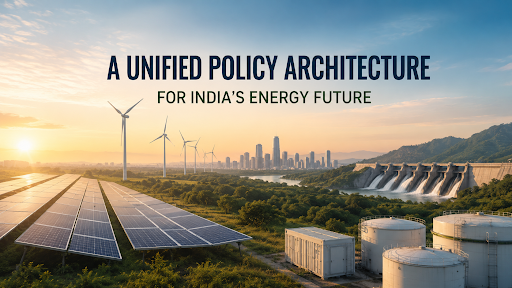
The Indian National Science Academy (INSA) released a policy brief advocating for a unified national energy framework to eliminate administrative silos.
What is a Unified Policy Architecture?
It refers to a coordinated framework that integrates policies across fossil fuels, renewable energy, electricity, energy efficiency, hydrogen, climate goals, and energy security.
Objectives
Why is a Unified Energy Policy Architecture Important for India?
Rising Energy Demand: Rapid industrialization, urbanization, and population growth escalate India’s absolute baseload power requirements.
Net-Zero Commitments: India requires a coordinated roadmap to meet its COP26 net-zero carbon emissions target by 2070.
Reducing Import Dependence: India imports over 85% of its crude oil, leaving the domestic economy highly vulnerable to geopolitical shocks.
Strengthening Energy Security: Heavy reliance on maritime chokepoints like the Strait of Hormuz necessitates domestic alternatives such as Dimethyl Ether (DME) blended LPG.
Supporting Industrial Growth: Heavy industries like steel and cement demand reliable, cost-effective energy for scalable domestic manufacturing.
Mitigating Macroeconomic Pressures: High energy import bills widen the Current Account Deficit (CAD) and fuel domestic inflation.
Balancing Grid Intermittency: A unified strategy integrates variable solar and wind generation as installed renewable capacity hits 260 GW by 2025.
What are the Key Features of a Unified Energy Architecture?
Integrated Energy Planning: Management of the national power grid as a single, holistic ecosystem rather than separate fuel markets.
Cross-Sector Coordination: Synchronization of regulatory policies across the ministries of Power, Coal, Petroleum & Natural Gas, and New & Renewable Energy.
Renewable Energy Integration: Expansion of grid-level battery storage and pumped hydro to absorb variable loads.
Energy Transition Financing: Deployment of innovative market mechanisms to fund the retrofitting of thermal utilities.
Data-Driven Policymaking: Utilization of digital technologies and smart grid data to optimize energy distribution.
Technology-Neutral Approach: Adoption of a diverse mix of clean technologies, including green hydrogen, advanced biofuels, and domestic nuclear power.
Four-Pillar Governance: Anchoring development around Adequacy, Access, Affordability, and Appropriate Sustainability.
Circular Economy and CCUS: Deployment of Carbon Capture, Utilization, and Storage (CCUS) technologies at heavy industrial sites.
Benefits of a Unified Energy Framework
Improved Energy Security: A domestic energy portfolio shields the economy from supply chain disruptions and price spikes.
Greater Policy Efficiency: Elimination of inter-ministerial overlaps accelerates project approvals and prevents suboptimal resource allocation.
Faster Clean Energy Transition: Coordinated planning speeds up the commercial scaling of green hydrogen and green ammonia.
Increased Investor Confidence: Consistent regulatory frameworks reduce policy uncertainty and attract private capital.
Reduced Carbon Emissions: A phased transition supports deep industrial decarbonization and international climate pledges.
Foreign Exchange Savings: Substituting LPG imports with a 20% DME blend saves nearly ₹34,000 crore annually.
Equitable Distribution: Strengthening last-mile delivery improves service quality for vulnerable rural households.
What are the Major Challenges Associated with India's Energy Transition?
Institutional Fragmentation: Entrenched policy silos across independent ministries hinder strategic planning.
Fossil Fuel Dependence: Coal remains the fundamental source of reliable baseload power.
Financing Constraints: Upgrading distribution grids and retrofitting thermal plants requires immense capital expenditure.
Energy Storage Challenges: Scaling high-capacity battery systems remains technically difficult and expensive.
Grid Integration Issues: The influx of intermittent solar and wind power strains aging transmission infrastructure.
Green Premiums: Sustainable alternatives like green hydrogen remain more expensive than fossil-fuel derivatives.
Federal Coordination: Finalizing uniform utility laws requires tight alignment between the Central government and State electricity boards.
What Institutional, Legal and Policy Frameworks Support India's Energy Sector?
Integrated Energy Policy: A roadmap for optimal national resource use, balancing energy security, affordability, and environmental sustainability.
National Green Hydrogen Mission: Backed by a ₹19,744 crore outlay, this initiative targets an annual production of 5 million metric tonnes of green hydrogen by 2030 to establish India as a global clean energy hub.
National Solar Mission: Initiative for utility-scale and rooftop solar capacity.
Energy Conservation Act: Mandates efficiency standards across industries.
Panchamrit Commitments: The five-fold climate pledge from COP26, including a target to achieve net-zero emissions by 2070 and 500 GW of non-fossil fuel energy capacity.
PM Ujjwala Yojana (PMUY): Expanded access to clean cooking fuel to over 10 crore economically vulnerable households.
Saubhagya Scheme: Delivered near-universal household electricity access.
Coal Gasification Scheme: A ₹37,500 crore initiative targeting 100 million tonnes of coal gasification annually by 2030.
What Measures Can Strengthen India's Energy Future?
Establishing Integrated Energy Governance: Create a specialized Department of Energy Resources and Security (DERS) directly under the PMO to centrally coordinate policy without replacing existing ministries.
Accelerating Renewable Energy Expansion: Deploy a phased, step-by-step transition plan that scales solar and wind while simultaneously prioritizing grid modernization.
Expanding Energy Storage Infrastructure: Diversify the storage portfolio by scaling grid-level battery systems, small hydro schemes, and massive pump-storage installations.
Strengthening Domestic Manufacturing: Partner with global technology leaders to locally manufacture high-efficiency electrolyzers and solar components, slashing production costs.
Mobilizing Green Finance: Issue sovereign green bonds and incentivize private investments to overcome infrastructure retrofitting costs.
Enacting an Energy Responsibility and Security Act: Establish a robust statutory framework that strictly enforces energy security, sustainability, and long-term transition accountability across all levels of government.
Appointing an Energy Ombudsman: Form a specialized authority to resolve complex regulatory and commercial disputes, harmonizing rules across the fragmented sector.
Conclusion
By institutionalizing the four-pillar framework of adequacy, access, affordability, and appropriate sustainability, India can dismantle administrative silos and secure a resilient, self-reliant, and decarbonized energy ecosystem.
Source: THEHINDU
|
PRACTICE QUESTION Q. "Achieving energy security, affordability and sustainability requires a coordinated policy approach rather than fragmented sectoral interventions." Discuss. (250 Words, 15 Marks) |
It is a coordinated, integrated national framework designed to shift energy planning away from fragmented, sector-specific silos (coal, oil, renewables) into a single cohesive ecosystem, ensuring that policies across ministries align toward common national development and climate goals.
India requires integrated planning because its rapidly growing energy demand cannot be solved by a single fuel source. A whole-of-system approach is necessary to securely balance the intermittency of 260 GW of renewable energy, safely phase down coal dependence, manage high infrastructure retrofitting costs, and eliminate conflicting regulations between multiple ministries.
Energy security prevents sudden macroeconomic shocks caused by geopolitical disruptions (like the Strait of Hormuz crisis). By reliably securing affordable domestic energy—and reducing the USD 166 billion crude oil import bill—India can curb inflation, lower the Current Account Deficit (CAD), and provide heavy industries with the stable power necessary for scalable manufacturing and job creation.
Renewable sources (solar, wind, hydro, biomass) are the absolute backbone of India's strategy to achieve energy self-reliance by 2047 and net-zero emissions by 2070. Scaling them reduces reliance on imported fossil fuels, cuts greenhouse gas emissions, and provides the decentralized energy needed to ensure last-mile delivery and equitable access for all citizens.





© 2026 iasgyan. All right reserved