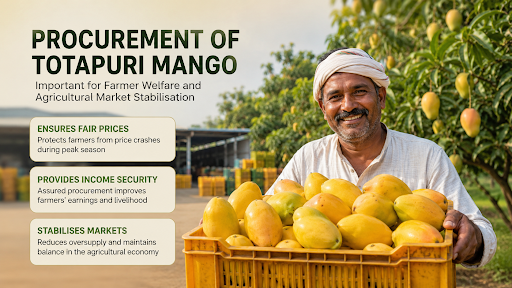
The Totapuri mango is a distinct South Indian variety easily recognized by its beak-like shape. Mildly sweet and highly fibrous, it forms the backbone of India's commercial pulp, juice, and concentrate industry rather than fresh table consumption.
Why In News?
The Union Ministry of Agriculture and Farmers' Welfare approves the procurement of 96,879 metric tonnes of Totapuri mangoes in Tamil Nadu under the Market Intervention Scheme (MIS).
What is the Totapuri Mango?
The Totapuri mango is a popular, commercially grown mango variety, serving primarily industrial food processing (juices, pulp, jams, baby foods) rather than fresh consumption.
Physical Characteristics: The fruit features an elongated shape, a distinct parrot beak-like tip, greenish-yellow skin, and medium fiber content.
Flavour Profile: It possesses moderate sweetness with a Brix level of 12-14, providing a firm texture ideal for blending with sugar during industrial processing.
Alternative Nomenclature: Local markets also identify this variety as Bangalora, Collector, Sandersha, and Ginimoothi.
Geographical Dominance: Farmers cultivate this variety extensively across tropical climates in South India, primarily in Karnataka, Andhra Pradesh, and Tamil Nadu.
Key Production Hubs: Major cultivation centers include Chittoor (Andhra Pradesh), Dharmapuri and Krishnagiri (Tamil Nadu), and Kolar (Karnataka).
What is the Market Intervention Scheme (MIS)?
It is a price-support program that protects farmers growing perishable, non-MSP crops (such as tomatoes, onions, potatoes, and apples) from distress sales when market prices crash.
How It Works?
Trigger Conditions: It activates at the request of a state government when there is at least a 10% drop in market prices (or a 10% increase in production) compared to the previous normal year.
Implementation: The government procures up to 25% of the total production at a fixed Market Intervention Price (MIP) or directly transfers the price difference into farmers' bank accounts.
Funding: Losses incurred during procurement are split equally between the Central Government and the requesting state (or 75:25 for North-Eastern states).
Coverage: It is a key component of the Pradhan Mantri Annadata Aay Sanrakshan Abhiyan (PM-AASHA) and is executed by agencies like NAFED (National Agricultural Cooperative Marketing Federation of India Ltd.).
Why is the Totapuri Mango Economically Important?
Agro-Processing Backbone: Totapuri acts as the base material for over 60% of India's commercially processed mango products, feeding directly into the pulp, juice, and concentrate industries.
Rural Employment Generation: The crop sustains massive labor forces across processing clusters; for example, Krishnagiri houses over 26 pulp processing industries relying on regional mango output.
Horticultural Growth Contribution: High yields drive regional economies; Andhra Pradesh alone generates approximately 52.65 lakh tonnes of mangoes annually.
Export-Oriented Value Chains: The variety forms the crux of canned pulp found in global supermarkets, heavily exported to international destinations like the Middle East.
Farmer Income Enhancement: The crop offers consistent, high-yield harvests per hectare, providing bulk revenue streams for farmers integrated into the food and beverage supply chain.
Source: THEHINDUBUSINESSLINE
|
PRACTICE QUESTION Q. Consider the following statements regarding the 'Totapuri' mango: 1. It is cultivated in Northern Indian states like Uttar Pradesh and Bihar for fresh table consumption. 2. It forms the foundation of India's commercial mango pulp and juice concentrate industry. 3. In the event of a market price crash, it is eligible for procurement under the Market Intervention Scheme (MIS). Which of the statements given above are correct? A) 1 and 2 only B) 2 and 3 only C) 1 and 3 only D) 1, 2, and 3 Answer: B Explanation: Statement 1 is incorrect. The 'Totapuri' mango is primarily cultivated in South Indian states such as Andhra Pradesh, Karnataka, and Tamil Nadu. It is known by various names in the south like Bangalora, Ginimoothi, and Collector. While it is sometimes eaten fresh (often with salt and chili due to its tangible, less sweet nature), it is not the primary table variety of Northern India (which are typically varieties like Dashehari or Langra in UP and Bihar). Statement 2 is correct. Totapuri forms the backbone of India's commercial mango pulp and juice concentrate industry. Because of its high pulp yield, moderate sweetness, and firm texture, a vast majority (often cited around 80%) of the harvest goes into processing for products like Maaza, Frooti, and Slice, as well as for export as pulp. Statement 3 is correct. The government has explicitly approved the procurement of Totapuri mangoes under the Market Intervention Scheme (MIS) during periods of price crashes to support farmers. For instance, recent reports confirm the Centre's approval for procuring Totapuri mangoes in Karnataka and Tamil Nadu under MIS to prevent distress sales. |
Totapuri is a commercially important mango cultivar grown primarily in the South Indian states of Karnataka, Andhra Pradesh, and Tamil Nadu. Recognizable by its elongated shape, green-yellow skin, and parrot beak-like tip, it has moderate sweetness (Brix 12-14) and is heavily utilized by the food and beverage industry.
Totapuri boasts characteristics ideal for industrial processing: a high flesh-to-seed yield, a firm texture that withstands mechanical processing, consistent quality, and a bright yellow color optimal for canned products. Because its moderate sweetness can easily be adjusted with sugar, it serves as the base for over 60% of India's commercial mango pulp, juice, and concentrate products.
The Market Intervention Scheme (MIS) is a state-supported safety net program implemented by the government to procure perishable agricultural and horticultural commodities that do not have a fixed Minimum Support Price (MSP). It aims to protect farmers from severe financial losses and distress sales during periods of extreme price crashes.



© 2026 iasgyan. All right reserved