India's rapid transition to E20 ethanol blending enhances energy security and cuts emissions but faces challenges in vehicle compatibility, mileage loss, and underutilized capacity. By adopting Brazil’s phased, consumer-centric flex-fuel model and diversifying feedstocks, India can ensure sustainable biofuel integration.
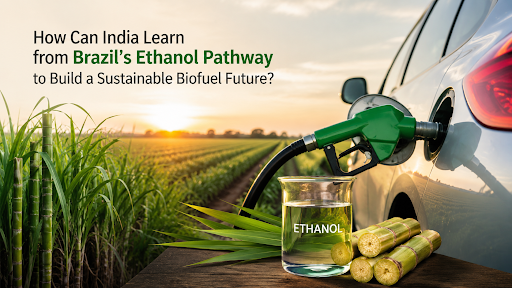
Why In News?
The Indian Sugar and Bio-Energy Manufacturers Association (ISMA) reports that 450-crore litres of domestic ethanol capacity remains unutilized, requiring a shift toward a consumer-driven, flex-fuel model similar to Brazil’s.
|
Read all about: ETHANOL-BLENDED PETROL IN INDIA l INDIA'S PUSH BEYOND E20 FUEL l INDIA'S ROADMAP FOR E85 AND E100 FLEX-FUELS |
Why is Brazil a Global Leader in Ethanol?
Early Policy Adoption: Brazil mandates ethanol blending since 1931 (5% anhydrous blend). The 1975 National Alcohol Programme (Proálcool) accelerated this, and the Fuel of the Future Law (2024-25) now mandates an E30 blend by 2025.
Flex-Fuel Vehicle (FFV) Dominance: Since the 2003 launch of the VW Gol 1.6 Total Flex, Brazil has produced over 40 million FFVs. These vehicles account for 90% of the current fleet and run on any mix from E20-E25 up to 100% hydrous ethanol (E100).
Consumer Incentives: Fuel stations offer both blended petrol and E100. Strategic pricing and local tax structures make E100 typically 25-35% cheaper than petrol, allowing consumers to choose fuel based on seasonal price fluctuations.
What Lessons Can India Learn from Brazil's Ethanol Experience?
Gradual Transition: India must avoid rushed timelines; the rapid leap to E20 by 2025 strains existing automotive infrastructure.
FFV Ecosystem: India needs to incentivize Original Equipment Manufacturers (OEMs) to scale production, integrating Software Fuel Sensors (SFS) and Direct Injection technologies.
Consumer Communication: Authorities must educate motorists on the calorific value differences between petrol and ethanol to manage expectations regarding mileage trade-offs.
Industry Preparedness: India must synchronize blending mandates with production. With a total capacity of 1,900 crore litres, the government should facilitate the export of surplus ethanol to sustain the industry.
Policy Stability: India should adopt long-term tax structures, similar to Brazil’s Rota 2030 program, to de-risk investments in Second-Generation (2G) biofuels.
Why is Ethanol Important for India?
Energy Security: India imports over 85% of its crude oil. The Ethanol Blended Petrol (EBP) Programme substituted over 289 lakh metric tonnes of crude oil between ESY 2014-15 and February 2026.
Economic Impact: The program saved ₹1.55 lakh crore in foreign exchange and boosted farmers' incomes by ₹1.36 lakh crore.
Carbon Reduction: Ethanol emits 1.50 kg CO2/litre compared to petrol’s 2.31 kg CO2/litre, resulting in a cumulative reduction of 869 lakh metric tonnes of CO2 by February 2026.
What Challenges Does India Face in its Ethanol Transition?
Vehicle Compatibility: Higher blends like E25 risk engine corrosion and degradation of rubber/plastic parts in older vehicles.
Fuel Efficiency: Ethanol contains 34% less energy per unit volume than gasoline, leading to direct mileage loss for consumers.
Feedstock Constraints: For ESY 2025–26, the government allocated only 289 crore litres from the sugar sector, leaving 900 crore litres of sugar-based capacity underutilized.
Environmental Concerns: Sugarcane cultivation is water-intensive, threatening groundwater reserves in states like Maharashtra.
Awareness Deficits: Lack of differentiated pricing and separate dispensing pumps leaves consumers unaware of the fuel blend they purchase.
What Should Be India's Way Forward?
Expand FFV Manufacturing: Mandate and subsidize the production of corrosion-resistant engines and Software Fuel Sensors.
Diversify Feedstocks: Utilize maize, broken rice, agricultural residues, and cassava as permitted by the 2022 amendments to the National Policy on Biofuels (NPB).
Promote 2G Biofuels: Fund the Pradhan Mantri JI-VAN Yojana (extended to 2028-29) to support "bolt-on" and brownfield 2G ethanol projects.
Infrastructure Upgrades: Install separate dispensing pumps at retail outlets to offer multiple fuel options (E10, E20, E85) with transparent, differentiated pricing.
Consultative Strategy: Finalize future milestones like E25 only after rigorous homologation testing and stakeholder consultations.
To secure a sustainable biofuel future, India must evolve its top-down ethanol blending mandate into a consumer-centric, flex-fuel ecosystem modeled on Brazil's phased and incentivized approach.
Source: INDIANEXPRESS
|
PRACTICE QUESTION Q. Examine the opportunities and challenges associated with India's ethanol blending programme and suggest a sustainable roadmap for the future. (250 Words, 15 Marks) |
A Flex-Fuel Vehicle is equipped with an internal combustion engine designed to run on more than one type of fuel, typically a mixture of petrol and ethanol. It automatically adjusts fuel injection and spark timing depending on the blend detected in the tank.
Ethanol has about 34% less energy density (calorific value) than pure petrol. Consequently, higher ethanol blends (like E20 or E25) yield lower mileage, meaning consumers must fill up more frequently compared to running on pure petrol.
It is a central government scheme providing financial support for setting up Second-Generation (2G) and Advanced Biofuel projects using lignocellulosic biomass and agricultural residues, diverting reliance away from food crops.



© 2026 iasgyan. All right reserved