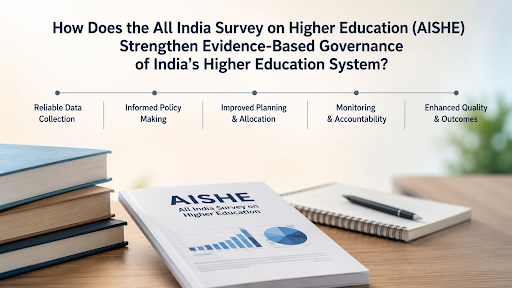
The All India Survey on Higher Education (AISHE) provides critical, data-driven demographic and spatial insights into India's higher education sector. It tracks enrollment growth, gender parity, and social inclusion, serving as a vital tool for evidence-based policymaking and governance.
Why In News?
The Union Ministry of Education released the AISHE 2022-23 and 2023-24 reports, highlighting progress in demographic expansion, gender parity, and the spatial distribution of institutions across India.
AISHE functions as a comprehensive, web-based annual demographic and institutional survey, serving as India’s primary source of official statistics for the higher education sector.
Origin: The government initiated the survey in 2010-11 to replace fragmented regional data with a unified Data Capture Format (DCF), which institutions upload directly.
Objectives: The survey calculates human capital indicators, including Gross Enrolment Ratio (GER), Pupil-Teacher Ratio (PTR), and Gender Parity Index (GPI), to provide a foundation for evidence-based policy.
Record Enrolment Growth and GER
Total Enrolment: India's higher education enrolment reached an all-time high of 4.50 crore in 2023-24, up from 4.46 crore in 2022-23.
Gross Enrolment Ratio (GER): The GER for the 18-23 age group climbed to 30.0 in 2023-24, compared to 29.5 in 2022-23 and 23.7 in 2014-15.
Gender Parity and Female Participation
Surge in Female Enrolment: Female enrolment grew, reaching 2.24 crore in 2023-24, marking a 42.2% jump over the past decade.
Gender Parity Index (GPI): The female GER surged to 31.2 in 2023-24, bringing the national GPI to 1.08. This confirms that female participation in colleges has remained higher than male participation for seven consecutive years.
Social Inclusion and Demographic Shifts
Dominance of Reserved Quotas: Students from marginalized communities now form the overwhelming majority, with Scheduled Caste (SC), Scheduled Tribe (ST), and Other Backward Classes (OBC) students constituting 60.8% of total enrollment in 2022-23.
Decadal Growth for Marginalized Groups: Enrolment among STs grew by 75.7% to 28.83 lakh, OBCs by 60.2% to 1.80 crore, and SCs by 51.4% to 69.72 lakh in 2023-24.
Minority Participation: Minority student enrolment increased by 52% over the decade to 33.3 lakh, with female minority enrolment growing even faster at 62.9%.
STEM and Discipline-Wise Trends
STEM Milestone: Enrolment in Science, Technology, Engineering, and Mathematics (STEM) courses crossed the 1-crore mark, reaching 1.02 crore in 2023-24.
Undergraduate Dominance: About 76.8% of students are enrolled in undergraduate (UG) programs, while 12.9% pursue postgraduate (PG) studies.
Top Disciplines: At the UG level, Arts attracts the largest share of students (32.1%), followed by Science (13.5%), Engineering & Technology (12.9%), and Commerce (12.0%).
Faculty, Research, and Institutional Capacity
Teaching Workforce: The number of faculty members expanded to 17.32 lakh in 2023-24. Female faculty representation also improved, growing to 7.78 lakh, which makes up 44.9% of the total workforce.
Research Expansion: The surveys show a strengthening research ecosystem, with PhD enrolment rising substantially to 3.44 lakh in 2023-24.
Institutional Density: Participation in the survey was strong, with 59,533 higher education institutions (HEIs) submitting data in 2023-24.
Data Quality: Reliance on voluntary self-reporting creates inherent limitations in absolute quality control.
Reporting Delays: The simultaneous release of two years of reports in mid-2024 creates an information lag that hinders real-time governance.
Structural Bottlenecks: Data reveals that fragmented institutional sizes and stagnant PTR constrain educational quality despite rising enrolment.
Incomplete Reporting: Approximately 5,223 registered institutions failed to upload data in 2023-24, preventing total universality.
Lack of Real-Time Analytics: The current framework provides retrospective snapshots rather than dynamic, real-time analytics for mid-semester interventions.
Real-Time Systems: Transition to a live-sync database integrated with university admission portals.
Incentivized Reporting: Link DCF compliance to federal funding and UGC accreditation renewals.
Third-Party Audits: Introduce mandatory geographic and demographic audits to verify self-reported data.
Digital Integration: Fuse databases with the National Academic Depository (NAD) and Academic Bank of Credits (ABC).
Advanced Analytics: Employ Artificial Intelligence (AI) to forecast regional skill deficits and infrastructure requirements.
Conclusion
AISHE guides higher education governance by converting complex data into evidence-based policies to achieve the equitable and qualitative goals of NEP 2020.
Source: PIB
|
PRACTICE QUESTION Q. Consider the following statements regarding the All India Survey on Higher Education (AISHE): (i) It is an annual survey conducted by NITI Aayog to measure learning outcomes in higher education. (ii) The Gender Parity Index (GPI) in India's higher education sector has remained above 1.0 for more than five consecutive years. Which of the statements given above is/are correct? (a) (i) only (b) (ii) only (c) Both (i) and (ii) (d) Neither (i) nor (ii) Answer: b Explanation: Statement (i) is incorrect: The All India Survey on Higher Education (AISHE) is an annual survey conducted by the Ministry of Education, not NITI Aayog. Its purpose is to track parameters like student enrollment, faculty, and institutional infrastructure, rather than individual learning outcomes. Statement (ii) is correct: Official reports by the Ministry of Education indicate that the Gender Parity Index (GPI) in India's higher education sector has been steadily improving, remaining consistently above 1.0 (indicating higher female participation relative to their proportion in the corresponding population cohort) for seven consecutive years. |
The All India Survey on Higher Education (AISHE) is a comprehensive, web-based annual survey initiated by the Ministry of Education. It collects data on parameters like student enrolment, faculty strength, and infrastructure to generate official statistics on India's higher education sector.
The survey is conducted by the Ministry of Education, Government of India, through its Department of Higher Education. Institutions self-report their data using a dedicated AISHE web portal.
AISHE serves as the primary monitoring mechanism for NEP 2020 targets, such as achieving a 50% GER by 2035. It also provides empirical data on the on-ground implementation of NEP reforms, including multidisciplinary undergraduate programs and the establishment of research cells.




© 2026 iasgyan. All right reserved