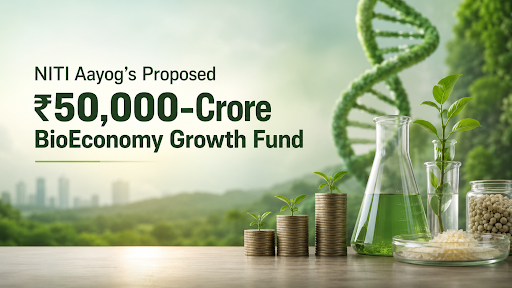
NITI Aayog proposes a ₹50,000-crore BioEconomy Growth Fund to scale India's bioeconomy to $691 billion by 2035. The roadmap includes six National BioMissions advancing biomanufacturing, gene therapies, and climate-resilient agriculture, transitioning India into a global AI-driven biotechnology powerhouse.
Why In News?
NITI Aayog released a comprehensive strategic document titled "Roadmap for Building India as a Leading BioEconomy Powerhouse by 2035" to expand India's bioeconomy.
What is the Proposed BioEconomy Growth Fund?
The fund operates as a targeted financial mechanism and a Special Purpose Fund under the broader Anusandhan National Research Foundation (ANRF) and RDI framework.
Objective: Bridge the "valley of death"—the vulnerable gap between proof-of-concept research and commercial-scale manufacturing—by providing blended finance, catalytic equity, and viability-gap funding to deep-tech biotech enterprises.
Proposed Duration and Corpus: Operates from 2026 to 2035 with a total corpus of ₹50,000 crore to back biomanufacturing and advanced therapeutics.
Why is Biotechnology Important for India's Future Growth?
High-Value Manufacturing: Facilitates transition from a low-cost generic drug supplier to an innovation-led leader, strategically capturing a lucrative share of the $300 billion worth of biologic drugs losing patent protection by 2030.
Healthcare and Pharmaceutical Innovation: Accelerates the deployment of affordable cell and gene therapies, precision diagnostics, and targeted vaccines to counter emerging infectious diseases and genetic disorders.
Food and Agricultural Security: Utilizes advanced CRISPR-based gene editing to engineer climate-resilient crop varieties and high-quality bio-inputs, reducing the agricultural sector's heavy chemical fertilizer dependence.
Green and Circular Economy Transition: Transforms agricultural and industrial waste into clean biofuels, bioplastics, and sustainable industrial enzymes, aligning with the BioE3 Policy (Biotechnology for Economy, Environment and Employment).
High-Skilled Employment: Expanding bioeconomy sector projects the creation of over 30 million high-value, high-tech jobs by 2035 across clinical research, advanced manufacturing, and bioinformatics.
Strategic Technological Sovereignty: Reduces India's reliance on imported Active Pharmaceutical Ingredients (APIs) and critical raw materials by establishing domestic biomanufacturing hubs and automated biofoundries.
Key Features of NITI Aayog's Biotechnology Roadmap
₹50,000-Crore BioEconomy Growth Fund: Dedicated financial engine targets mid-to-late-stage biotech ventures requiring scale-up infrastructure and GMP-compliant manufacturing facilities.
Biomanufacturing Capacity Expansion: Deploys Production-Linked Incentives (PLI) tailored for biomanufacturing to drive investments into fermentation-based products, advanced biologics, and bio-based intermediates.
Synthetic Biology and Genomics Promotion: Launches the BioX Foundry mission to operationalize highly automated Design-Build-Test-Learn (DBTL) platforms, aiming to foster at least 100 synthetic biology startups.
Advanced Therapeutics and Diagnostics Support: GeneIndia and BioPharmaNext missions scale up accessible vector-based therapies, monoclonal antibodies, and utilize AI-driven drug discovery engines.
Industry-Academia Collaboration: Establishes a BioEconomy Investment & Policy Forum to align sovereign funds, private venture capital, and public research priorities.
Regulatory Reforms and Faster Commercialisation: Mandates an exclusive Regulatory Sandbox and modernizes the Central Drugs Standard Control Organisation (CDSCO) to slash the current 900-day approval average down to competitive global standards.
Intellectual Property and Innovation Support: Proposes a BioIP & Innovation Evaluation Agency to systematically evaluate intellectual property, assist startups in patenting, and create dedicated fast-track IP translation pathways.
What are the Major Challenges Associated with India's Biotechnology Ecosystem?
Funding Gaps for Scale-Up: A severe Series A/B capital crunch blocks promising startups from acquiring pilot plants and late-stage commercialization capital.
Regulatory Delays: Fragmented, multi-agency overlaps cause bottlenecks, pushing India's regulatory approval timelines to a staggering 900-day average, compared to approximately 500 days in competitor nations.
Limited Commercialisation of Research: Inadequate practical translational platforms, validated animal models, and clinical trial networks limit the commercialization of India's high research output.
Dependence on Imported Technologies: The domestic industry relies heavily on low-cost Chinese biotech imports, specifically critical biocatalytic enzymes, CRISPR kits, and specialized reagents.
Talent and Infrastructure Constraints: India hosts a critically low ratio of only 259 researchers per million people, creating an extremely thin talent pipeline in advanced fields like bioinformatics and regulatory science. (Source: NITI Aayog)
Global Competition in Emerging Technologies: Competitors like the USA ($950 billion bioeconomy) and the EU ($2.6 trillion bioeconomy) leverage massive whole-of-government approaches, threatening India's capacity to lead without urgent scaling. (Source: NITI Aayog)
What Measures Can Help India Become a Global Biotechnology Leader?
Expanding Public and Private R&D Investment: Establish the proposed BioEconomy Investment & Policy Forum to strategically align sovereign wealth funds, global impact investors, and public capital.
Strengthening Biomanufacturing Infrastructure: Build a nationwide, interconnected network of Biofoundries offering highly automated Design-Build-Test-Learn (DBTL) engineering for rapid biological prototyping.
Enhancing Global Research Partnerships: Leverage the One Health Grid mission for cross-border outbreak intelligence, antimicrobial resistance tracking, and integrated disease surveillance.
Simplifying Regulatory Processes: Form an Empowered Committee on National BioMissions to bypass bureaucratic silos and rapidly introduce a 180-day listing pathway for indigenous domestic biologics.
Building a Skilled Biotechnology Workforce: Increase post-doctoral fellowships, introduce specialized bio-engineering curricula, and link academic programs with the 100,000 Allied Health Professionals pipeline.
Promoting Innovation-Driven Entrepreneurship: Deploy High-Performance Computing (HPC) centers tailored for AI-enabled drug discovery, creating a BioDigital Twin ecosystem for ambitious startups.
Conclusion
The ₹50,000-crore BioEconomy Growth Fund and six National BioMissions will transition India from a generic drug supplier into a $2.6 trillion biotechnology powerhouse by 2047.
Source: INDIANEXPRESS
|
PRACTICE QUESTION Q. "Biotechnology is emerging as a strategic sector with implications for healthcare, food security, industrial development and economic competitiveness." Examine. 150 words |





© 2026 iasgyan. All right reserved