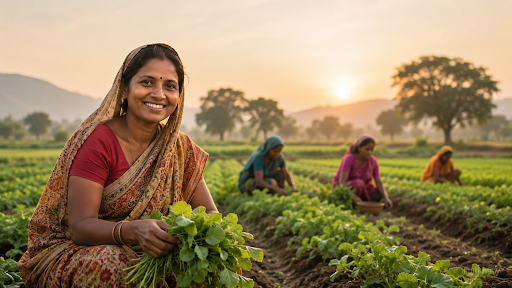
Women farmers form the backbone of rural economies, driving global food security. Despite producing much of our food, they face systemic challenges like lack of land ownership, restricted credit access, and wage disparities. Empowering them is vital for sustainable agriculture.
Why In News?
The Maharashtra Legislative Assembly passed the Women Farmers Empowerment Bill, 2026, becoming the first Indian state to legally recognise women as farmers irrespective of land ownership.
Why Do Women Farmers Need Legal Recognition?
The Invisible Backbone of Indian Agriculture
Consequences of Non-Recognition
What is the Maharashtra Women Farmers Empowerment Act, 2026?
The Act adopts a highly inclusive definition of "agriculture" and "farmer", aligning with the National Policy for Farmers (2007).
It includes any woman resident of Maharashtra engaged in crop husbandry, animal husbandry, poultry, dairy farming, apiculture, fishery, agro-forestry, mushroom cultivation, and primary processing.
It covers landless cultivators, lessees, sharecroppers, and pastoralists.
Key Features of the Law
Institutional Mechanisms for Women's Agricultural Empowerment
Why is the Law Significant for Indian Agricultural Sector?
Promotes Gender Justice in Agriculture: It corrects historic gender imbalance, transforming women from "helpers" into independent economic actors.
Enhances Financial Inclusion: By enabling access to the Kisan Credit Card (KCC) and direct bank loans, it rescues women from high-interest informal microfinance.
Strengthens Women's Economic Agency: It secures their control over agricultural income and integrates their priorities into Gram Panchayat Development Plans (GPDPs).
Improves Agricultural Productivity: Equipping women with targeted extension services, seeds, and modern technology boosts crop yields.
Supports Inclusive Rural Development: Aligns with the Commonwealth Local Government Forum's (CLGF) Samata Gram programme, pushing gender-responsive budgeting at the grassroots.
Advances Sustainable Development Goals: Women drive climate adaptation; recognizing their role accelerates sustainable agrifood systems, coinciding with 2026 being the International Year of the Woman Farmer.
What are the Major Challenges Faced by Women Farmers in India?
Low Land Ownership
Limited Access to Institutional Credit
Gender Wage Gaps
Inadequate Access to Technology and Extension Services
Climate Vulnerability
Limited Representation in Agricultural Decision-Making
What Measures Can Further Empower Women Farmers?
Expanding Women's Land Ownership
Legal reforms must enforce inheritance rights and prevent patriarchal coercion that forces women to surrender property.
Improving Access to Institutional Credit
Banks should de-link women's creditworthiness (CIBIL scores) from their male relatives' loan defaults and formulate women-centric lending schemes.
Strengthening Agricultural Extension Services
Promote networks like the Sakhi Unique Resource Enterprise (SURE), where rural women are trained as local climate entrepreneurs to disseminate organic farming practices.
Promoting Women Farmer Producer Organisations (FPOs)
Case Study: In Ambejogai (Beed), women formed organic farming collectives and now dominate the weekly vegetable market, directly controlling economic transactions and bargaining.
Enhancing Climate-Resilient Farming Support
Case Study: Jayashree Gorakh Mali in Dharashiv utilized SURE training to adopt hydroponic green fodder technology and vermicomposting, increasing her daily dairy income to Rs 600 and gaining household decision-making power.
Increasing Representation in Agricultural Governance
Ensure mandatory inclusion of women in Gram Sabhas and local water management bodies to democratize natural resource allocation.
Conclusion
The legal recognition of women farmers through progressive legislation like Maharashtra's 2026 Act is a catalyst for eradicating rural poverty, ensuring food security, and achieving true gender equity in agrarian economy.
Source: INDIANEXPRESS
|
PRACTICE QUESTION Q. "Despite their substantial contribution to agriculture, women farmers continue to face structural barriers to recognition and access to resources." Discuss (250 Words, 15 Marks) |



© 2026 iasgyan. All right reserved