The National Investment Policy for Urea-2026 replaces NIP-2012 to boost domestic gas-based urea production. Offering transparent cost separations and assured returns, it aims to eliminate India's 10 million tonne import dependency, stabilise agricultural supply chains, and foster long-term self-reliance.

Why In News?
The Cabinet Committee on Economic Affairs (CCEA), chaired by the Prime Minister, approves the National Investment Policy for Urea-2026 (NIPU-2026) to attract fresh capital into the domestic urea manufacturing sector.
What is the National Investment Policy for Urea-2026 (NIPU-2026)?
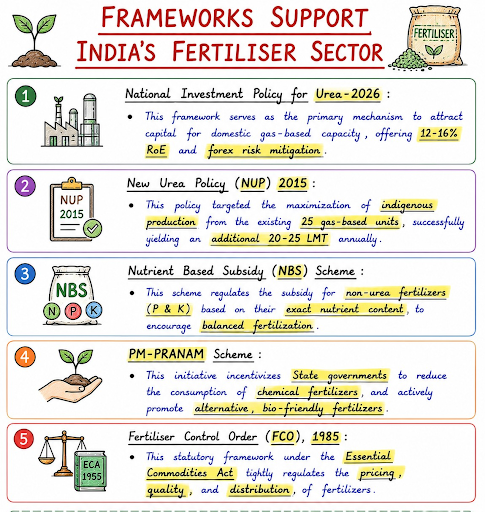
The policy introduces a transparent financial architecture by separating fixed and variable costs and guarantees a viable Return on Equity (RoE) band between 12% and 16%.
The previous New Investment Policy (NIP)-2012 successfully established 6 new urea units (4 via Public Sector Joint Ventures and 2 private), adding 76.2 Lakh Metric Tonnes Per Annum (LMTPA) to domestic capacity before expiring in October 2019.
Current Capacity: India operates 33 urea manufacturing plants with an installed capacity of 269.42 LMT.
Why is NIPU-2026 Important for India?
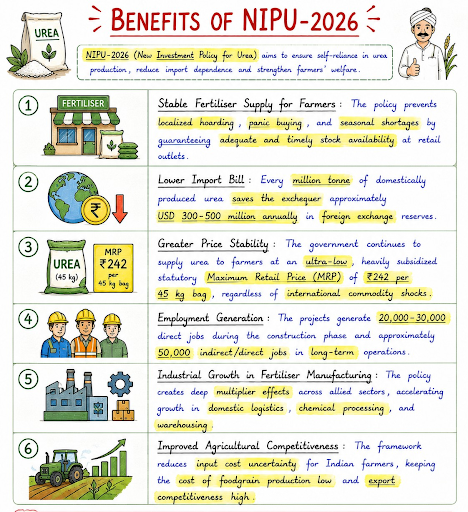
Strengthens Fertiliser Self-Reliance: The policy closes the 10 million tonnes supply void between domestic production and localized demand.
Reduces Import Dependence: Replaces the 10 MT of urea currently sourced from overseas markets, insulating India from volatile international supply chains and shipping constraints.
Supports Food Security: Ensures that basic soil nutrients remain readily available during critical Kharif and Rabi crop sowing seasons without supply shocks.
Enhances Agricultural Productivity: Shields farmers from extreme international urea price spikes, which surged 3-4 times since 2018, allowing them to maintain consistent soil nutrition and high crop yields.
Improves Supply Chain Stability: Limits exposure to geopolitical conflicts and volatile international Liquefied Natural Gas (LNG) prices by shifting reliance to domestic gas-based production.
Promotes Industrial Investment: Channels capital into greenfield and brownfield chemical manufacturing infrastructure, modernizing the industrial backbone of the country.
Key Features of NIPU-2026
Promotion of New Gas-Based Urea Plants: Mandates and incentivizes the establishment of natural gas-based manufacturing units, phasing out older, polluting feedstocks.
Incentive Framework for Fresh Investments: Reforms cost assessments by strictly separating fixed and variable costs, ensuring highly transparent subsidy calculations.
Guaranteed Returns: Provides a statutory Return on Equity (RoE) floor at 12% and a ceiling at 16%, offering investors predictable, stable profit margins.
Focus on Energy-Efficient Production Technologies: Plants to adopt modern, highly energy-efficient operational technologies to minimize natural gas consumption and adhere to strict environmental standards.
Encouragement of Public and Private Sector Participation: Follows the successful precedent of NIP-2012 by inviting Joint Venture Companies (JVCs) of nominated PSUs and direct private sector giants to build new units.
Long-Term Domestic Capacity Expansion: Offers powerful forex risk mitigation strategies resulting in estimated capital savings of over ₹250 crore per plant compared to the older NIP-2012 framework.
What are the Major Concerns Associated with Urea Policy?
Dependence on Natural Gas: Urea manufacturing depends on natural gas. Domestic gas fields (e.g., Krishna-Godavari Basin, Mumbai Offshore) fall short, necessitating expensive LNG imports.
Environmental Concerns from Fertiliser Use: Massive, unchecked urea application results in nitrogen runoff, severe groundwater contamination, and high greenhouse gas emissions.
Urea Overconsumption and Soil Degradation: Because the government heavily subsidizes urea, farmers over-apply it compared to phosphatic and potassic fertilizers. This destroys the ideal N-P-K soil nutrient ratio, leading to severe long-term land degradation.
High Subsidy Burden: The fertilizer subsidy bill severely strains the national fiscal deficit. It spiked to a staggering ₹2.25 lakh crore in 2022-23 (Revised Estimates) post-Ukraine war, and stands at a massive ₹1.71 lakh crore allocated for 2026-27.
Need for Balanced Nutrient Application: Over-reliance on urea crowds out the usage of critical secondary and micro-nutrients required for holistic plant health.
Measures to Strengthen India's Fertiliser Security
Promoting Balanced Fertiliser Use: Launch extensive agricultural extension programs to educate farmers on adopting the scientifically recommended N-P-K ratio.
Expanding Nano Urea Adoption: A recent impact study by the National Productivity Council (2024–2026) verifies that utilizing Nano Urea as a foliar application in conjunction with a conventional basal urea dose significantly increases overall crop productivity.
Improving Domestic Gas Availability: Accelerates exploration and extraction in domestic gas fields while building a robust national pipeline grid to assure uninterrupted feedstock to urea plants.
Encouraging Green Ammonia and Green Hydrogen-Based Fertilisers: Advances sustainable production. SECI procures 7.24 lakh metric tonnes of green ammonia annually via e-reverse auctions.
Strengthening Fertiliser Logistics and Distribution: Enhances the distribution network via Primary Agricultural Cooperative Societies (PACS) to resolve last-mile delivery bottlenecks, which often cause localized scarcities despite sufficient national stocks.
Conclusion
Source: INDIANEXPRESS
|
PRACTICE QUESTION Q. Fertiliser self-reliance is essential for ensuring India's food security and reducing external vulnerabilities." Examine (250 Words, 15 Marks) |




© 2026 iasgyan. All right reserved