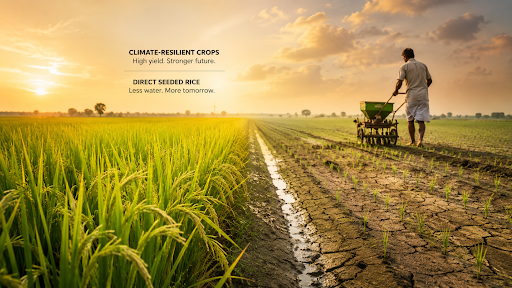
Direct-Seeded Rice (DSR) replaces water-intensive transplanting with direct sowing, saving up to 35% water and cutting labour costs and methane emissions. Despite weed management challenges, non-GM herbicide-tolerant varieties and state subsidies make DSR crucial for India's climate resilience.
Why In News?
State governments promote Direct-Seeded Rice (DSR) to combat severe El Niño-induced monsoon deficits and rapid groundwater depletion.
What is Direct-Seeded Rice (DSR)?
It is a cultivation technique where farmers directly sow seeds into the main field using tractor-mounted machines, completely bypassing the traditional nursery raising and transplanting stages.
Conventional rice cultivation requires intensive puddling and transplanting in waterlogged fields, demanding massive manual labor and continuous flooding.
Global Recognition: Global agricultural bodies view DSR as an indispensable climate-smart agricultural practice tailored for arid and warming ecosystems.
What are the Key Features of Direct-Seeded Rice?
Direct Sowing: Farmers utilize laser land levelers and specialized seed drills to plant seeds directly into the soil at a precise 20 cm row-to-row spacing, entirely bypassing the 25-30 day nursery growth phase.
Reduced Irrigation: Cultivators provide the first irrigation only 18-20 days post-sowing and subsequently irrigate only to retain essential soil moisture, discarding the mandatory 4-5 cm deep standing water requirement.
Lower Labor Demand: The mechanized nature of DSR heavily limits reliance on manual labor, slashing traditional workforce dependencies by over 25-30% and eliminating transplanting expenditures entirely.
Mechanization Integration: DSR easily integrates with modern agronomic tools like step planters and tractor-guided seed drills, resolving uneven seed germination problems and optimizing farm energy inputs.
Methane Reduction: DSR successfully lowers methane emissions to a fractional 1.5 to 4.7 kg/ha because the soil avoids the prolonged anaerobic conditions associated with flooded transplanting fields. (Source: Indian Agricultural Research Institute)
Why is Direct-Seeded Rice Important for India?
Groundwater Preservation: India diverts over 80% of its extracted groundwater to irrigation, causing critical aquifer exhaustion in states like Punjab (94% exploitation rate) and Haryana (84% exploitation rate). (Source: World Bank)
Climate Mitigation: Climate change threatens to reduce Indian agricultural output by 16% and trigger a 2.8% annual GDP loss by 2030. (Source: World Bank)
Labor Optimization: Traditional transplanting demands 4-5 labourers per acre at a steep cost of ₹4,000, creating operational bottlenecks during peak seasons.
Irrigation Efficiency: Conventional puddled transplanted rice (PTR) requires 28 irrigations at a heavy volume of 5 hectare-cm (500,000 liters) per cycle.
Cost Efficiency: DSR brings down the cost of producing one kilogram of rice to ₹8.43, lower than the ₹9.88 incurred under traditional PTR farming, protecting smallholder farm profitability and guaranteeing uninterrupted national food buffers. (Source: Indian Ecological Society)
What are the Major Concerns Associated with DSR?
Weed Management: Uncontrolled weed growth forms the absolute biggest hurdle in DSR, as the technique removes the natural herbicidal shield provided by standing water.
Rainfall Sensitivity: DSR fields remain highly sensitive to dry spells immediately post-sowing, as seeds require adequate topsoil moisture to trigger successful germination.
Precision Agronomy Requirements: Farmers must carefully manage and spray chemical weed-killers like Pendimethalin (pre-emergent) and Imazethapyr (post-emergent) at exact intervals, demanding high technical expertise.
Limited Awareness: Despite lucrative financial policies, knowledge gaps caused Haryana to achieve only 6 lakh acres of DSR cultivation against an ambitious 10 lakh acre target over five years.
Specialized Machinery Constraints: Basic zero-till seed drills leave wide aeration gaps that encourage weeds; farmers must invest in specific, expensive machinery like the step planter to ensure fixed plant-to-plant distances.
What Measures Can Strengthen Adoption of Direct-Seeded Rice in India?
Promoting Precision Farming: Governments must mandate and subsidize laser land leveling, which mathematically flattens soil surfaces to ensure uniform water distribution, optimum seed depth, and effective weed-killer coverage.
Expanding Farmer Training: Agricultural extension agencies like Krishi Vigyan Kendras (KVKs) must launch intensive, village-level workshops to train farmers on calculating exact herbicide doses and application timings.
Strengthening Mechanization Support: Policymakers need to increase financial capital subsidies directly targeting advanced machinery like step planters and tractor-mounted DSR drills, fixing the mechanical flaws that trigger weed aeration gaps.
Developing DSR-Suitable Varieties: Scientific institutions must scale up the multiplication and distribution of Herbicide-Tolerant (HT) mutated seed lines—such as Pusa Basmati-1985, Pusa Basmati-1979, and Savannah's Sava-134—which safely tolerate chemical weed control.
Providing Financial Incentives: States must emulate Haryana’s model by linking direct financial bonuses to DSR adoption, offering compensation for transition risks and distributing carbon credits directly to smallholder farmers.
Integrating Climate Adaptation Strategies: Administrations must weave DSR targets comprehensively into broader groundwater conservation policies like the Atal Bhujal Yojana, enforcing the technique across very high risk" climate-vulnerable districts.
Conclusion
Expanding Direct-Seeded Rice (DSR) via precision tools and herbicide-tolerant seeds is a policy necessity to protect India's agriculture from groundwater loss and climate change.
Source: INDIANEXPRESS
|
PRACTICE QUESTION Q. Consider the following statements regarding Direct-Seeded Rice (DSR) cultivation: 1. DSR requires less water per individual irrigation cycle compared to traditional Puddled Transplanted Rice (PTR). 2. DSR cultivation entirely eliminates the emission of methane gas from paddy fields. 3. Newly developed Herbicide-Tolerant (HT) basmati varieties like Pusa Basmati-1985 are engineered using genetically modified (GM) transgenic technology from soil bacteria. Which of the statements given above is/are correct? A) 1 only B) 1 and 2 only C) 2 and 3 only D) 1, 2, and 3 Answer: A Explanation: Statement 1 is Correct: Direct-Seeded Rice (DSR) is a water-saving technique that uses significantly less water compared to traditional Puddled Transplanted Rice (PTR). PTR involves labor-intensive puddling and maintaining standing water (continuous flooding), which consumes large amounts of water. In contrast, DSR eliminates the need for nursery preparation, puddling, and standing water, often saving 16–38% (up to 35-40%) of total water requirements. Statement 2 is Incorrect: While DSR significantly reduces methane emissions, it does not "entirely eliminate" them. Studies indicate that DSR can reduce methane emissions by 30% to 98% compared to PTR, depending on the specific method (e.g., dry-DSR vs. wet-DSR) and environmental conditions. Methane is produced by methanogenic bacteria in anaerobic (flooded) soil conditions; since DSR reduces the duration and intensity of flooding, emissions drop but are not zero. Statement 3 is Incorrect: Pusa Basmati 1985 (and Pusa Basmati 1979) are explicitly classified as non-GM (non-genetically modified) herbicide-tolerant varieties. They were not engineered using transgenic technology from soil bacteria. Instead, they were developed through mutation breeding (using the chemical mutant ethyl methanesulfonate or EMS) to alter the acetolactate synthase (ALS) gene, conferring tolerance to the herbicide Imazethapyr. |


© 2026 iasgyan. All right reserved