India’s urban informal sector employs over 80% of the urban workforce, driving 45% of the national GDP. Formalising this workforce through robust social security, the e-Shram portal, and digital inclusion remains essential for sustainable, equitable, and inclusive economic growth.
Why In News?
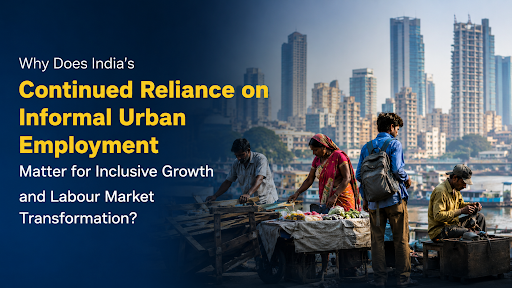
The Ministry of Statistics and Programme Implementation (MoSPI) released the Annual Survey of Unincorporated Sector Enterprises (ASUSE) 2025, revealing that 1.98 crore informal workers operate across India's 46 million-plus cities.
What is Informal Urban Employment?
The urban informal sector comprises small-scale, unincorporated enterprises and workers operating entirely outside formal regulatory and planning frameworks.
The National Commission for Enterprises in the Unorganized Sector (NCEUS) defines informal workers as individuals working in unorganised enterprises or households who lack regular employment or social security benefits.
The International Labour Organization (ILO) conceptualises "informality" to identify the activities of the working poor who operate unprotected by spatial or labour legislations.
Formalisation integrates unincorporated urban units into formal frameworks to enhance institutional governance, guaranteeing a statutory safety net of minimum wages, healthcare, and occupational safety for all workers.
Why is Informal Employment Important for Indian Urban Economy?
Livelihood Generation: Informal sector employs over 90% of the urban workforce, serving as the primary entry point for millions of rural-to-urban migrants navigating the urban economy.
Urban Service Delivery: Informal workers manage urban logistics, street vending, and sanitation, making urban living affordable by supplying daily goods and nutrition to the poor and middle class.
Economic Shock Absorber: The sector acts as a safety valve during macroeconomic shocks or pandemics, preventing displaced formal workers from falling below extreme poverty lines.
Migration Facilitation: Internal migration adds 90 million people to urban centres between 2011 and 2021, with these individuals relying entirely on informal jobs to survive the geographical transition.
GDP Contribution: Informal sector generates 45% of India's total Gross Domestic Product (GDP) despite facing geographical marginalisation.
Key Findings Regarding Informal Employment in India's Cities
Urban Concentration: Out of India's 12.81 crore informal workers in 2025, 1.98 crore operate exclusively within 46 million-plus cities.
Gender Representation: Women constitute approximately 26% (52 lakh) of this urban informal workforce.
Geographic Hotspots: Greater Hyderabad holds the highest concentration with 15.7 lakh informal workers, followed by Delhi, Kolkata, Surat, Mumbai, and Jaipur.
Establishment Density: Kolkata hosts the highest spatial density of informal businesses, housing 8.84 lakh establishments.
Symbiotic Coexistence: The 46 major cities generate 21% of the Gross Value Added (GVA) of the unincorporated non-agricultural sector, highlighting how formal companies outsource labour to informal units.
Why Does High Informality Remain a Concern?
Social Security Deficit: 90% of India's workforce operates without fundamental job security, health insurance, or paid leave.
Stagnant Wage Growth: Informal sector pay increases by a mere 3.9% in 2025, reflecting stagnant productivity and distress-driven labour absorption.
Contractual Absence: Employers rely on casual or oral agreements, exposing workers to algorithmic volatility and arbitrary dismissals without legal recourse.
Credit Exclusion: Only 14% of informal MSMEs secure formal credit, forcing a heavy reliance on local moneylenders who charge 30-50% annual interest.
Hazardous Work Environments: Construction and waste management workers navigate dangerous spatial environments without occupational health coverage or protective gear.
Gender Inequality: Women spend 363 minutes daily on unpaid care compared to men's 123 minutes (as per the Time Use Survey 2024), structurally excluding them from formal urban employment.
What Benefits Can Formalisation of Urban Employment Offer?
Productivity Boost: Formalisation integrates micro-enterprises into the digital economy, helping them scale and increase their Gross Value Added (GVA) per worker.
Welfare Enforcement: Legal frameworks enforce minimum wages, occupational safety, and defined working hours, eliminating extreme labour exploitation.
Fiscal Expansion: Transitioning unstructured units into regulatory compliance widens the formal tax base and enhances national fiscal capacity.
Financial Inclusion: Formal employment generates verifiable income trails, such as payslips and tax filings, empowering workers to access institutional banking.
Systemic Resilience: Secured workers withstand spatial and economic shocks better, preventing mass crises like the reverse migration of 10 million people during the 2020 pandemic.
Universal Social Security: Formalisation ensures universal access to provident funds (EPFO), maternity benefits, and healthcare frameworks like Ayushman Bharat.
What are the Major Challenges in Formalising Urban Employment?
Micro-Enterprise Dominance: Over 60% of unincorporated enterprises operate as single-person units lacking the capital required to transition into formal mid-sized entities.
Compliance Barriers: Burdensome compliance costs, complex tax structures, and bureaucratic hurdles actively deter small-scale urban businesses from declaring formality.
Workforce Skill Deficit: A severe skill mismatch plagues the labour market, as only a minimal percentage of the workforce holds formal vocational training according to the PLFS 2025.
Market Fragmentation: Continuous spatial migration and the absence of real-time data complicate targeted interventions, marginalising vast segments of the urban poor.
Gig Economy Expansion: The gig economy employs 77 lakh workers in 2020–21, with projections reaching 2.35 crore by 2029–30 (per NITI Aayog), leaving workers vulnerable to algorithmic volatility and lacking traditional legal protections.
Frameworks Support Labour Formalisation
e-Shram Portal: The Ministry of Labour and Employment launched in 2021, registering over 30.48 crore unorganised workers (over 53% women) by late 2024 and issuing a Universal Account Number (UAN) for portable benefits.
Code on Social Security, 2020: This reform consolidates nine labour laws into one unified framework, bringing gig, platform, and home-based workers under statutory social security nets like the Employees' State Insurance Corporation (ESIC).
PM SVANidhi Scheme: This initiative provides collateral-free working capital micro-loans to urban street vendors, successfully disbursing loans where 43% of beneficiaries are female.
Skill India Mission: The program bridges the skill deficit by linking vocational training with formal industrial demands, enhancing employability for informal workers.
Digital Labour Platforms: Platforms like Urban Company and Zomato provide flexible entry points for women facing spatial and domestic constraints, bringing previously invisible domestic work into the counted economy.
What Measures Can Accelerate Formalisation of Urban Employment?
Universal Social Security Expansion: Enforce the Code on Social Security, 2020 mandates requiring platform companies to contribute 1-2% of their annual turnover into a dedicated social security fund for gig workers.
Skill Development Strengthening: Implement frameworks similar to Germany’s Dual Vocational Training System to blend theoretical education with hands-on industrial apprenticeships.
MSME Formalisation Support: Expand access to initiatives like the Pradhan Mantri Mudra Yojana (PMMY), which sanctions millions of loans with a strong focus on female and marginalised entrepreneurs.
Digital Inclusion Enhancement: Leverage Digital Public Infrastructure (DPI) to utilise UPI transaction histories as "information collateral," facilitating formal credit for micro-units lacking physical assets.
Urban Labour Governance Improvement: Strengthen Town Vending Committees (TVCs) under the Street Vendors Act to guarantee legal vending zones and protect street vendors from spatial exclusion and evictions.
Gig Worker Protection Extension: Institute algorithmic accountability and define a minimum floor wage to protect gig workers from piece-rate wage traps and digital exploitation.
Conclusion
Achieving urban "formalisation without exclusion" and capturing India's demographic dividend requires expanding financial inclusion via Digital Public Infrastructure (DPI), and ensuring equitable spatial planning.
Source: INDIANEXPRESS
|
PRACTICE QUESTION Q. "India's urbanisation has generated employment opportunities, but a large share of workers continue to remain outside the formal economy." Critically Analyze. (250 Words, 15 Marks) |
Informal employment involves working in small, unincorporated enterprises or households without regulatory oversight. Workers in this sector lack written contracts, legal protections, minimum wages, and social security benefits. It includes street vendors, domestic workers, gig workers, and daily wage labourers.
Informal employment is common due to massive rural-to-urban migration driven by a search for better livelihoods. Because formal urban sectors lack the capacity to absorb this massive influx, and migrants often lack formal industrial skills, the informal sector acts as an immediate safety valve for labour absorption.
Informal workers face severe income volatility, algorithmic exploitation (in gig work), hazardous working environments, lack of access to institutional credit, and absence of social safety nets like health insurance (ESIC) or pension funds (EPFO). They are highly vulnerable to macroeconomic shocks.
India can promote formalisation by implementing the Code on Social Security 2020, enhancing digital financial inclusion via DPI (like UPI-based credit), expanding vocational training (Skill India), and strengthening urban governance frameworks like Town Vending Committees to legally integrate unorganised workers into the urban economy.




© 2026 iasgyan. All right reserved