

Why In News?
Following states like Rajasthan, Karnataka, and Jharkhand, the Telangana State Assembly passed the landmark Telangana Platform-Based Gig Workers (Registration, Social Security and Welfare) Bill, 2026.
|
Read all about: SOCIAL SECURITY FOR GIG WORKERS l GIG AND PLATFORM WORKERS DATA GAP l IS THE 10-MINUTE DELIVERY MODEL NECESSARY? l QUICK DELIVERY APPS EXPLOITING GIG WORKERS |
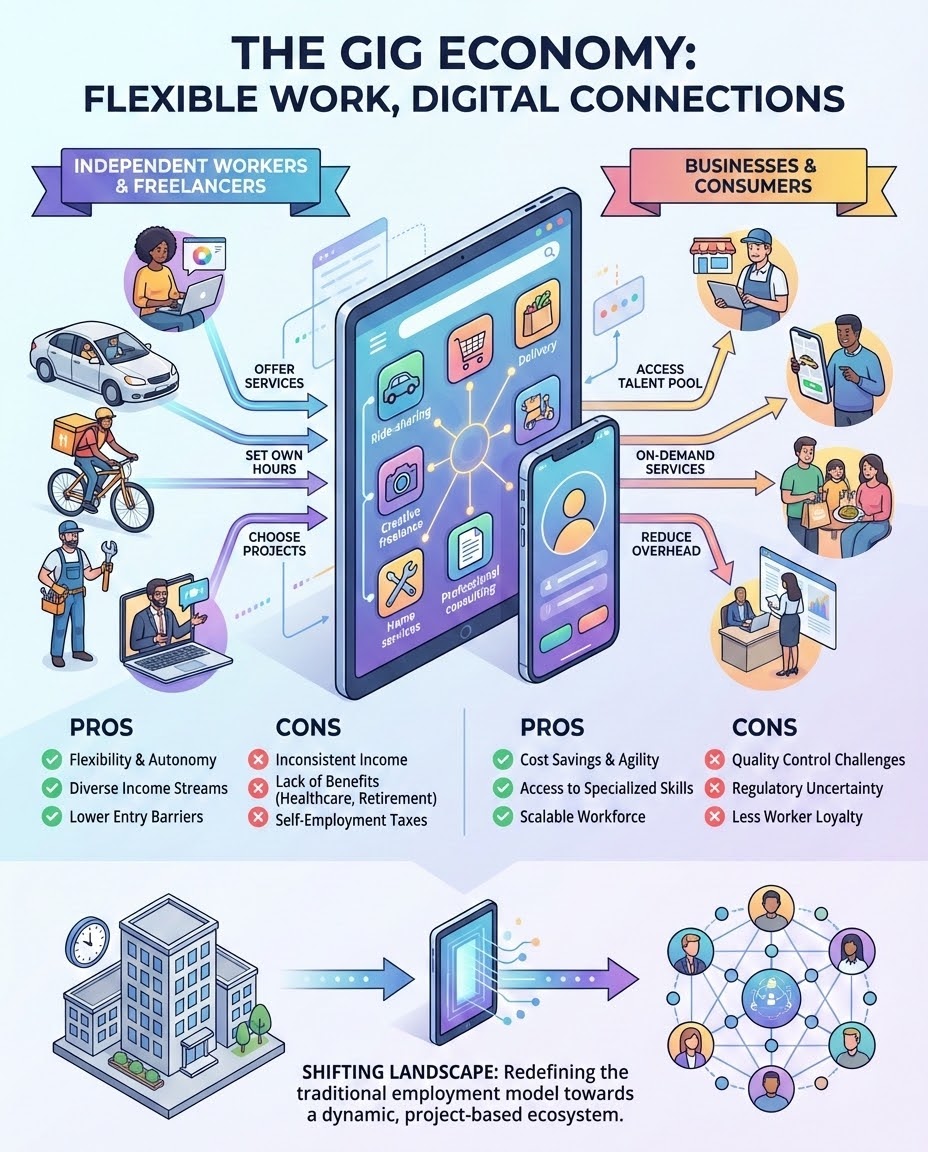
The "Gig Economy"—a labor market characterized by the prevalence of short-term contracts or freelance work as opposed to permanent jobs—has moved from the fringes to the center of India’s economic strategy.
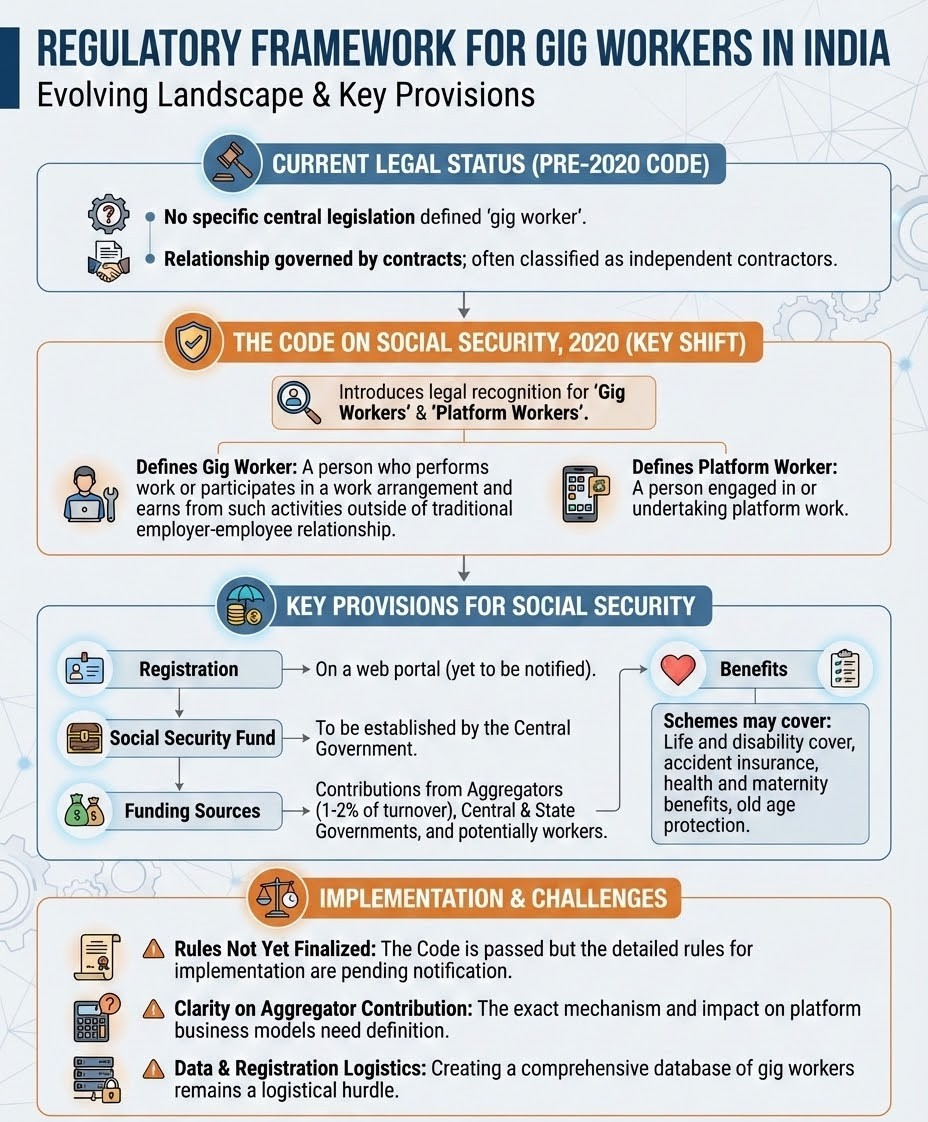
According to the Code on Social Security, 2020, a gig worker is "a person who performs work or participates in a work arrangement and earns from such activities outside of traditional employer-employee relationship".
 Data & Trends
Current Workforce Size: According to the Economic Survey 2025-26, India’s gig workforce surged to 12 million (1.2 crore) in FY 2025, registering a growth of 55% from FY 2021.
Future Projections: The NITI Aayog report titled "India's Booming Gig and Platform Economy" projects the workforce to expand to 23.5 million (2.35 crore) by 2029-30.
Employment Share: Gig workers are expected to constitute 4.1% of the total livelihood in India and 6.7% of the non-agricultural workforce by 2029-30. (Source: NITI Aayog)
Skill Distribution: Contrary to popular belief, the gig economy isn't just delivery; medium-skilled jobs (e.g., beauty services, plumbing) and high-skilled jobs (e.g., IT, graphic design) make up nearly 53% of the sector. (Source: NITI Aayog)
Global Dominance: India has emerged as a global hub for online freelancing, with Indian workers holding a 55% market share in global software development and technology gig work.
Economic Contribution: The sector involves transactions worth billions, with projections suggesting it could contribute up to 1.25% to India's GDP by the long term. (Source: NITI Aayog)
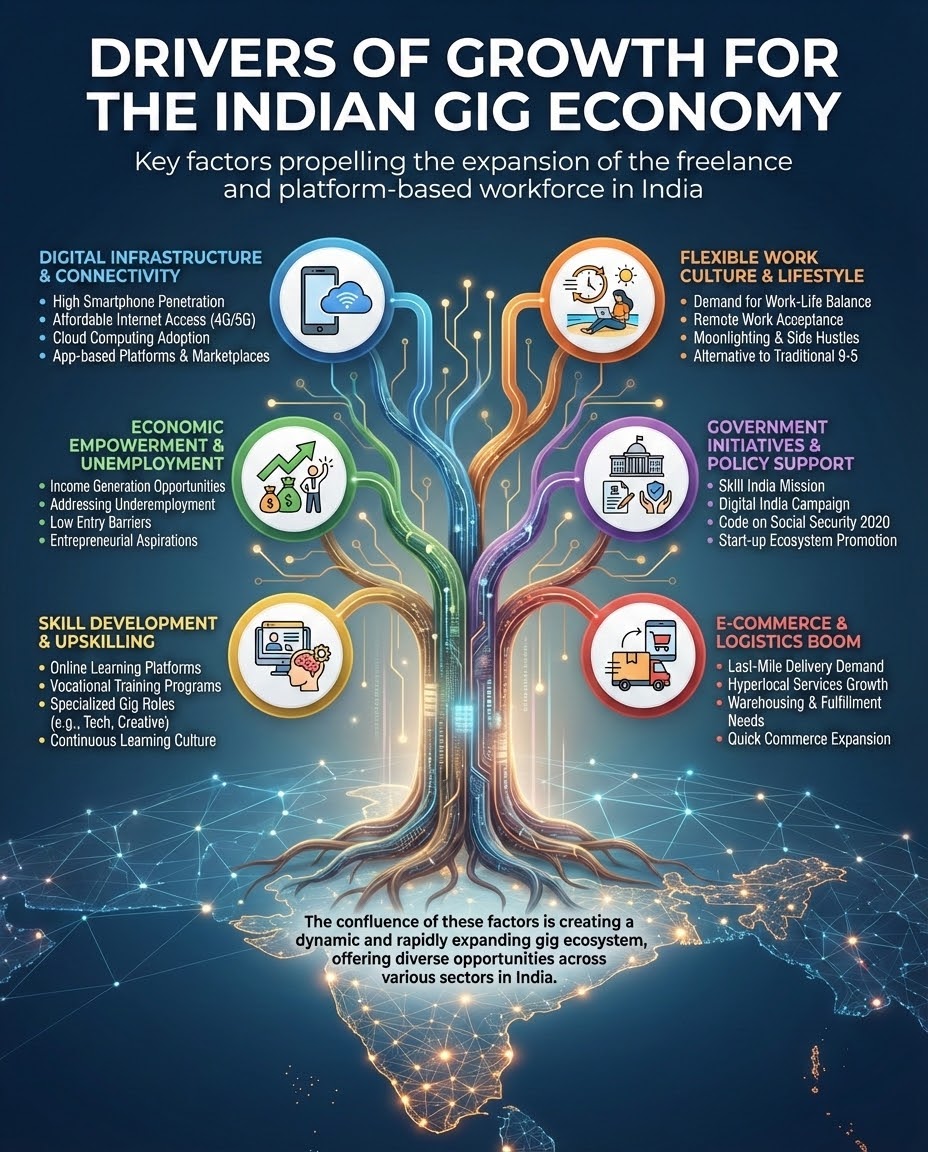
Smartphone Penetration: The Economic Survey 2025-26 highlighted the growth in the gig workforce primarily due to the massive base of over 80 crore smartphone users, which serves as the primary tool of trade for platform workers.
Frictionless Payments: With Unified Payments Interface (UPI) processing over 15 billion transactions per month, platforms instantly settle micro-payments for tasks, making "daily payouts" a reality that attracts liquidity-constrained workers.
B. The "Quick Commerce" & Hyper-Local Boom
Post-pandemic consumption patterns have shifted permanently towards "instant gratification."
Tier-2 & Tier-3 Expansion: Growth is no longer limited to metros. The expansion of Quick Commerce (10-minute delivery) and logistics into smaller cities has created a localized demand for delivery partners and warehouse staff, decentralizing job creation.
Service Consumption: The services sector, which contributes over 55% to India's GDP, is being delivered via platforms (e.g., Urban Company for home services), creating a new category of "location-based" gig work.
C. Demographic Dividend & "Flexi-Work" Preference
Youth Autonomy: Millennials and Gen Z (who make up the bulk of the workforce) prefer the autonomy of "logging in" at will over rigid 9-to-5 schedules. This is cited as a key "pull factor" for the youth.
Female Labour Force Participation (FLFPR): Platforms offer flexibility that allows women to balance caregiving with earning. The Economic Survey 2025-26 notes a rise in female FLFPR to 41.7%, partly aided by flexible gig opportunities that do not require commuting to a fixed office.
D. Cost Efficiency for Corporates
Variable vs Fixed Costs: Companies are shifting from "hiring" (fixed cost: salary + PF + office space) to "contracting" (variable cost: pay-per-task). This allows startups to scale up or down instantly based on demand without the burden of long-term employment liabilities.
E. Global "Freelance Hub" Status
India now holds approximately 40% of the global freelance workforce market share, driven by high-skilled workers in IT, software, and finance servicing global clients from home. (Source: WEF)
 Regulatory Framework For Gig Workers In India
Code on Social Security, 2020 (Central Level)
Legal Recognition: For the first time, the terms "Gig Worker" and "Platform Worker" were defined as distinct from traditional employees.
Mandatory Registration: It mandates that all gig and platform workers register on the e-Shram portal to receive a Universal Account Number (UAN), which is essential for accessing government benefits.
Social Security Fund: Section 141 of the Code envisions a dedicated fund. Aggregators (like Uber, Zomato, or Urban Company) are required to contribute 1-2% of their annual turnover, ensuring that the welfare of the "partners" is funded by the platforms themselves.
National Social Security Board: The Act establishes a board to recommend and monitor schemes related to life and disability cover, health benefits, and old-age protection specifically for gig workers.
Rajasthan Model
Since labor is a subject in the Concurrent List (Schedule VII), states can pass their own laws. Rajasthan's 2023 Act is considered a benchmark for protecting gig workers.
Rajasthan, Karnataka, Jharkhand, Telangana, and Bihar have either passed or introduced legislation to regulate gig workers and ensure their social security.
 What are the Core Provisions of the State-Level Laws/Bills?
Mandatory Registration & Unique ID: States are making it compulsory for all gig workers to be registered in government databases.
Dedicated Social Security Fund: Creation of a corpus fund financed by a levy on transactions.
Algorithmic Transparency: To prevent exploitation, platforms are now required to disclose their salary structures and deduction policies clearly.
Tripartite Welfare Boards: These laws establish dedicated Welfare Boards with representation from the government, aggregators, and workers.
Strong Deterrent Penalties: To ensure compliance, the laws impose heavy financial penalties on non-compliant aggregators.
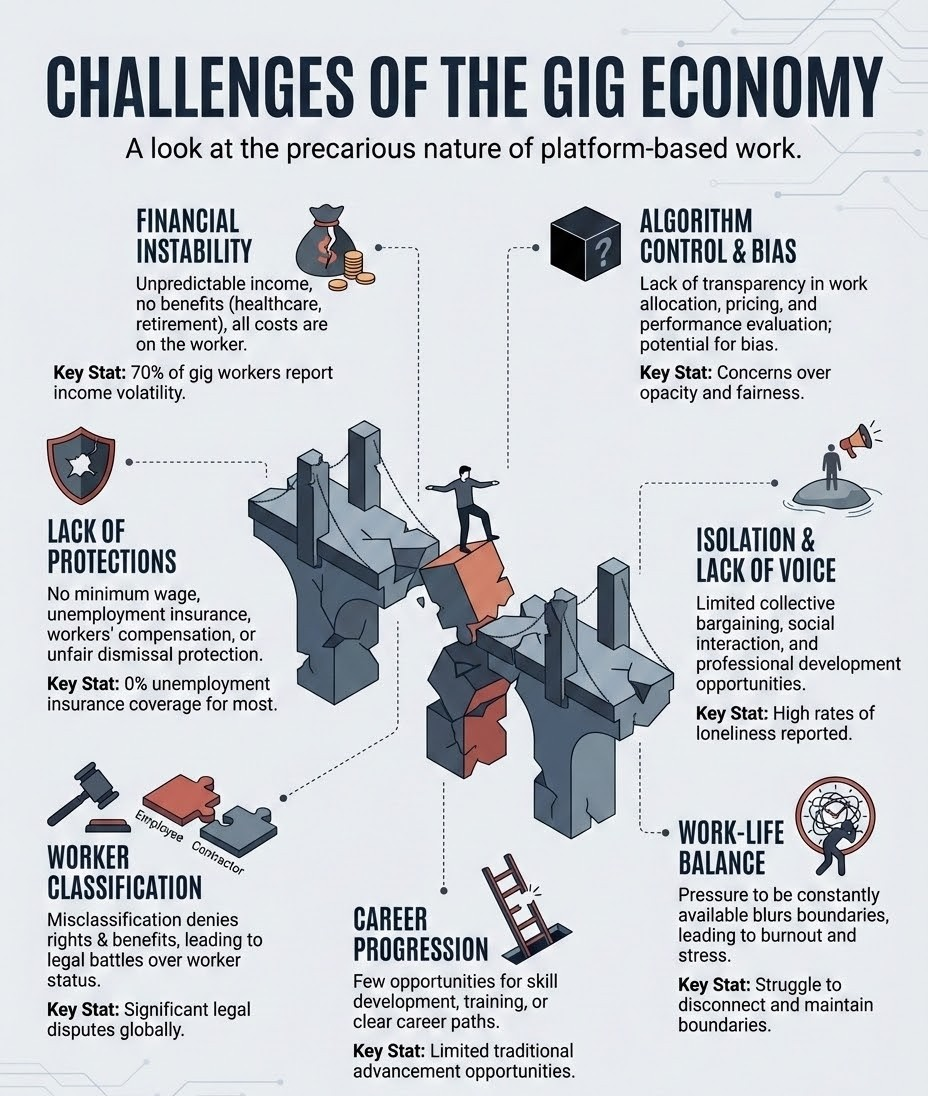
Avoidance of Statutory Benefits: Platforms classify workers as "independent partners" rather than employees. This allows companies to bypass mandatory payments for Gratuity, Maternity Benefits, and Minimum Wage.
Lack of Collective Bargaining: Because they are not "employees," gig workers lack the legal right to form recognized unions under traditional labor laws, leaving them with little negotiating power against large tech aggregators.
B. Algorithmic Management
Workers are managed by opaque software logic rather than human supervisors, leading to several psychological and financial pressures.
Information Asymmetry: Workers do not understand why their "ratings" drop or why they are suddenly "de-platformed" (blocked) from the app. This lack of transparency creates an environment of constant surveillance and anxiety.
The Incentive Trap: Algorithms use "gamification" (e.g., "Complete 12 rides for a ₹500 bonus") to push workers into working 12–14 hour shifts, leading to extreme physical fatigue and increased road accident risks.
C. Income Volatility and the "Working Poor"
Earnings Compression: As more workers join platforms, the "per-task" rate drops. The Economic Survey 2025-26 notes that nearly 40% of gig workers earn less than ₹15,000 per month.
Asset Depreciation: Workers bear all the "capital costs," such as fuel, vehicle maintenance, and smartphone EMI, which eat into their take-home pay.
D. The Social Security Vacuum
While the Code on Social Security 2020 exists, its full-scale implementation remains a "work in progress."
Lack of Safety Nets: Most gig workers still operate without Health Insurance, Life Insurance, or Pension schemes. An accident or a medical emergency can push a gig-dependent household into a debt trap.
Gender Gap: While flexibility helps women, they face a "digital divide" and earn less than their male counterparts due to the inability to work late-night shifts or in high-traffic zones.
E. Skill Stagnation
Dead-end for career growth: A delivery partner may remain a delivery partner for a decade without acquiring any transferable skills. This creates a "skill trap" where workers are stuck in low-value tasks without a path to formal, high-paying roles.
 Way Forward For India’s Gig Economy
NITI Aayog recommends a five-pronged strategy to professionalize the sector:
B. Legal & Regulatory Reforms
Operationalize the Code on Social Security, 2020: Government must fast-track the notification of final rules, specifically the "Aggregator Contribution" clause (1-2% of annual turnover) to create a sustainable welfare corpus.
Harmonize State & Central Laws: As states like Rajasthan and Karnataka pass their own Gig Worker Acts, the Centre must ensure a unified definition of "aggregator" to prevent regulatory fragmentation that could hurt "Ease of Doing Business".
Minimum Pay Floor: To counter income volatility, India should consider a "Minimum Pay Floor" for active hours (time spent on delivery/ride), similar to the model adopted in New York City or the UK.
C. Social Security Architecture
Universal Registration: Push for 100% registration on the e-Shram portal. Linking the Universal Account Number (UAN) to platform IDs ensures that benefits are portable— a worker keeps their insurance even if they switch from Swiggy to Zomato.
Health & Insurance Integration: Interim Budget 2025-26 extended Ayushman Bharat (PM-JAY) coverage to all Anganwadi and ASHA workers; the next step is to include registered Gig Workers under this ₹5 Lakh health cover.
Unemployment Support: Create a specific "Downtime Allowance" or micro-insurance product that compensates workers for days lost due to vehicle breakdown or accident recovery.
D. Technological Interventions
Algorithmic Transparency: Following the European Union’s Platform Work Directive, India should mandate that platforms disclose the broad parameters of how tasks are assigned and how "ratings" are calculated.
"Fair Work" Certification: Encouraging independent audits (like the Fairwork India Ratings) can push companies to compete on worker welfare, not just customer speed.
Skilling & Upward Mobility
Skill India Digital Hub Integration: Gig work should not be a "dead-end." Platforms should collaborate with the Ministry of Skill Development to issue "Micro-Credentials" for skills learned on the job (e.g., communication, navigation, time management).
Financial Inclusion: Guidelines for banks to treat "Gig Income" (verified via platform statements) as valid proof for loan eligibility, enabling workers to escape high-interest informal lenders.
Learn from Global Best Practices in Gig Worker Regulation
|
Region/Country |
Key Legal Provision/Principle |
|
European Union |
Establishes a "rebuttable presumption of employment." If a platform controls a worker's pay or performance, the law presumes they are an employee, shifting the burden of proof to the company. |
|
Singapore |
Mandates that platform operators provide workplace injury compensation and make statutory contributions to the worker's retirement fund (Central Provident Fund). |
|
United Kingdom |
Classified platform drivers as "workers" (a category between employee and independent contractor), entitling them to a national minimum wage and paid holidays. |
The Gig Economy is not a fleeting trend but a structural transformation of the Indian labor market. It offers a path to formalize the informal, provided the regulatory architecture keeps pace with technological innovation.
Realising the Viksit Bharat 2047 vision requires transforming gig work into a formal, protected profession by implementing the Code on Social Security (2020) and state-level welfare boards to ensure economic dignity and decent work.
Source: INDIAN EXPRESS
|
PRACTICE QUESTION Q. The rapid growth of the gig economy in India presents a unique paradox of employment generation and labor exploitation. Discuss. 250 words |
A platform-based gig worker is an individual who earns income by providing specific services or completing tasks through digital platforms or aggregators, such as ride-hailing apps, freelance marketplaces, or food delivery networks.
Algorithmic transparency requires digital platforms to explicitly disclose their salary structures, deduction mechanisms, and rating criteria. It prevents platforms from using hidden automated systems (algorithms) to arbitrarily reduce guaranteed payouts or penalize workers without human oversight.
According to a report by NITI Aayog, the Indian gig workforce is projected to experience explosive growth, expanding from 7.7 million workers in 2020-21 to 23.5 million workers by the year 2029-30.
© 2026 iasgyan. All right reserved
