

Copyright infringement not intended
Picture Courtesy: THE HINDU
The 10-minute delivery model by Q-commerce platforms (Blinkit, Zepto, Swiggy Instamart) provides consumer convenience but fuels a debate over its necessity, sustainability, and workforce costs.
|
Read all about: DARK STORES, RISE OF QUICK COMMERCE l HIDDEN COSTS OF INSTANT DELIVERY l QUICK DELIVERY APPS EXPLOITING GIG WORKERS |
Quick Commerce, or Q-Commerce, is an evolution of e-commerce focused on ultra-fast delivery, promising to get goods to customers within 10 to 30 minutes of placing an order.
This model is built on a hyper-local logistical network, serving high-demand consumer goods like groceries, stationery, and over-the-counter medicines.
How Does Q-Commerce Work?
Dark Stores
These are small, strategically located warehouses in dense urban residential areas, functioning solely as fulfillment centers for major platforms like Blinkit and Zepto across major cities.
Predictive Analytics & AI
AI is used by companies to forecast demand for items in various areas, allowing dark stores to be stocked efficiently and reducing fulfillment time.
High Rider Density
A large fleet of delivery partners is concentrated around each dark store, ensuring a rider is always available to pick up an order immediately.
Indian e-commerce industry, valued at $125 billion in 2024, is expected to reach $345 billion by 2030, driven by urban millennials and Gen Z seeking convenience. (Source: IBEF).
The rise of Q-Commerce presents a classic development dilemma: the convenience and economic activity it generates must be weighed against its social and environmental costs.
The "Pros": Drivers of Growth and Benefits
Unmatched Consumer Convenience: Caters to unplanned, urgent needs (e.g., forgotten grocery items, baby supplies) and impulse purchases, fitting into fast-paced urban lifestyles.
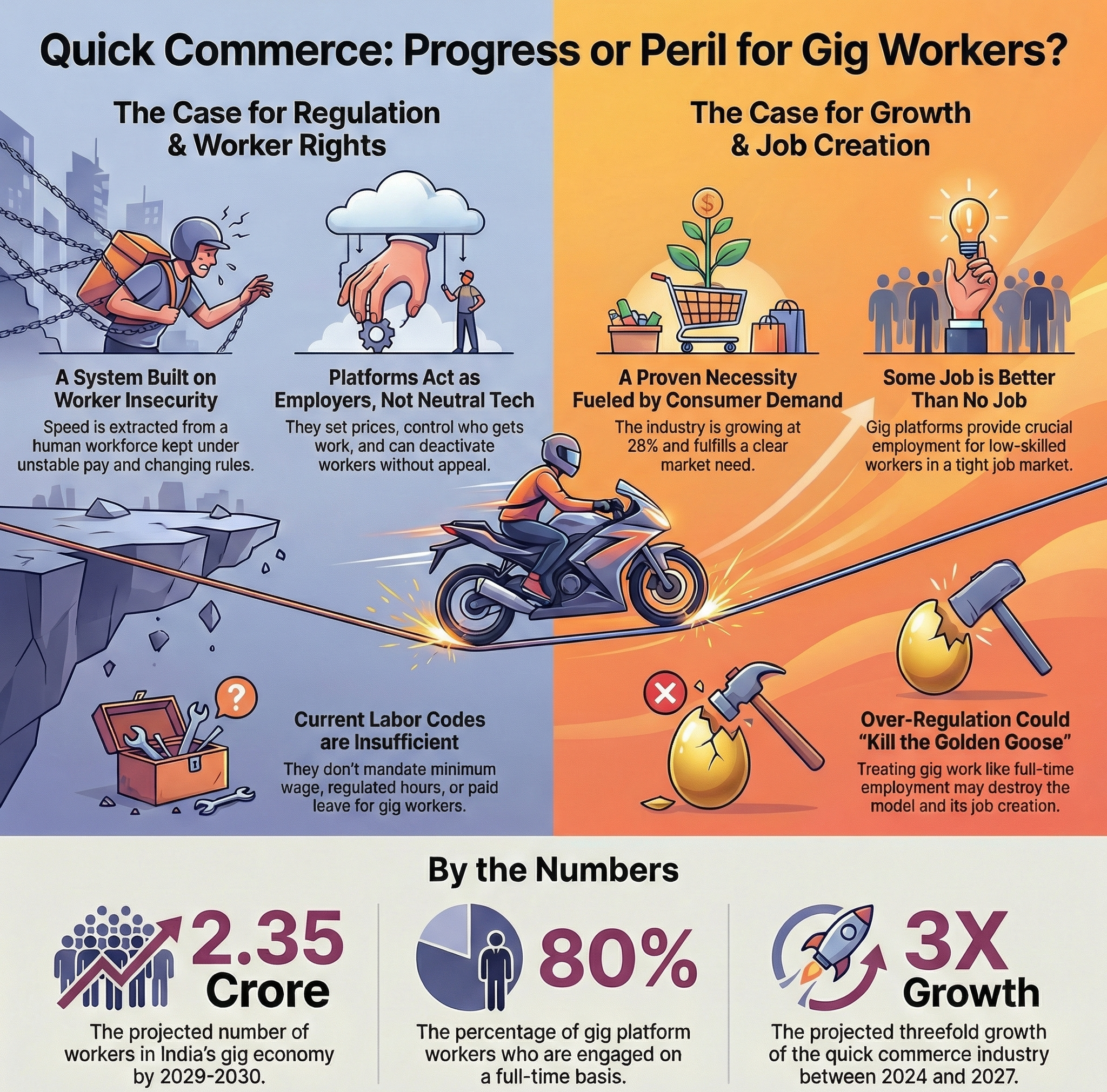
Job Creation in the Gig Economy: The model has created jobs for delivery partners. Indian gig workforce was estimated at 7.7 million in 2020-21 and is projected to expand to 23.5 million by 2029-30. (Source: NITI Aayog)
Logistical Innovation: It drives innovation in supply chain management, hyperlocal logistics, and inventory management technologies.
 The "Cons": Critical Challenges and Externalities
The promise of "instant" delivery comes with hidden costs, borne by workers, the environment, and society at large.
Human Cost & Labour Exploitation
Precarious Work: Delivery partners are classified as 'gig workers' or 'independent contractors', not employees, denying them benefits like provident fund, health insurance, and paid leave.
Low & Unstable Wages: The Fairwork India Report 2024 highlighted that most platforms fail to ensure workers earn a local living wage after accounting for work-related costs like fuel.
Intense Pressure & Safety Risks: The 10-minute deadline encourages speeding, increasing road accidents. Incentive pressure to complete more trips causes stress and burnout.
Environmental Sustainability
Increased Carbon Emissions: The model relies on a large fleet of two-wheelers making frequent, short trips for small-value orders, increasing urban pollution.
Packaging Waste: Small, individual deliveries lead to a surge in single-use plastic and other packaging materials, straining urban waste management systems.
Traffic Congestion: A constantly moving fleet of delivery vehicles adds to traffic congestion and noise pollution in already crowded urban centers.
Socio-Economic Impact
Promoting Hyper-Consumerism: The ease of instant delivery encourages impulse buying and over-consumption, contributing to a "throwaway culture."
Impact on Local Retail: The model poses a competitive threat to small, local Kirana stores, which have traditionally been the backbone of neighbourhood economies.
Distorting Consumer Expectations: It creates a culture of impatience, making slower, more sustainable delivery models seem unappealing to consumers.
The Code on Social Security (2020) replaces several older laws and introduces specific protections for the gig economy:
State-Level Legislations
Rajasthan: The first state to pass the Rajasthan Platform Based Gig Workers (Registration and Welfare) Act, 2023, which established a dedicated Welfare Board and a welfare cess on transactions.
Karnataka: Enacted the Karnataka Platform-Based Gig Workers Social Security and Welfare Act, 2025, which mandates algorithmic transparency, requiring platforms to explain how tasks are allocated and earnings are determined.
Telangana: Proposed the Draft Telangana Gig and Platform Workers Bill, 2025, which includes strict rules against arbitrary deactivation, requiring a seven-day notice before a worker is removed from a platform.
The Indian model is currently a "hybrid" approach. Unlike the UK (which classifies Uber drivers as "workers" with minimum wage) or California (which uses the "ABC test" to classify many as employees), India focuses on providing social security safety nets while allowing workers to remain classified as independent contractors to maintain flexibility.
Strengthening Regulation
A national-level, comprehensive policy framework is needed for the gig economy to ensure minimum wages, social security benefits, and safe working conditions, learning from Rajasthan's model.
Promoting Green Logistics
Government can offer incentives like subsidies under the FAME-II scheme for aggregators to accelerate the transition to EVs and encourage the use of sustainable, plastic-free packaging.
Re-orienting for 'Sustainable Speed'
Platforms can use AI to prioritize safety and efficiency over raw speed, shifting from an aggressive "10-minute" guarantee to a more reliable "30-minute" delivery window to reduce worker pressure.
Encouraging Consumer Awareness
Educating consumers about the hidden costs of ultra-fast delivery can encourage more conscious purchasing decisions, such as consolidating orders or choosing slower, more sustainable delivery options.
Hybrid Models
Promoting collaboration between Q-commerce platforms and local kirana stores (a model known as hyperlocal commerce) can help traditional retailers digitize and survive, creating a more inclusive ecosystem.
The 10-minute delivery model is an expensive, non-essential convenience for India. Achieving a fast, efficient, fair, safe, and sustainable system requires enforcing social security, promoting EVs and better logistics, and promoting corporate responsibility and conscious consumerism to moderate these extremes.
Source: THE HINDU
|
PRACTICE QUESTION Q. The rise of the quick commerce model highlights a conflict between consumer convenience and the socio-economic security of gig workers. Critically analyze. 250 words |
The quick commerce, is an e-commerce system that delivers groceries and essentials to customers within 10-20 minutes. It works through a network of small, strategically located warehouses called 'dark stores' and uses technology like AI to manage inventory and optimize delivery routes for speed.
For the first time in Indian law, the Code on Social Security, 2020, officially recognizes "gig workers" and "platform workers." It mandates the creation of a social security fund for them, to be financed by a 1-2% contribution from the aggregators' annual turnover. This fund is intended to provide benefits like health insurance, disability cover, and old age protection.
Dark stores are small, non-public warehouses or micro-fulfilment centers situated in dense urban areas, close to customers. They stock a limited range of high-demand products, which allows for extremely fast order picking and packing. Their hyperlocal nature ensures that delivery distances are short, making the 10-minute promise achievable.
© 2026 iasgyan. All right reserved