Q-commerce has transformed urban consumption by offering ultra-fast deliveries, but its speed-driven model creates significant social and governance challenges. Delivery workers face high accident risks, unstable incomes and algorithmic pressure, while cities experience rising traffic violations and congestion linked to gig operations. Weak labour regulations and incomplete social-security frameworks leave workers vulnerable, and platforms often evade accountability through opaque incentive systems. Although governments have introduced measures such as social-security codes, welfare boards and safety guidelines, implementation remains uneven. A balanced approach that strengthens worker protection, ensures platform transparency and improves urban regulation is essential to make the quick-delivery ecosystem safe, fair and sustainable.
Copyright infringement not intended
Picture Courtesy: The Hindu
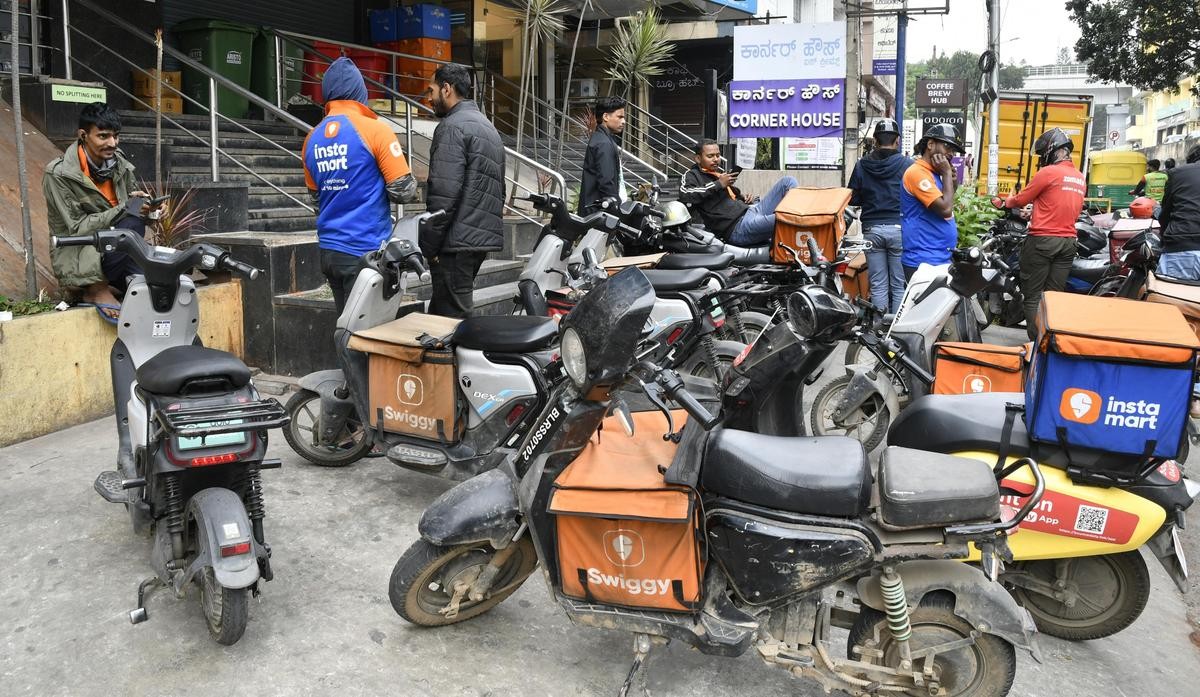
Bengaluru’s rapid expansion of quick-commerce (Q-commerce) and the middle class’s growing dependence on 10-minute deliveries has produced a set of unintended social, economic, and governance consequences.
|
Must Read: QUICK COMMERCE | DEBATE ON ECOMMERCE IN INDIA | INDIAN E-RETAIL MARKET | |
Quick Commerce (Q-Commerce) refers to fast-delivery retail model where essential goods—such as groceries, medicines, snacks, daily-use items, or small appliances—are delivered to customers within 10 to 30 minutes using a network of hyperlocal dark stores, micro-warehouses, and gig-delivery partners.
|
Dimension |
Quick Commerce (Q-Commerce) |
Traditional E-Commerce |
|
Fundamental Objective |
Built around speed and immediacy, aiming to convert impulse and urgent needs into instant fulfilment. |
Built around variety, scale, price competitiveness, and planned consumption patterns. |
|
Delivery Timeline |
Ultra-short usually 10–30 minutes, sometimes under 15 minutes, enabled by dense stocking points and real-time dispatch. |
Longer timelines same-day to multi-day depending on distance, warehouse location, and logistics network. |
|
Supply Chain & Fulfilment Model |
Hyperlocal model with dark stores, micro-warehouses, and neighbourhood-level stocking to shrink last-mile travel time. |
Centralised or regional warehouses with bulk inventory; follows hub-and-spoke logistics across cities and states. |
|
Operational Philosophy |
High-velocity picking, micro-order processing, and on-demand fleet mobilisation with minimal inventory depth. |
Bulk inventory holding, planned dispatch cycles, and consolidated packaging for cost efficiency. |
|
Product Universe |
Narrow, curated SKUs—fast-moving groceries, daily essentials, OTC medicines, snacks—optimised for high turnover. |
Extremely wide assortment—electronics, clothing, appliances, slow-moving goods—optimised for long-tail demand. |
|
Basket Characteristics |
Low-value, high-frequency, impulsive and convenience-driven purchases; average basket size is small. |
High-value, lower-frequency, planned purchases; larger baskets often consolidated in single deliveries. |
|
Delivery Workforce Structure |
Highly dependent on gig and platform-based workers using two-wheelers and EVs; flexible but precarious labour model. |
Combination of contractual logistics workers, courier networks, and delivery partners with more structured operations. |
|
Technological Backbone |
Heavy reliance on AI-driven routing, instant pick algorithms, dense GPS tracking, micro-routing. |
Uses automation, warehouse robotics, centralised inventory management, and long-distance optimisation algorithms. |
|
Cost & Unit Economics |
High per-order cost due to rapid delivery pressure; profitability depends on density, order volume, and subscription models. |
Lower per-order cost due to economies of scale; more stable margins achieved through consolidated shipments. |
|
Urban Impact & Externalities |
Contributes to traffic density, footpath riding, road safety risks, noise, and neighbourhood congestion from dark stores and on-demand fleets. |
Lower hyperlocal disturbance; operations are concentrated in large fulfilment centres away from residential spaces. |
|
Environmental Footprint |
Higher carbon footprint per item (unless EV-based) due to multiple micro-deliveries and packaging waste. |
Lower footprint per item due to bulk shipments and consolidated delivery routes. |
|
Consumer Behaviour Influence |
Creates a culture of instant gratification, micro-orders, and reduced reliance on local markets. |
Encourages planned purchasing and comparison shopping; strengthens long-term retail habits. |
|
Regulatory Context |
Operates in a grey zone of labour regulations, micro-mobility laws, dark-store zoning norms, and worker safety protections. |
Well integrated into established e-commerce rules on taxation, consumer protection, and logistics regulation. |
|
Risk & Vulnerability |
High operational fragility traffic, weather, workforce strikes, and urban congestion can disrupt timelines instantly. |
More resilient due to distributed logistics, inventory depth, and diversified supply chain networks. |
|
Returns & Reverse Logistics |
Limited scope—most Q-commerce items have low return probability or no-return policy. |
Extensive return systems across categories (electronics, apparel, appliances), including reverse logistics networks. |
|
Business Strategy |
Growth driven by speed differentiation, customer stickiness through memberships, and local network density. |
Growth driven by assortment breadth, competitive pricing, and national-scale distribution. |
Surge in traffic violations: Bengaluru has witnessed a dramatic rise in traffic violations by delivery personnel, with cases increasing from 30,968 in 2023 to 52,153 in 2024, and further to 63,718 in just the first nine months of 2025. This surge reflects a deeper systemic problem where overspeeding, signal jumping, riding on footpaths, and aggressive manoeuvring through congested lanes have become routine behaviours for gig workers trying to meet time-bound delivery commitments.
Rising accidents and gig-worker vulnerability: Delivery workers are themselves frequent victims of unsafe conditions, with at least 27 accidents recorded over the past three years. Late-night deliveries make them particularly vulnerable to theft, phone snatching, assault, and intimidation by local rowdy elements.
Increase in crimes involving delivery personnel: Law-and-order incidents involving delivery personnel have also risen, with 13 cases reported in 2023, 7 in 2024, and 24 cases already in 2025. These include theft, robbery, molestation, drug transport, assault, and public nuisance, showing that gig work can intersect with criminality in multiple ways.
Misuse of delivery platforms for illegal activities: Police investigations reveal that drug peddlers exploit parcel delivery options to transport contraband, sometimes without the workers’ knowledge and sometimes with their active collusion.
Unrealistic expectations intensify pressure: Consumers increasingly expect near-instant deliveries, often making multiple irate calls when orders are delayed by a few minutes
Weak regulatory framework governing gig work: India’s rapid expansion of gig work has not been matched by a strong regulatory framework. Key labour reforms, including the Industrial Relations Code and the Code on Wages, do not adequately define gig workers or establish employer accountability.
Migration and economic compulsion: Most delivery partners are migrant workers earning around ₹30,000–40,000 per month, significantly higher than many other informal jobs that average ₹15,000.
Karnataka Gig Workers Act (2025) not fully implemented: Although Karnataka’s Gig Workers (Social Security and Welfare) Act, 2025 is widely praised for its forward-looking provisions, its incomplete implementation has created a regulatory vacuum. Workers cannot yet access the protections envisioned by the Act.
|
Ethical and Constitutional Concerns Privacy and Surveillance Concerns: Workers are continuously tracked through GPS, order logs, and behaviour analytics. Excessive data monitoring without safeguards can violate their informational privacy. Article 14 – Right to Equality: Gig workers face algorithmic discrimination, arbitrary deactivation, and inconsistent incentive policies. Since platforms deny an employer–employee relationship, workers cannot demand non-arbitrary treatment. Article 21 – Right to Life, Livelihood, Safety, and Dignity: Unsafe delivery timelines, lack of medical benefits, and exposure to crime challenge the dignity and safety guaranteed under Article 21. |
Code on Social Security 2020: This is the first national law that formally recognises gig and platform workers as a separate labour category. It creates the National Social Security Board for Gig and Platform Workers. The Code envisions schemes related to life insurance, disability cover, health protection, maternity support and old-age benefits. Funding is designed as a shared responsibility between the Centre, States, platforms and workers. However full implementation is still pending in many states.
e-Shram Portal: The e-Shram platform provides a national database for informal workers including gig workers. It issues a unique identification number and allows easy access to future social-security schemes. During emergencies several states used the e-Shram database for cash transfers.
Insurance Convergence with Existing Schemes: Gig workers registered on e-Shram receive accidental insurance under the Suraksha Bima Yojana and life insurance under the Jeevan Jyoti Bima Yojana.
Rajasthan Gig Workers Welfare Act 2023: This is India’s first dedicated law for gig workers. It mandates registration of workers and aggregators and creates a welfare board and a welfare fund. Platforms contribute a small percentage of each transaction to this fund. The law also proposes a scorecard system to assess the social-security performance of companies.
Karnataka Gig Workers Social Security and Welfare Act 2025: This law introduces mandatory safety protocols for delivery workers. It requires background checks, SOS features, uniforms, ID cards and regular training. It also mandates a contributory social-security structure where platforms share responsibility for worker protection.
NITI Aayog Framework 2022: NITI Aayog recommended a national-level welfare architecture for gig workers. It suggested mandatory social-security contributions from aggregators and called for health protection, skilling programmes and financial inclusion.
|
CASE STUDY UK Supreme Court vs Uber (2021) recognised drivers as “workers” entitled to minimum wage and paid leave. India can draw lessons for balancing flexibility with protection. |
The rapid growth of Q-commerce has created new opportunities in urban retail, yet it relies on an increasingly vulnerable gig workforce that faces safety risks, unstable incomes and weak legal protections. Strengthening social security, ensuring fair platform practices, improving urban regulation and recognising gig workers’ rights are essential to make this ecosystem both equitable and sustainable. A balanced framework that protects workers while enabling innovation is the only way to achieve inclusive growth in India’s digital economy.
Source: The Hindu
|
Practice Question The rise of Q-commerce has reshaped India’s urban economy but has also intensified concerns about labour precarity, traffic safety and regulatory gaps. Discuss. (250 words) |
Q-commerce, or quick commerce, is a hyperlocal delivery model that promises ultra-fast delivery of groceries and essential goods, usually within 10 to 30 minutes, using dark stores and gig-delivery workers.
It has expanded due to rising urbanisation, increased digital adoption, convenience-driven consumer behaviour, and the availability of cheap gig labour. The COVID-19 pandemic further accelerated demand for doorstep delivery.
Gig workers face income volatility, unsafe delivery deadlines, lack of social security, algorithmic control, traffic risks and exposure to harassment or crime during late-night deliveries.





© 2026 iasgyan. All right reserved