Description
Copyright infringement not intended
Picture Courtesy: Mint
Context:
The capital goods sector forms the backbone of India’s industrial and infrastructure ecosystem by supplying machinery, equipment and technology required for production across sectors. Recognising its multiplier effect on growth, employment and competitiveness, the Union Budget 2026–27 places strong emphasis on expanding domestic capacity, promoting high-precision manufacturing and supporting infrastructure-led economic growth.
What are Capital Goods?
Capital goods refer to plant, machinery, equipment and tools used for manufacturing goods or providing services. These are essential for capacity expansion, modernization and technological upgradation across sectors such as manufacturing, mining, agriculture, construction, logistics and services.
Importance of the Capital Goods sector:
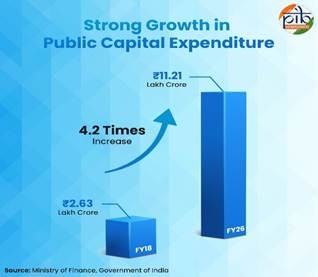
- High multiplier impact on economic growth: Investment in capital goods creates strong economy-wide spillover effects by stimulating demand across core sectors such as steel, cement, logistics and services. With government capital outlay rising nearly 2 times from ₹2.63 lakh crore in FY18 to ₹11.21 lakh crore in FY26 (BE) and public capex proposed at ₹12.2 lakh crore for FY27, the sector plays a critical role in accelerating investment-led growth and crowding in private capital.
- Foundation of manufacturing expansion: The capital goods sector provides the machinery backbone for key industries including automobiles, electronics, textiles, power and heavy engineering. Its growing strength is reflected in industrial performance, with the capital goods segment under the Index of Industrial Production registering 8.1% year-on-year growth in December 2025, indicating rising capacity creation and industrial activity.
- Driver of productivity and technological upgradation: A strong domestic capital goods base enables industry to adopt advanced manufacturing technologies such as automation, precision engineering and digitally enabled production systems. Government initiatives such as Hi-Tech Tool Rooms, Centres of Excellence and the Capital Goods Competitiveness Scheme are aimed at strengthening high-precision manufacturing and improving technology diffusion across the industrial ecosystem.
- Strategic role in emerging and future sectors: Capital goods are essential for India’s transition towards clean energy and advanced manufacturing. The sector supports the development of renewable energy infrastructure, lithium-ion battery manufacturing, energy storage systems and critical mineral processing, all of which are central to energy security, electric mobility and supply chain resilience.
- Employment and skill development potential: Capital goods manufacturing is technology- and skill-intensive, generating employment across engineering design, fabrication, machine operation and maintenance. With initiatives such as the Production Linked Incentive (PLI) schemes generating over 12.6 lakh jobs (direct and indirect) and attracting investments exceeding ₹2 lakh crore, the sector is emerging as a major contributor to high-quality employment and long-term skill development.
Key highlights of Union Budget 2026–27 for Capital Goods sector:
- Higher public capital expenditure: The Budget proposes public capital expenditure of ₹12.2 lakh crore, reflecting a steady increase over previous years. This continued emphasis on infrastructure development is expected to generate sustained demand for machinery, construction equipment and industrial systems, thereby encouraging private sector investment and strengthening the capital goods ecosystem.
- Development of a domestic container manufacturing ecosystem: To support logistics efficiency and reduce import dependence, a ₹10,000 crore Container Manufacturing Scheme has been announced for a five-year period. This initiative seeks to build a globally competitive container manufacturing base and facilitate the smooth expansion of trade and supply chains.
- Promotion of high-precision manufacturing: The establishment of Hi-Tech Tool Rooms by Central Public Sector Enterprises will provide digitally enabled services for design, testing and manufacturing of high-precision components. By improving access to advanced manufacturing facilities at lower costs, the initiative is expected to enhance productivity and technological standards across industries.
- Strengthening construction and infrastructure equipment manufacturing: A new scheme for the Enhancement of Construction and Infrastructure Equipment (CIE) aims to promote domestic production of technologically advanced and high-value equipment. This includes machinery required for urban infrastructure, metro systems, high-altitude construction and safety applications, thereby supporting large-scale infrastructure expansion.
- Tax incentives to promote toll and electronics manufacturing: To reduce capital investment burdens and attract foreign participation, the Budget provides a five-year income tax exemption for non-resident entities supplying capital goods, equipment or tooling to toll manufacturers operating in bonded zones. Additional support has been extended to electronics manufacturing, with the measure applicable for tax years up to 2030–31.
- Support for energy transition technologies: In line with India’s clean energy goals, the Budget extends basic customs duty exemption on capital goods used for manufacturing lithium-ion cells for Battery Energy Storage Systems. This step is expected to facilitate the development of domestic energy storage capacity and support renewable energy integration.
- Facilitating critical mineral value chains: To strengthen domestic processing capabilities, customs duty exemption has also been proposed on capital goods required for the processing of critical minerals. This measure will help build resilient supply chains for sectors such as clean energy, electronics and advanced manufacturing.
- Reinforcing existing manufacturing initiatives: The Budget continues to support ongoing programmes such as the Production Linked Incentive (PLI) schemes and the Capital Goods Competitiveness Scheme, which focus on attracting investment, promoting innovation, improving testing infrastructure and enhancing skill development.
Challenges in the Capital Goods sector:
- Inverted duty structure affecting domestic competitiveness: In several segments, higher import duties on raw materials and intermediate inputs compared to finished equipment increase the cost of domestic production. This reduces value addition within the country and makes imported capital goods more price-competitive, thereby discouraging local manufacturing.
- Technology gaps and low research intensity: Despite improvements, domestic technological depth remains limited in high-precision and advanced machinery. India’s overall R&D expenditure remains around 0.6–0.7% of GDP, significantly lower than major manufacturing economies, resulting in continued dependence on imported high-end components, machine tools and automation systems.
- High logistics and infrastructure costs: Logistics costs in India are estimated at 13–14% of GDP, compared to about 8–9% in developed economies. For heavy and over-dimensional capital goods, inefficient transport networks, port delays and high handling costs increase delivery timelines and reduce export competitiveness.
- Fragmented industry structure and MSME constraints: A large share of the capital goods ecosystem consists of MSMEs, which often face limited access to long-term finance, advanced testing facilities and modern technology. This fragmentation restricts economies of scale and constrains their ability to meet global quality and certification standards.
- Import dependence in advanced segments: Rising capital goods imports, which grew from 6% in Q1 FY26 to 13.4% in Q3 FY26, reflect strong investment demand but also highlight continued reliance on technologically advanced foreign equipment.
Government initiatives for the capital goods sector:
- Production Linked Incentive (PLI) schemes for manufacturing expansion: The PLI framework aims to attract large-scale investments, promote advanced technology adoption and improve global competitiveness. As of September 2025, the schemes have mobilised over ₹2 lakh crore in actual investment, generated incremental production worth ₹18.7 lakh crore, supported exports exceeding ₹8.2 lakh crore, and created more than 12.6 lakh jobs (direct and indirect) across sectors such as automobiles, advanced chemistry cells and electronics.
- Scheme for enhancement of competitiveness in the capital goods sector (Phase II): Launched to strengthen domestic capability, this scheme focuses on technology development, industry–academia collaboration and skill creation. It supports Centres of Excellence, Common Engineering Facility Centres, testing and certification infrastructure, and innovation platforms. As of November 2025, 29 projects have been approved with a total project cost of ₹891 crore, helping Indian firms develop technologies that have also found export markets.
- Construction and Infrastructure Equipment (CIE) Development Support: Targeted interventions have been introduced to promote domestic manufacturing of technologically advanced construction and infrastructure equipment such as tunnel-boring machines, high-altitude machinery, safety systems and heavy urban infrastructure equipment. This supports large-scale infrastructure expansion while reducing import dependence.
- Make in India: The Make in India initiative places the capital goods sector at the centre of India’s industrial transformation by encouraging domestic production of machinery and equipment. By promoting local manufacturing instead of imports, the programme aims to strengthen industrial self-reliance and support the expansion of sectors such as infrastructure, power, automobiles and electronics.
Key measures for strengthening the Capital Goods sector:
- Expansion of shared high-precision infrastructure: The network of Hi-Tech Tool Rooms, Common Engineering Facility Centres and testing infrastructure should be expanded to provide MSMEs access to advanced “mother machinery.” Shared facilities will improve precision manufacturing, reduce costs and help smaller firms integrate into global supply chains.
- Promotion of indigenous advanced machinery manufacturing: Targeted incentives and dedicated schemes are required to support domestic production of high-value equipment such as tunnel-boring machines, semiconductor manufacturing tools, heavy construction machinery and automation systems. This will reduce import dependence and enhance technological self-reliance.
- Lowering the cost of capital: Given the capital-intensive nature of the sector, easier access to long-term credit, interest subvention, tax incentives and customs rationalisation can reduce upfront investment burdens. Measures such as tax exemptions for tooling and equipment supply to manufacturers can further encourage technology acquisition.
- Strengthening research, innovation and industry - academia linkages: Higher public and private investment in R&D, along with the development of Centres of Excellence and innovation clusters, is essential for developing indigenous technologies, improving product design and moving up the global value chain.
- Improving logistics efficiency and supply chains: Reducing logistics costs through multimodal transport networks, port modernisation and digital supply chain systems will enhance cost competitiveness. Initiatives such as domestic container manufacturing and infrastructure expansion can further improve delivery efficiency and export performance.
Conclusion:
The capital goods sector is a critical pillar of India’s investment-led growth, as it drives infrastructure creation, industrial expansion and technological advancement across the economy. With rising public capital expenditure, targeted policy support and initiatives such as Make in India and PLI, the sector is gradually strengthening domestic manufacturing capabilities and reducing import dependence. Sustained focus on innovation, competitiveness and capacity building will be essential for positioning India’s capital goods industry as a global manufacturing hub and supporting long-term economic growth.
Source: Mint
|
Practice Question
Q. The capital goods sector plays a crucial role in India’s investment-led growth strategy. Discuss its significance for industrial development and examine the key policy measures taken by the government to strengthen the sector. (250 words)
|
Frequently Asked Questions (FAQs)
Capital goods are plant, machinery and equipment used for producing other goods or delivering services. They support capacity creation, modernization and technological upgradation across industries.
The sector has a strong multiplier effect as it supplies essential machinery to manufacturing, infrastructure, power, transport and construction, thereby driving investment, productivity and employment.
Higher public capital expenditure on infrastructure increases demand for construction equipment, electrical machinery and industrial systems, which also encourages private sector investment.