The 16th Finance Commission backs 41% vertical devolution but reshapes horizontal criteria by adding States’ GDP contribution, balancing equity with performance. It proposes fiscal discipline through curbing off-budget borrowings, subsidy sunset clauses, and power reforms, while flagging cesses and surcharges as a key challenge to cooperative federalism.

Copyright infringement not intended
Picture Courtesy: news18
Context
The Government accepted the 16th Finance Commission's recommendation to keep the states' share of central taxes at 41% for the five-year period from April 1, 2026, to March 31, 2031.
|
Read all about: 16TH FINANCE COMMISSION REPORT SUBMITTED TO PRESIDENT l STATES AND THE CHALLENGE BEFORE THE FINANCE COMMISSION l FISCAL FEDERALISM IN INDIA EXPLAINED |
What is Finance Commission?
It is a constitutional body established under Article 280 of the Constitution to define the financial relationship between the central and state governments.
Objectives: Recommend how tax revenues should be shared between the Centre and States.
Structure and Appointment
Key Functions
The Commission advises the President of India on:
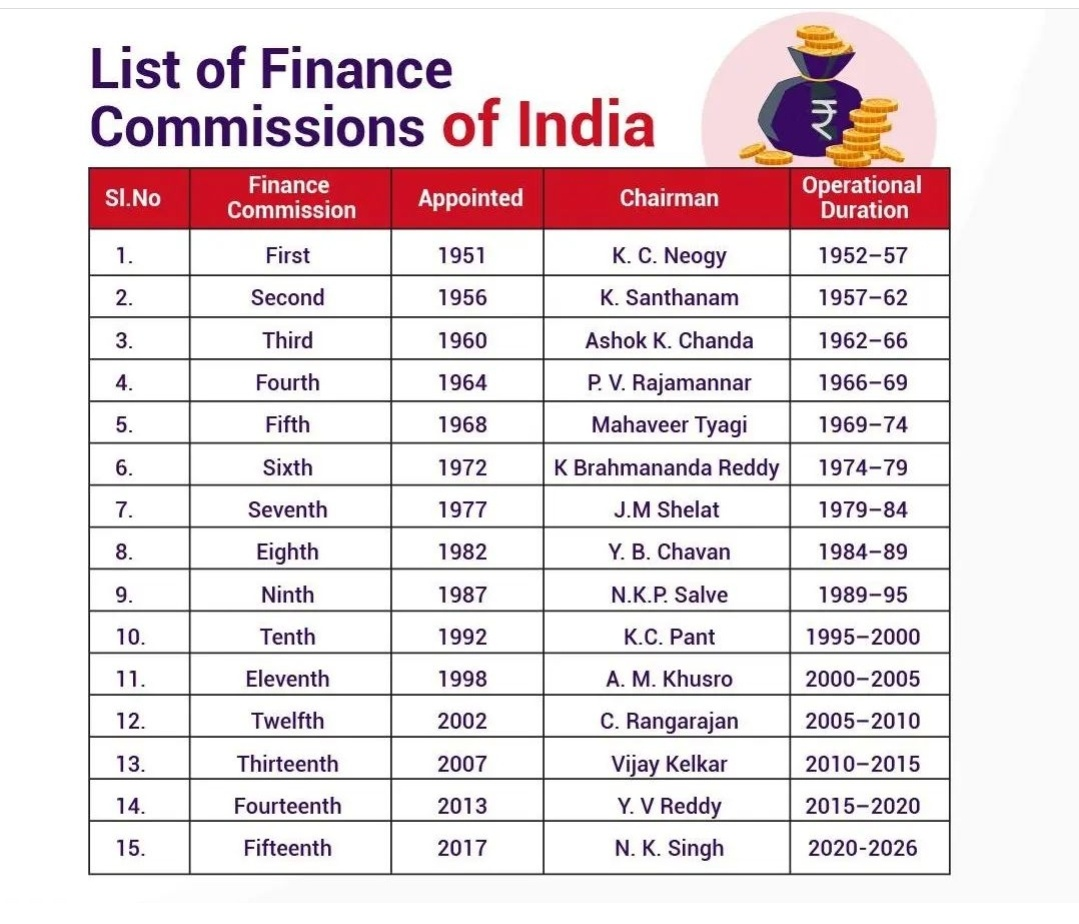
16th Finance Commission (2026–2031)
|
Criteria |
Weight (16th FC) |
Change from 15th FC |
|
Income Distance |
42.5% |
Reduced from 45% |
|
Population (2011) |
17.5% |
Increased from 15% |
|
Area |
10.0% |
Reduced from 15% |
|
Forest & Ecology |
10.0% |
Retained |
|
Demographic Performance |
10.0% |
Reduced from 12.5% |
|
Contribution to GDP |
10.0% |
NEW |
|
Tax Effort |
0% |
Removed (Was 2.5%) |
Key Recommendation 1: Vertical Devolution
The 16th FC recommended keeping the states' share of the central divisible tax pool at 41%, maintaining the 15th FC's status quo.
Key Recommendation 2: Horizontal Devolution
The 16th FC reformed the distribution criteria to address the historical grievance of Southern states, balancing need-based support with rewarding economic efficiency and population control efforts
Shift in Devolution Criteria: Rewarding Efficiency
The Commission introduced a new criterion, "State’s Contribution to GDP," and adjusted the weights of other parameters, shifting the formula to a hybrid "Need + Efficiency" model from a purely "Need-based" one.
|
Parameter |
Key Change by 16th FC |
Impact |
|
State's Contribution to GDP |
A new criterion introduced to reward states with higher economic output. |
Benefits industrially advanced states. |
|
Population & Demographic Performance |
Weights have been reworked to reduce the heavy reliance on the 1971 population data and better reflect current demographics without penalizing population control. |
Balances the needs of populous states with the achievements of states with lower fertility rates. |
Impact of New Formula
Major Recommendations on Fiscal Reforms
The 16th FC has proposed strict measures to improve the fiscal health of states, aligning with concerns raised by the Economic Survey and the RBI.
End Off-Budget Borrowings
Rationalize Subsidies with Sunset Clauses
Conclusion
The 16th Finance Commission has achieved a balancing act by rewarding economic efficiency, addressing Southern states' concerns, and maintaining fiscal support for states with greater needs.
Source: INDIANEXPRESS
|
PRACTICE QUESTION Q. How does the exclusion of Cesses and Surcharges from the divisible pool affect the spirit of cooperative federalism? 150 words |
The 16th Finance Commission (chaired by Arvind Panagariya) covers the five-year period from April 1, 2026, to March 31, 2031. The report was formally submitted to the President in November 2025, and tabled in Parliament on February 1, 2026.
The Commission introduced a new criterion—"State’s Contribution to GDP"—with a 10% weightage in the horizontal devolution formula. This rewards economically efficient states (including Southern states like Karnataka, Kerala, and industrial states like Gujarat, Haryana). Other changes included lowering the weight of area and increasing the weight of population to balance interests.
These are loans taken by state-owned entities or agencies rather than the government directly, with the state acting as a guarantor, often used to bypass fiscal deficit limits. The 16th FC has advised states to completely discontinue this practice, demanding all such borrowings be brought onto their budgets to ensure fiscal transparency.






© 2026 iasgyan. All right reserved