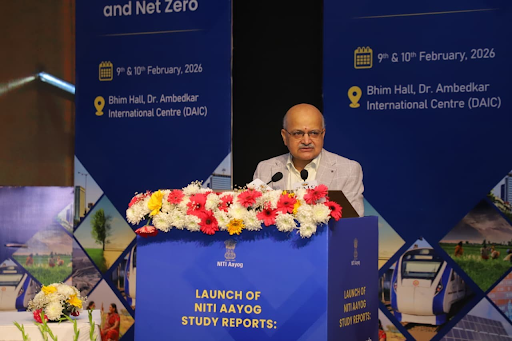
NITI Aayog’s report Scenarios Towards Viksit Bharat and Net Zero outlines a path to a $30 trillion economy by 2047 and Net Zero by 2070, requiring $22.7 trillion investment with a $6.5 trillion gap. It stresses renewable expansion, critical minerals security, and a just coal transition.
Copyright infringement not intended
Picture Courtesy: PIB
Context
NITI Aayog released 11 reports outlining pathways for India to become a $30 trillion developed nation (Viksit Bharat) by 2047 and achieve Net Zero emissions by 2070.
What are the Key highlights of NITI Aayog's "Viksit Bharat and Net Zero" Report?
Reports predict major structural changes in Indian economy, demography, and energy, with a core shift from a consumption-led to an investment-driven economy.
|
Parameter |
Baseline |
Projected Target |
|
GDP |
USD 4.18 trillion in 2025 |
USD 30 trillion by 2047 |
|
Urban Population Share |
37% in 2023 |
51% by 2047 and 65% by 2070 |
|
Share of Electricity in Final Energy |
21% in 2025 |
60% by 2070 (driven by EVs, induction cooking) |
|
Share of Fossil Fuels in Primary Energy |
87% in 2025 |
14% by 2070 |
|
Car Ownership (per 1,000 people) |
32 in 2025 |
200-250 by 2070 |
|
Air Conditioner (AC) Penetration |
10% in 2025 |
80% by 2070 |
The Energy Transition Blueprint
The transition to Net Zero is anchored in four key pillars: massive electrification, scaling up renewables and nuclear power, and phasing down fossil fuels with carbon capture technology.
Electrification as the Core: Electricity's share in final energy demand is set to triple by 2070, driven by the adoption of Electric Vehicles (EVs), electric cooking, and industrial heat pumps.
Renewable Energy Expansion: Solar and Wind capacity will need to scale from 164 GW in 2025 to over 6,000 GW by 2070.
Strategic Role of Nuclear Energy: Nuclear power capacity projected to expand from 8 GW to over 300 GW by 2070.
Phasing Down Fossil Fuels: Share of fossil fuels will reduce. Remaining usage in hard-to-abate sectors will depend on Carbon Capture, Utilisation, and Storage (CCUS) technology.
What are Challenges for India in Achieving Viksit Bharat and Net Zero?
The Financial Gap
Transition to net zero requires a cumulative investment of USD 22.7 trillion by 2070 (approx. USD 500 billion annually). Given current annual investments of USD 135 billion, there is a huge financing gap of USD 6.5 trillion requiring international capital.
Critical Mineral Security
India is heavily dependent on imports for Critical Energy Transition Minerals (CETMs) like Lithium, Cobalt, and Nickel, which are essential for EV batteries.
Technology Readiness
Key technologies like CCUS, Long-duration Energy Storage, and Small Modular Nuclear Reactors are still nascent and not yet proven at scale in India.
Infrastructure "Lock-in" Risk
Since 86% of the 2070 building floor space is yet to be built, there is a major risk of locking in high energy demand unless green building codes and super-efficient appliances are immediately mandated.
Just Transition Imperative
Over 150 districts are dependent on the fossil fuel economy. The transition will require massive reskilling and social protection for the 17 million workers in these sectors.
Water-Energy Nexus
Nearly 75% of India's renewable energy capacity is located in water-stressed states, creating potential conflicts between energy generation and water conservation.
Way Forward for India to achieve Viksit Bharat and Net Zero
Mainstream Behavioural Change
Systematically integrate Mission LiFE (Lifestyle for Environment) to moderate energy demand through sustainable consumption, public transport, and circular economy principles like Extended Producer Responsibility (EPR).
Strengthen Urban Mobility
Prioritize Transit-Oriented Development (TOD) by integrating land use with public transport (rail, metro) to reduce travel demand, rather than just replacing private cars with EVs.
Adopt a Green Industrial Policy
Use blended finance and public procurement to de-risk investments in emerging green technologies like Green Hydrogen and low-carbon cement.
Build Resilient Supply Chains
Enhance domestic exploration for critical minerals and empower institutions like KABIL (Khanij Bidesh India Ltd.) to acquire strategic overseas assets.
Implement a Just Transition Framework
Utilize funds like the District Mineral Foundations (DMF) and the Skill India Mission to finance reskilling and provide social safety nets for workers shifting from fossil fuel industries.
Strengthen Climate Finance Architecture
Establish a National Green Finance Institution and develop a unified Climate Finance Taxonomy to attract foreign capital and bridge the investment gap.
Leverage Digital Public Infrastructure
Create interoperable digital platforms for energy services, similar to UPI, such as a Unified Energy Interface (UEI) for EV charging, to enhance efficiency and accessibility.
Conclusion
NITI Aayog views India's Net Zero transition as a major developmental opportunity, not just an environmental duty. By blending economic growth with sustainability, India can create a new "Indian Development Model" for the Global South.
Source: PIB
|
Q. With reference to the NITI Aayog’s "Scenarios Towards Viksit Bharat and Net Zero" report, consider the following statements: 1. India aims to achieve Net Zero emissions by the year 2050. 2. The report suggests an immediate phase-out of coal to meet climate goals. Which of the statements given above is/are correct? A) 1 only B) 2 only C) Both 1 and 2 D) Neither 1 nor 2 Answer: D Explanation: Statement 1 is incorrect: NITI Aayog's "Scenarios Towards Viksit Bharat and Net Zero" report, released in February 2026, aligns the goal of a developed India by 2047 with achieving Net Zero emissions by 2070, not 2050. Statement 2 is incorrect: The report indicates that India's coal consumption is expected to increase until at least 2047, rather than suggesting an immediate phase-out. |
The goal is for India to transform into a developed economy with a GDP of $30 trillion by the year 2047, coinciding with the centenary of India's independence.
The report estimates a cumulative investment requirement of $22.7 trillion by 2070 to achieve Net Zero emissions.
A "Just Transition" is critical because over 150 districts in India, particularly in eastern states, depend on the fossil fuel economy. Moving away from coal without a safety net could lead to regional economic collapse and job losses.



© 2026 iasgyan. All right reserved