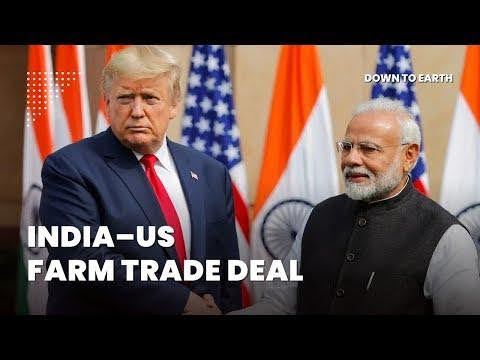
The India - United States farm trade understanding allows limited imports of sorghum and distillers’ dried grains to support India’s rapidly growing animal feed demand while retaining the ban on genetically modified maize and soyabean to protect domestic farmers and biosafety standards. As India’s feed industry, producing about 60 million tonnes and valued at over ₹1.7 lakh crore, faces rising demand and productivity constraints, the agreement aims to balance feed security and cost stability with agricultural self-reliance, though concerns remain over future import dependence and the need to strengthen domestic crop productivity.
Copyright infringement not intended
Picture Courtesy: Down to Earth
Amid rising demand for animal feed driven by increasing consumption of milk, eggs, meat and fish, India’s understanding with the United States has kept the ban on GM maize and soyabean but allowed limited imports of non-GM sorghum and DDGS. This creates a small entry point for US feed products, helping the domestic feed industry manage raw material shortages while cautiously protecting Indian farmers and the country’s GM policy stance.
|
Must Read: INDIA-U.S. RELATIONS | INDO-US TIES: ECONOMICS AND STRATEGY | INDIA US DEFENCE PARTNERSHIP | |
Key highlights of the India - US trade deal:
Selective Market Opening: India has agreed to limited market access for specific US agricultural feed products while avoiding a broad-based liberalisation of its sensitive farm sector.
Retention of GM Restrictions: India has maintained its regulatory position by continuing the ban on imports of genetically modified maize and soyabean, thereby safeguarding its precautionary approach toward GM crops.
Window for Alternative Feed Imports: The agreement permits the import of non-GM red sorghum and Distillers’ Dried Grains with Solubles (DDGS), creating a targeted entry point for US participation in India’s animal feed market.
Addressing Feed Supply Constraints: The limited opening is intended to help the domestic feed industry manage shortages, stabilise input prices, and support the growing demand for livestock, poultry and aquaculture products.
Protection of Domestic Agriculture: By restricting access to select products rather than core crops, India seeks to balance industry requirements with the need to protect farmer incomes and domestic production.
Strategic Trade Engagement: The arrangement reflects a calibrated bilateral approach that reduces trade friction with the United States while preserving policy autonomy in agriculture, food safety and biotechnology regulation.
India - US trade relations:
Record Growth in Bilateral Trade: Economic ties between India and the United States have strengthened significantly, with total bilateral trade reaching about USD 132 billion in FY25, marking a notable rise from the previous year and reflecting deepening commercial engagement.
Sustained Trade Surplus for India: India continues to enjoy a favourable trade balance with the US, recording a surplus of over USD 40 billion in FY25, highlighting the competitiveness of Indian exports in the American market.
Import Profile from the United States: India’s key imports from the US are concentrated in high-value and strategic sectors, including crude oil and petroleum products, precious stones and metals, industrial machinery, nuclear reactors, and electrical equipment, which support domestic manufacturing and energy needs.
Export Strengths to the US Market: India’s exports are driven by diversified sectors such as electrical and electronic goods, gems and jewellery, pharmaceuticals, engineering products, petroleum products, and iron and steel articles, indicating strong industrial and value-added capabilities.
Investment Partnership: The United States remains a major source of long-term capital, ranking among the top foreign investors in India, with cumulative Foreign Direct Investment inflows exceeding USD 70 billion between 2000 and 2025.
Strategic Economic Framework: To further deepen economic and strategic cooperation, the two countries launched the US-India COMPACT (Catalyzing Opportunities for Military Partnership, Accelerated Commerce and Technology) in 2025, under which the Mission 500 initiative aims to expand bilateral trade to USD 500 billion by 2030, supported by ongoing negotiations for a comprehensive Bilateral Trade Agreement (BTA).
Significance of the farm trade deal:
For India:
Managing feed demand pressures: The agreement allows limited imports of sorghum and DDGS, helping India address emerging shortages in feed ingredients as demand rises with the expansion of the dairy, poultry and aquaculture sectors.
Stabilising input costs: Access to additional feed sources can moderate price volatility in maize and protein substitutes, improving cost efficiency for the livestock and poultry industries and supporting overall food inflation management.
Supporting nutritional transition: By strengthening feed availability, the deal indirectly supports increased production of milk, eggs, meat and fish, aligning with India’s shift toward protein-rich diets.
Protecting domestic agriculture: India has retained its ban on genetically modified maize and soyabean, ensuring that farmer livelihoods, biosafety concerns and policy autonomy remain safeguarded.
Calibrated trade liberalisation: The selective opening reflects a cautious strategy—meeting supply gaps without exposing core crops to large-scale import competition.
For United States:
Access to a large emerging market: India’s rapidly expanding demand for animal feed offers significant long-term export potential for US agricultural products such as sorghum and DDGS.
Diversification beyond traditional markets: The deal helps the US reduce dependence on a limited set of buyers by expanding its presence in one of the world’s fastest-growing agricultural demand centres.
Building a strategic trade foothold: Even limited access allows US exporters to establish supply chains, industry linkages and market familiarity, which could support future negotiations for broader agricultural access.
Value addition through by-product exports: The export of DDGS, a by-product of ethanol production, strengthens the economic viability of the US biofuel industry by creating additional overseas demand.
Current status of feed market in India:
Challenges of the farm trade deal:
Way forward:
Conclusion:
The India–United States farm trade arrangement adopts a calibrated approach that addresses rising feed demand through limited and need-based imports while safeguarding domestic farmers and regulatory autonomy, but its long-term sustainability will depend on strengthening domestic productivity, improving feed crop resilience and ensuring that growing import dependence does not weaken farmer incomes or agricultural self-reliance.
Source: Down to Earth
|
Practice Question Q. India’s interim farm trade understanding with the United States reflects a calibrated approach to balancing feed security and farmer protection. Discuss. (250 words) |
India’s demand for animal feed is rising due to higher incomes, urbanisation and changing food habits, which are increasing the consumption of milk, eggs, meat and fish, thereby expanding the requirement for feed ingredients such as maize and protein meals.
India has permitted limited imports of non-genetically modified sorghum and distillers’ dried grains with solubles, which are used as energy and protein sources in the animal feed industry.
According to projections by the United States Department of Agriculture, India’s feed demand is expected to grow sharply in the coming decades, making it one of the fastest-growing markets for feed ingredients globally.


© 2026 iasgyan. All right reserved