Copyright infringement not intended
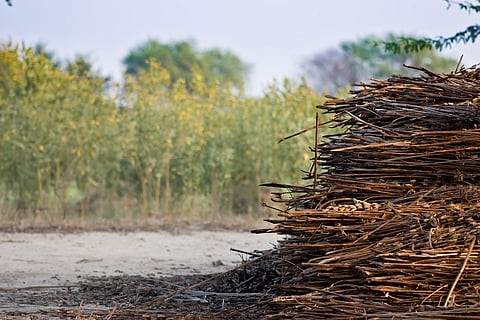
Picture Courtesy: Down to Earth
Context:
On 17 February 2026, the Press Information Bureau outlined India’s vision to transform agricultural waste into economic value, projecting a $2 trillion circular economy by 2050 and 10 million jobs.
What is circular economy in agriculture?
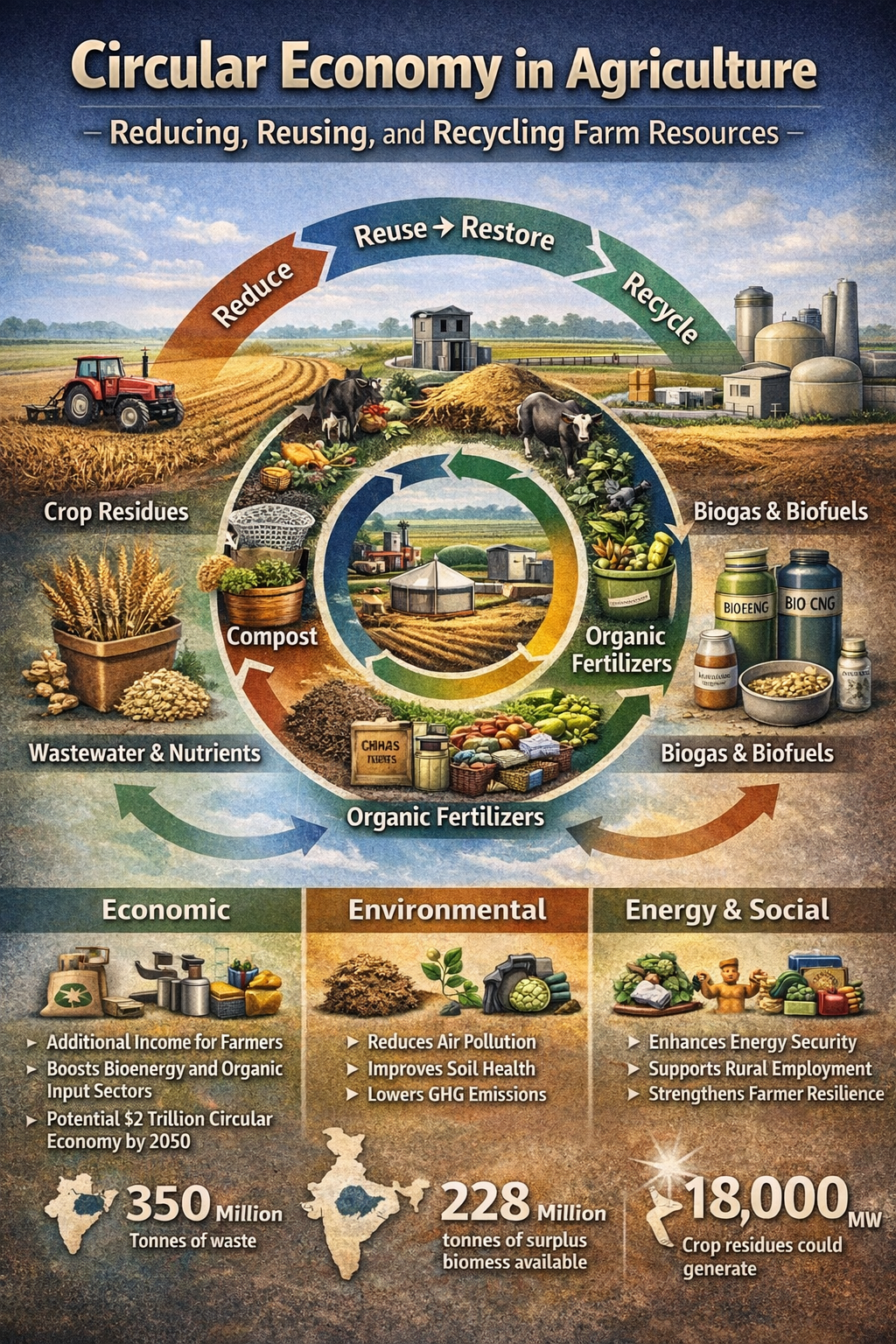
A circular economy in agriculture refers to a sustainable production system that seeks to minimise waste, optimise resource use, and regenerate natural systems by keeping materials and nutrients in continuous use. It focuses on reducing waste, reusing resources, recycling biological outputs, and converting agricultural residues into valuable products such as bioenergy, organic fertilisers, compost, animal feed, bio-based chemicals, and industrial raw materials.
Unlike the conventional linear model of agriculture i.e. produce, consume, and dispose, the circular approach promotes a regenerative model based on reduce, reuse, recycle, and restore. Crop residues, livestock waste, food waste, wastewater, and by-products from processing are reintegrated into the production cycle, thereby reducing environmental pollution and lowering dependence on synthetic inputs.
Current status of circular economy in agriculture:
- India generates nearly 350 million tonnes of agricultural waste annually, including crop residues, livestock waste, agro-processing by-products, and post-harvest losses.
- Crop residues alone have the potential to produce more than 18,000 megawatts of renewable power, indicating significant scope for clean energy generation.
- The country has an estimated 228 million tonnes of surplus biomass available each year that can be utilised for bioenergy, compressed biogas, biofuels, and other value-added products.
- Improper management of organic waste leads to the emission of methane, a greenhouse gas with a much higher global warming potential than carbon dioxide.
- Open burning of crop residues contributes to air pollution, soil nutrient loss, and adverse public health impacts.
- Agricultural waste is highly dispersed across small and fragmented landholdings, making large-scale collection and aggregation difficult.
- Waste generation is seasonal and region-specific, varying according to cropping patterns, harvest cycles, and agro-climatic conditions.
- The bulky and low-density nature of biomass increases the cost of storage, transportation, and processing.
Significance of circular agriculture for India:
Economic significance:
- India’s circular economy in agriculture has the potential to create a $2 trillion market by 2050, making it a major driver of green economic growth.
- It enables diversification of farmers’ income through the sale of crop residues, dung, and other agricultural by-products.
- The sector can accelerate the growth of bioenergy, compressed biogas, organic fertilisers, bio-based chemicals, and other green industries, creating new value chains in rural areas.
- It helps reduce post-harvest losses and improves resource efficiency, thereby enhancing overall agricultural productivity and profitability.
Environmental significance:
- Circular utilisation of crop residues helps reduce stubble burning, a major contributor to seasonal air pollution in northern India.
- Scientific waste management lowers greenhouse gas emissions, particularly methane from decomposing organic waste and open burning.
- Recycling biomass into compost, biochar, and organic manure helps restore soil health, improve soil organic carbon, and reduce dependence on chemical fertilisers.
- It supports sustainable water and nutrient management, reducing environmental degradation.
Energy security:
- Large-scale biomass utilisation can reduce dependence on coal and fossil fuels in power generation and industry.
- Promotion of indigenous bioenergy sources such as biomass power, biofuels, and compressed biogas strengthens India’s energy self-reliance.
- It contributes to the country’s renewable energy and climate commitments.
Social significance:
- The sector has the potential to create up to 10 million jobs across biomass collection, processing, logistics, and bio-based industries.
- It promotes rural entrepreneurship through decentralised waste-to-wealth enterprises, farmer producer organisations, and local energy units.
- By creating local economic opportunities, circular agriculture can help reduce rural distress and migration while strengthening the rural economy.
Key concerns in India’s circular agriculture transition:
Policy - implementation gap in biomass co-firing:
- Coal-based thermal power plants are mandated to undertake 5 per cent biomass co-firing, increasing to 7 per cent from FY 2025–26.
- The expected biomass demand is 55 million tonnes annually, but actual utilisation in FY 2024–25 was only 1.62 million tonnes, about 4 per cent of the requirement.
- Only 68 out of 191 thermal power plants have adopted co-firing, with implementation largely concentrated in Punjab, Haryana, and Uttar Pradesh, indicating uneven regional performance.
- Key challenges include weak biomass supply chains, poor pellet quality, limited torrefied pellet capacity, equipment compatibility issues, and uncertainty regarding the utilisation of environmental penalty funds.
Uncertainty in infrastructure utilisation:
- Despite large investments under schemes such as the Agriculture Infrastructure Fund, publicly available data remains limited regarding:
- The operational status of cold storage and processing facilities
- Actual capacity utilisation levels
- Measurable reduction in post-harvest losses
- This raises concerns about the effectiveness and outcomes of capital expenditure.
Narrow policy focus on stubble burning:
- Policy attention and public discourse remain largely centred on stubble burning, while other critical waste streams receive inadequate focus, including:
- Post-harvest losses during storage and transportation
- Food waste at retail and household levels
- Scientific management of animal carcasses
- Limited large-scale deployment of emerging technologies such as biochar and waste-to-soil solutions
Market Constraints
- The sector faces inherent challenges such as fragmented landholdings and the predominance of small farmers.
- Agricultural biomass is seasonal, scattered, and bulky, resulting in high costs for collection, storage, and transportation.
- Weak market linkages, price uncertainty for bio-products, and limited private sector participation further constrain scale and sustainability.
Major government framework for circular agriculture:
- Organic recycling: The Government has promoted waste-to-energy and nutrient recycling through the GOBARdhan programme, under which 979 biogas plants are operational across 4 per cent of districts. To strengthen market viability, compressed biogas has been integrated into carbon credit mechanisms, while standards under the Fertiliser Control Order have been simplified to facilitate the production and sale of organic manure.
- Crop residue management: To address crop residue burning and promote in-situ management, the Government has allocated ₹3,926 crore between 2018 and 2026. The initiative has led to the establishment of over 42,000 Custom Hiring Centres, along with the distribution of more than 3.24 lakh machines, including Happy Seeders and Super Straw Management Systems, to improve residue handling at the farm level.
- Post harvest infrastructure development: Under the Agriculture Infrastructure Fund, loans worth ₹66,310 crore have been sanctioned across over 1.13 lakh projects, mobilising large-scale investment in agricultural logistics. The supported infrastructure includes 2,454 cold storage units, 22,827 processing facilities, along with warehouses, grading, and value-addition centres aimed at reducing post-harvest losses.
- Livestock waste management: Circularity in the livestock sector is being promoted through the Animal Husbandry Infrastructure Development Fund, with a corpus of ₹15,000 crore to support investments in dung-to-biogas systems, manure management, and scientific disposal of animal waste.
- Water circularity in agriculture: Efforts to promote water reuse are being undertaken through Jal Shakti initiatives, which encourage the reuse of treated wastewater for irrigation, along with watershed development and groundwater recharge, thereby improving water efficiency and sustainability in agriculture.
Global best practices:
European Union: The Farm-to-Fork strategy promotes circularity by integrating food waste reduction, resource efficiency, and nutrient recycling across the entire agricultural value chain.
Brazil: Brazil has successfully developed large-scale biomass energy systems, particularly through the utilisation of sugarcane bagasse for power generation and industrial energy needs.
Netherlands: The Netherlands has adopted a model of circular agriculture based on nutrient recycling, precision farming, and efficient resource management, ensuring high productivity with minimal environmental impact.
Key measures for strengthening circular agriculture:
- Outcome based monitoring: There is a need to shift from expenditure-based tracking to outcome-oriented monitoring by measuring indicators such as crop residue utilisation rates, reduction in emissions, operational capacity of infrastructure, and improvements in farmer income.
- Strengthening biomass supply chains: The development of efficient supply systems requires support for biomass aggregation centres, decentralised pellet manufacturing units, and Farmer Producer Organisations, which can reduce logistics costs and ensure a steady supply of quality biomass.
- Effective use of environmental compensation: Environmental penalty funds collected for non-compliance should be earmarked for corrective action, including air pollution mitigation, strengthening biomass logistics, supporting local processing infrastructure, and providing incentives to farmers for residue collection.
- Expanding the scope beyond stubble: Circular agriculture policies should move beyond crop residue burning to address food waste across the supply chain, scientific management of animal waste and carcasses, and reduction of post-harvest losses through integrated and value-chain-based planning.
- Creating sustainable markets for bio-products: Long-term viability requires assured demand through mandatory procurement of bio-based products, along with strengthening carbon markets, green credit mechanisms, and price support systems to attract private sector participation.
Conclusion:
India’s circular agriculture vision is economically and environmentally compelling, but the gap between policy ambition and field-level implementation remains significant. Transparent monitoring, strong supply chains, and market-linked incentives will determine whether agricultural waste truly becomes rural wealth or remains an unrealised promise.
Source: Down to Earth
|
Practice Question
Q. India’s circular economy in agriculture reflects high policy ambition but faces serious implementation challenges. Discuss. (250 words)
|
Frequently Asked Questions (FAQs)
A circular economy in agriculture is a system that focuses on minimising waste and maximising resource efficiency by recycling crop residues, livestock waste, food waste, and by-products into useful outputs such as bioenergy, organic manure, animal feed, and bio-based products.
Circular agriculture is important because India generates large volumes of agricultural waste, which, if unmanaged, causes air pollution, greenhouse gas emissions, and resource loss. It also offers opportunities for additional farmer income, rural employment, renewable energy generation, and improved soil health.
Major initiatives include GOBARdhan for biogas and organic manure, the Crop Residue Management scheme, the Agriculture Infrastructure Fund, the Animal Husbandry Infrastructure Development Fund, and measures to promote biomass co-firing and wastewater reuse.