Carbon Capture, Utilisation and Storage (CCUS) is a key technology for reducing emissions from hard-to-abate sectors such as cement and steel, where carbon dioxide is released from core production processes. With budgetary support, indigenous research, and global cooperation, CCUS can help India balance industrial growth with climate commitments and move steadily towards its net-zero emissions target by 2070.
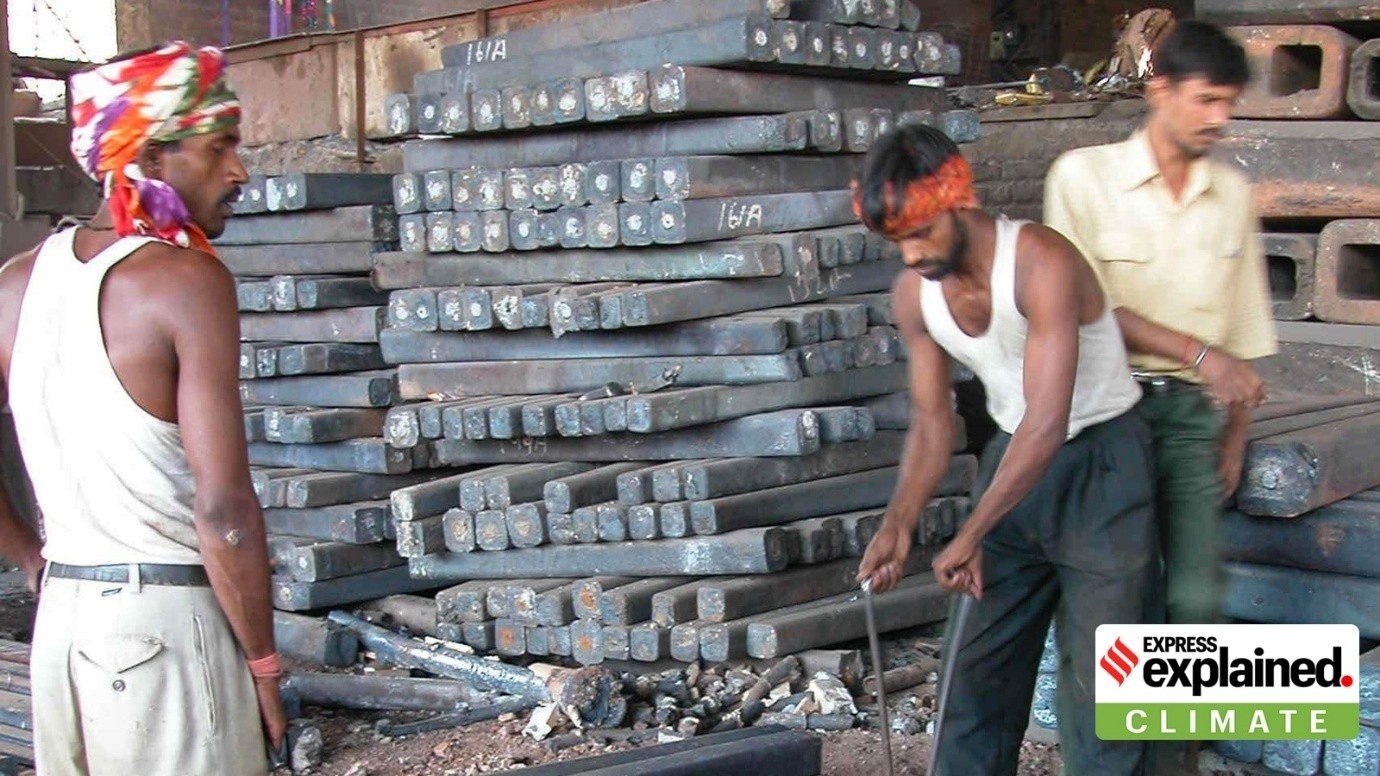
Copyright infringement not intended
Picture Courtesy: Indian Express
Union Budget’s allocated ₹20,000 crore for next five years on carbon capture, utilisation and storage (CCUS).
|
Must Read: CARBON CAPTURE AND STORAGE | CARBON CAPTURE UTILISATION TECHNOLOGIES | |
Carbon Capture, Utilisation and Storage (CCUS) is a group of technologies that aim to reduce greenhouse gas emissions by capturing carbon dioxide generated from industrial processes and power generation and either storing it safely underground or converting it into economically useful products.
Key Components of CCUS
Carbon Capture: Carbon dioxide is separated from exhaust gases released during activities such as cement manufacturing, steel production, power generation, refining, and chemical processing using chemical, physical, or advanced material-based techniques.
Carbon Transportation: The captured carbon dioxide is compressed and transported through pipelines, ships, or road-based systems to designated utilisation or storage sites in a controlled and monitored manner.
Carbon Utilisation: The captured carbon dioxide is reused as a raw material for producing chemicals, synthetic fuels, building materials, and other value-added products, thereby promoting a circular carbon economy.
Carbon Storage: Carbon dioxide is injected deep underground into suitable geological formations such as depleted oil and gas reservoirs or saline aquifers, where it can be securely stored for long durations.
Decarbonising hard-to-abate sectors: CCUS is essential for industries like cement and steel where a major portion of emissions arises from inherent chemical reactions rather than from fuel combustion alone.
Supporting climate commitments: CCUS plays a critical role in achieving long-term climate targets, including India’s net-zero emissions goal, as global mitigation pathways indicate that deep decarbonisation is not feasible without it.
Balancing growth and sustainability: CCUS enables continued industrial and infrastructure expansion while limiting the growth of carbon emissions, especially in developing economies.
Enhancing global competitiveness: The adoption of CCUS helps industries reduce carbon intensity and remain competitive in international markets facing carbon-related trade measures.
Government of India has allocated ₹20,000 crore over the next five years to support the development, demonstration, and scale-up of Carbon Capture, Utilisation and Storage (CCUS) technologies.
Rationale behind the budget support: The budgetary push for carbon capture reflects recognition that CCUS is essential for reducing emissions from sectors where decarbonisation through renewable energy alone is difficult, particularly in steel, cement, power, refineries, and chemicals. These industries contribute significantly to India’s CO₂ emissions and face challenges in cutting carbon because much of their emissions stem from process-related reactions rather than fuel combustion alone.
Bridging the technology gap: Although CCUS technologies have existed for decades, their large-scale deployment has been limited due to high costs, insufficient investment, and technical challenges in moving from lab-scale innovations to commercial applications. Many promising technologies developed through Indian research institutions require field testing, demonstration and scaling up to achieve readiness levels suitable for industrial adoption. The budget allocation is designed to provide this critical investment, helping technologies evolve from demonstration to commercial viability.
Supporting India’s climate goals: India has pledged to achieve net-zero emissions by 2070, a target that most global climate pathways indicate cannot be met without significant CCUS deployment. With emissions expected to grow in the near and medium term because of infrastructure and industrial expansion, CCUS becomes an important tool to balance economic growth with emissions reduction.
Economic and trade benefits: In addition to environmental gains, CCUS can help Indian industries remain competitive in global markets, particularly in regions implementing carbon-related trade measures such as the EU’s Carbon Border Adjustment Mechanism (CBAM). Lowering embedded carbon through CCUS adoption can reduce tariff risks and protect export competitiveness.
Institutional and Policy Framework
India has already begun laying the groundwork for CCUS deployment by:
The budgetary support aims to align public investment with these institutional efforts, fostering an ecosystem where research can translate into commercial solutions.
High cost of carbon capture: Carbon capture remains capital- and energy-intensive, with global estimates indicating capture costs ranging from $40 to $120 per tonne of CO₂, making large-scale deployment financially challenging without sustained public support or carbon pricing.
Energy loss: CCUS systems consume 15–30% additional energy in power and industrial plants, reducing overall efficiency and increasing operational costs, particularly in energy-intensive sectors like steel and cement.
Scaling from pilot to commercial level: Many CCUS technologies in India have proven successful at laboratory or pilot scale but face engineering and financial barriers when scaled to capture 100–500 tonnes of CO₂ per day, which is necessary for commercial viability.
Transport and storage infrastructure deficit: India currently lacks a dedicated CO₂ pipeline network, and large-scale storage requires extensive geological surveying, monitoring, and long-term infrastructure investment.
Storage safety and long-term liability: Concerns persist regarding potential CO₂ leakage, induced seismicity, and unclear responsibility for monitoring and liability over decades or centuries, discouraging private sector participation.
National CCUS research and development roadmap: The Department of Science and Technology (DST) has released a CCUS R&D roadmap up to 2030, identifying technological gaps, financing needs, and policy bottlenecks to accelerate indigenous development and deployment.
Establishment of Centres of Excellence: Dedicated Centres of Excellence on CCUS have been set up in leading scientific institutions to promote advanced research in capture materials, storage safety, and CO₂ utilisation pathways suited to Indian conditions.
Support for pilot and demonstration projects: The government has facilitated pilot-scale CCUS projects in cement, steel, and chemical plants to test feasibility, reduce costs, and improve technology readiness levels before large-scale commercial deployment.
Mapping of CO₂ storage potential: Government-supported scientific studies have identified potential geological storage sites, including depleted oil and gas fields and deep saline aquifers, to assess India’s long-term carbon storage capacity.
Global Initiatives:
It advises countries on designing regulatory frameworks covering CO₂ transport, storage rights, monitoring, reporting, verification (MRV), and long-term liability.
Carbon Capture, Utilisation and Storage is indispensable for decarbonising India’s hard-to-abate sectors such as steel and cement, where emissions arise from core production processes. With targeted budgetary support, supportive regulation, and learning from global case studies, CCUS can bridge the gap between economic growth and climate commitments, making it a key enabler of India’s net-zero by 2070 transition.
Source: Indian Express
|
Practice Question Q. Critically examine the role of Carbon Capture, Utilisation and Storage (CCUS) in India’s transition towards a net-zero economy. (250 words) |
CCUS is a set of technologies that capture carbon dioxide emitted from industrial processes or power generation and either store it underground or convert it into useful products to prevent its release into the atmosphere.
CCUS is crucial for India because emissions from sectors such as cement and steel arise largely from chemical processes, making them difficult to decarbonise through renewable energy alone.
While renewable energy reduces emissions by replacing fossil fuels, CCUS addresses emissions that cannot be avoided even when clean energy is used, especially in industrial manufacturing.




© 2026 iasgyan. All right reserved