The UNEP State of Finance for Nature 2026 report highlights a severe global imbalance in environmental finance, revealing that more than $30 is spent on activities that harm nature for every $1 invested in protecting it. Nature-negative financial flows reached around $7.3 trillion annually, while funding for nature-based solutions (NbS) stood at only $220 billion. Harmful subsidies for fossil fuels, industrial agriculture, and resource-intensive sectors continue to dominate global spending patterns. Although investment in NbS has shown modest growth and some decline in fossil fuel financing is visible, progress remains far too slow. UNEP warns that NbS funding must rise to at least $571 billion per year by 2030 to meet global climate, biodiversity, and land restoration targets. Without redirecting financial systems toward nature-positive investments, the triple planetary crisis of climate change, biodiversity loss, and pollution will intensify.

Copyright infringement not intended
Picture Courtesy: Down to earth
The UNEP report highlights a severe distortion in global financial flows, where for every $1 invested in protecting nature, more than $30 is spent on activities that harm it.
|
Must Read: NATURE- BASED SOLUTION | PLATFORM FOR URBAN NATURE-BASED SOLUTIONS | |
Key Highlights of the UNEP State of Finance for Nature 2026:
Nature-based solutions:
Nature-based Solutions are actions that protect, restore, or sustainably manage ecosystems in ways that address societal challenges such as climate change, biodiversity loss, disaster risk, water security, and human well-being.
Types of nature-based solutions:
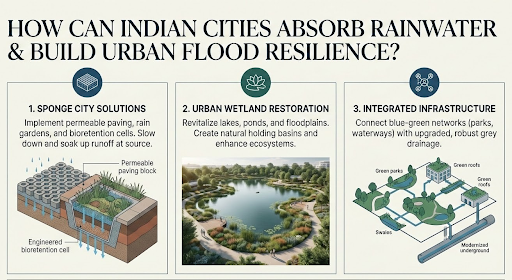
NbS include activities such as reforestation, afforestation, wetland and mangrove restoration, watershed management, agroforestry, urban green spaces, coral reef protection, and sustainable land and water management.
Challenges in Nature-based Solutions (NbS) finance:
Massive global finance imbalance: Despite global commitments, the world currently spends over $30 on nature-destructive activities for every $1 invested in nature protection, with annual nature-negative flows at around $7.3 trillion compared to $220 billion for NbS in 2023, a stark imbalance that undercuts efforts to shift capital toward NbS at the scale needed.
Enormous investment gap: To meet global biodiversity, climate and land-restoration targets, NbS investment must increase 2.5 times to about $571 billion per year by 2030, yet current funding is far below this level, representing only about 0.5 % of global GDP. This persistent financing gap is a core structural challenge.
Heavy dependence on public finance: Nearly 90 % of current NbS funding comes from public sources, while private investment remains very low (about $23.4 billion in 2023). This over-reliance on public budgets limits scale because government resources are finite and face competing development priorities.
Weak private sector participation: Private capital flows heavily into nature-negative sectors, and private investment in NbS is just around $23 billion, reflecting low private appetite due to perceived uncertain or long payback periods, lack of clear financial returns, and limited high-quality, bankable NbS projects.
Limited financial instruments: There is a lack of diversified financial instruments tailored to NbS needs (e.g., blended finance, impact bonds, risk-sharing mechanisms). Without innovative tools that can de-risk investments and attract institutional finance, scaling remains constrained.
Strategic challenges for India arising from low NbS finance:
Measures to scale up Nature-based Solutions (NbS):
Conclusion:
Scaling up finance for Nature-based Solutions is not merely an environmental priority but an economic and developmental necessity, as restoring ecosystems strengthens climate resilience, biodiversity, and long-term human well-being.
Source: Down to Earth
|
Practice Questions Nature-based Solutions are emerging as cost-effective tools to address climate change and biodiversity loss, yet remain severely underfunded. Examine. |
Nature-based Solutions are actions that protect, restore, or sustainably manage ecosystems to address challenges like climate change, biodiversity loss, water scarcity, and disaster risks while also supporting human well-being.
NbS contribute to climate mitigation by absorbing carbon in forests, soils, and wetlands, and support climate adaptation by reducing flood risks, preventing coastal erosion, and lowering urban heat.
Global investment in NbS remains far below what is needed, with spending on nature protection being vastly overshadowed by finance flowing into activities that harm ecosystems.



© 2026 iasgyan. All right reserved