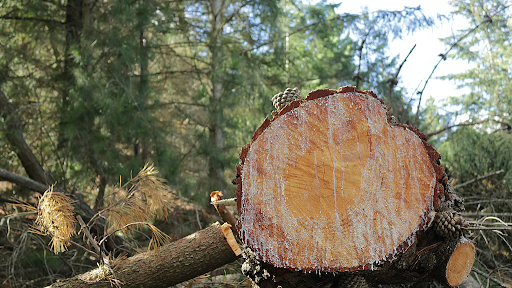
The amendment to the Van (Sanrakshan Evam Samvardhan) Adhiniyam allows private commercial plantations on forest land, exempt from NPV and CA, to support Make in India and the paper industry. However, it risks weakening forest protection, promoting monocultures, and clashing with Forest Rights Act safeguards.
Copyright infringement not intended
Picture Courtesy: DOWNTOEARTH
Context
The Union Ministry of Environment, Forests and Climate Change (MoEF&CC) notified an amendment to the Van (Sanrakshan Evam Samvardhan) Adhiniyam, 1980 — earlier known as the Forest Conservation Act, 1980 — granting direct access to forest land.
|
Read all about: FOREST RIGHTS ACT (FRA) EXPLAINED l FOREST CONSERVATION RULES 2022 l COMMUNITY FOREST RIGHTS (CFR): CHALLENGES AND WAY FORWARD |
What are the Key Changes introduced in the Forest Rules?
Exemption from Levies
Private companies setting up commercial plantations are now exempted from paying the Net Present Value (NPV) and charges for Compensatory Afforestation (CA). NPV is a mandatory fee for the loss of ecological services when forest land is diverted.
Reclassification of Activities
New rules classify afforestation and plantations by any organization, including private ones, as a "forestry activity." Previously, commercial plantations were considered a "non-forest activity," requiring stricter central government clearance.
Why Shift in Policy?
Addressing Industrial Needs: The paper and pulp industry faces a severe raw material deficit.
Boosting Economic Growth: The policy supports the 'Make in India' initiative by ensuring a steady supply of domestic raw materials, aiming to revive struggling mills and reduce the import bill.
Meeting Climate Commitments: The government frames this as a step towards achieving India’s climate goals, including:
Supporting Rural Livelihoods: The expansion of plantations is expected to create jobs and income for rural communities, building on existing agroforestry models that already involve an estimated 500,000 farmers.
What are the Major Environmental and Social Concerns?
While the industry has welcomed the move, environmentalists and social activists have raised several critical concerns.
|
Concern |
Explanation |
|
Environmental Concerns |
|
|
Social & Livelihood Concerns |
|
Way Forward
Robust Regulatory Framework
Government must create stringent guidelines to ensure plantations are restricted to genuinely degraded lands and establish a transparent mechanism for land identification.
Uphold Community Rights
Implementation must fully comply with the Forest Rights Act, 2006. The free, prior, and informed consent of the Gram Sabha must be a mandatory prerequisite.
Promote Ecological Restoration
Policy should incentivize mixed-species plantations using native trees to support biodiversity, rather than just monocultures.
Leverage Technology
Mandate the use of drones and satellite imagery for real-time monitoring to prevent encroachment and ensure compliance with environmental safeguards.
Prioritize Farm Forestry
Primary focus should remain on expanding industry-driven agroforestry models on private farmlands, which have a proven record of success without harming natural forests.
Learn from Global Best Practices
Sustainable Certification: Canada and Scandinavian countries use certification systems like the Forest Stewardship Council (FSC) to ensure forestry is ecologically sound, respects indigenous rights, and is economically viable.
Focus on Degraded Agricultural Land: Brazil boosted pulp industry by focusing plantations on degraded farmlands, not by clearing natural forests.
Community-Centric Forestry: Involving local communities in management and benefit-sharing, as a best practice, ensures social justice and leverages traditional knowledge.
Conclusion
Economic growth through raw material access for industry requires a balance with robust environmental safeguards, ecological restoration, and the protection of forest-dependent communities.
Source: DOWNTOEARTH
|
PRACTICE QUESTION Q. Which of the following best describes 'Net Present Value' (NPV) in the context of Indian forest laws? A) The total market value of timber present in a forest area. B) A one-time charge levied for diverting forest land based on the value of ecosystem services. C) The annual profit generated by a paper mill from forest-sourced raw materials. D) The cost incurred by the government for mandatory afforestation in urban areas. Answer: B Explanation: Net Present Value (NPV) refers to a mandatory one-time payment that a user agency must pay for diverting forest land for non-forest use (such as for industry, mining, or urban development) |
It allows private companies to use forest land for commercial plantations without paying two key environmental levies: the Net Present Value (NPV) and Compensatory Afforestation (CA) charges.
The Indian paper industry has been facing a chronic shortage of raw materials, leading to underutilization of its capacity and a heavy dependence on imports. This amendment aims to provide the industry with access to degraded forest lands to create a stable domestic supply of wood pulp.
NPV is a mandatory one-time payment made when forestland is diverted for non-forest purposes, intended to compensate for the loss of ecological services. Compensatory Afforestation (CA) is the requirement to afforest an equivalent area of non-forest land or double the area of degraded forest land to compensate for the diverted forest.



© 2026 iasgyan. All right reserved