India will host the first Global Big Cat Summit in 2026, reinforcing leadership in environmental diplomacy through the International Big Cat Alliance. The alliance promotes South-South cooperation to conserve seven big cat species, addressing habitat loss, conflict, and poaching through strong institutions, community-led conservation, and technology-driven solutions.
Copyright infringement not intended
Picture Courtesy: THEHINDU
Context
The Union Finance Minister announced that India will host the inaugural International Big Cat Summit, where ministers from 95 range countries will discuss joint conservation strategies.
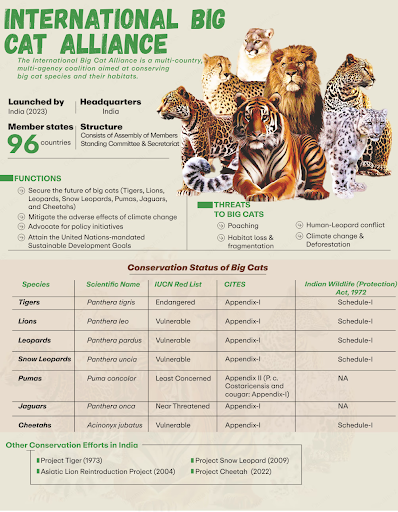
What is the International Big Cat Alliance (IBCA)?
Launch: Announced by the Prime Minister of India in April 2023, to commemorate 50 years of "Project Tiger".
Status: It became a treaty-based inter-governmental body in January 2025.
Objective: To create a global network for countries home to big cats to share knowledge, access resources, and implement joint conservation strategies.
Governance Bodies: It consists of an Assembly of Members (apex decision-making body meeting every two years), a Standing Committee, and a Secretariat.
Framework: The organization's statute is modeled after the International Solar Alliance (ISA).
Headquarters: New Delhi, India.
Funding: Government of India has committed an initial grant of ₹150 crore for the first five years (2023-28) (Source: PIB).
The Seven Big Cats
The alliance focuses on the conservation of the world's seven major big cats. Five of these species are found in India.
|
Big Cat Species |
Found in India? |
|
Tiger |
Yes |
|
Lion |
Yes (Asiatic Lion) |
|
Leopard |
Yes |
|
Snow Leopard |
Yes |
|
Cheetah |
Yes (Reintroduced from Africa) |
|
Jaguar |
No |
|
Puma |
No |
What is Environmental Diplomacy?
It is the practice of managing international relations through negotiation and communication to address shared ecological challenges that transcend national borders.
It serves as the intersection of environmental and foreign policy, where nations collaborate to protect global ecosystems while balancing their own national interests.
Core Objectives
Managing Global Commons: Cooperatively managing shared resources like the oceans, atmosphere, and biodiversity that no single nation owns.
Preventing Transboundary Harm: Addressing issues like air and water pollution that originate in one country but affect neighbors (e.g., acid rain disputes between the U.S. and Canada).
Promote Equity: Resolving the "Common but Differentiated Responsibilities" (CBDR) principle, which balances the historical responsibility of industrialised nations with the development needs of poorer countries.
Key Tools and Mechanisms
Multilateral Agreements (MEAs): Large-scale treaties such as the Paris Agreement (climate) and the Montreal Protocol (ozone layer).
Bilateral Pacts: Direct agreements between two nations, such as the Indo-Bhutan Green Grid Project or U.S.-China joint climate announcements.
Financial Diplomacy: Using mechanisms like the Green Climate Fund to help developing nations invest in sustainable infrastructure.
Science Diplomacy: Relying on authoritative data from bodies like the IPCC to inform political negotiations.
IBCA and India's Environmental Diplomacy
The IBCA is key to India's soft power and foreign policy, highlighting its global environmental commitment.
Major Challenges in Big Cat Conservation
Habitat Loss & Fragmentation
Unplanned urbanization, infrastructure, and agriculture lead to habitat isolation and increased human-wildlife conflict.
Human-Wildlife Conflict
Habitat loss pushes predators into human settlements, causing attacks on livestock and people, which often results in big cat retaliatory killings.
Poaching & Illegal Trade
Organized wildlife crime, driven by global demand for big cat parts (skin, bones) in traditional medicine and luxury goods.
Climate Change
Alters ecosystems and prey availability. For example, rising sea levels in the Sundarbans directly threaten the habitat of the Royal Bengal Tiger.
Way Forward
The success of the IBCA will depend on sustained, concrete actions by member nations.
Strengthen Institutional Frameworks
Strengthen the IBCA with a clear mandate, sustainable funding beyond India's initial grant, and compliance mechanisms
Promote Community-Centric Conservation
Transition from 'fortress conservation' to an inclusive model, empowering local communities as partners who benefit economically (e.g., through eco-tourism) from conservation efforts.
Leverage Modern Technology
Modernize monitoring and combat poaching using technologies like AI surveillance, satellite mapping, and DNA forensics.
Integrate Conservation with Development
Member nations must integrate biodiversity safeguards into their economic and infrastructure plans to prevent development from damaging wildlife corridors.
Conclusion
India cements its role as a proactive and responsible leader in global environmental governance by spearheading the International Big Cat Alliance while working to secure the future of big cat species
Source: THEHINDU
|
PRACTICE QUESTION Q. With reference to the International Big Cat Alliance (IBCA), consider the following statements: 1. It is a treaty-based inter-governmental body headquartered in New Delhi. 2. It aims to conserve all 15 species of wild cats found globally. 3. India has provided an initial support of ₹150 crore for its first five years. Which of the statements given above is/are correct? (a) 1 and 2 only (b) 2 and 3 only (c) 1 and 3 only (d) 1, 2 and 3 Answer: (c) Explanation: Statement 1 is correct: The International Big Cat Alliance (IBCA) is a treaty-based inter-governmental body that officially came into force on January 23, 2025. It is headquartered in New Delhi, India. Statement 2 is incorrect: The IBCA specifically focuses on the conservation of seven major big cat species: the Tiger, Lion, Leopard, Snow Leopard, Cheetah, Jaguar, and Puma. Statement 3 is correct: The Government of India has approved an initial budgetary support of ₹150 crore for the first five years (2023-24 to 2028-29) to fund its operations, infrastructure, and secretariat. |
The IBCA is a global coalition launched by India, which became a treaty-based inter-governmental body in January 2025. It aims to create a collaborative platform for 95 big cat range countries to conserve the world's seven major big cats through shared expertise and resources.
India is hosting the summit to showcase its leadership in environmental conservation, leveraging the success of initiatives like Project Tiger. It positions India as a leader of the Global South on environmental issues and uses conservation as a tool for soft power and diplomacy.
Launched in 1973, Project Tiger is a highly successful conservation program that has resulted in India hosting over 75% of the world's wild tiger population. Its success provides India with the credibility and a proven model of conservation to lead a global alliance like the IBCA.




© 2026 iasgyan. All right reserved