Airstrikes on Tehran’s oil facilities caused “black rain,” releasing toxic pollutants, PFAS, and carcinogens, creating severe health and environmental risks. The incident exposes gaps in international laws on environmental warfare and underscores the need for stronger legal safeguards, disaster preparedness, and diplomatic conflict resolution.
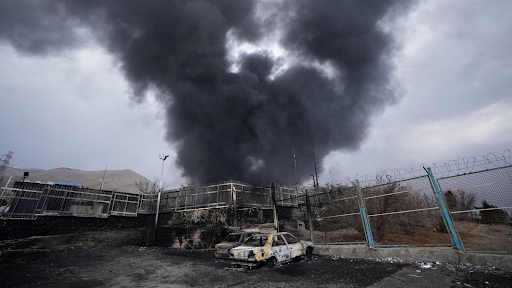
Copyright infringement not intended
Picture Courtesy: indianexpress
Airstrikes on Iran's oil facilities caused massive fires, releasing pollutants that led to "black rain" in Tehran, creating a severe public health and environmental crisis.
Black rain is precipitation contaminated with dark, toxic pollutants like soot, ash, and chemicals, often resulting from industrial fires, massive oil depot blazes, or nuclear explosions.
It appears black, is highly acidic, and causes severe health issues, including breathing difficulties, skin burns, and long-term cancer risks.
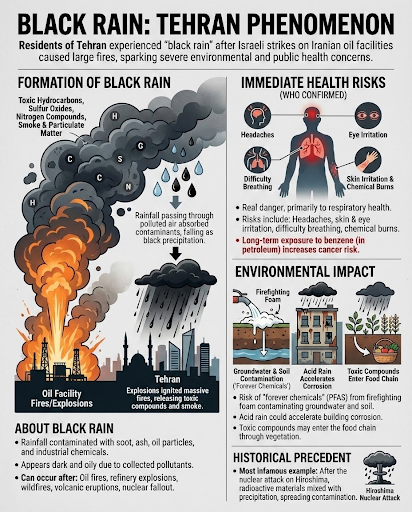
Massive Pollutant Release
The burning of oil storage facilities released a toxic mix into the atmosphere, including particulate matter (soot), hydrocarbons, sulfur oxides (SOx), and nitrogen oxides (NOx).
Atmospheric Interaction
The airborne pollutants were absorbed by moisture within the clouds.
Contaminated Precipitation
As rain formed and fell through the dense pollution plume, it collected the soot and oily particles, turning the rain dark, acidic, and toxic.
Impact on Public Health
Immediate Health Risks
Long-Term Health Risks
Environmental and Economic Impact
Soil and Water Contamination
Toxic soot and chemicals degrade soil fertility and can enter the food chain. Runoff pollutes rivers and groundwater, contaminating drinking water sources.
Acid Rain Formation
SOx and NOx react with atmospheric moisture to form acid rain. This damages crops, acidifies water bodies (killing aquatic life), and corrodes buildings and infrastructure.
Economic Disruption
Infrastructure destruction causes immediate economic damage. Long-term costs involve environmental cleanup, higher public healthcare spending, and agricultural losses.
|
Event |
Cause |
Key Environmental Impact |
Lesson Learned |
|
Hiroshima (1945) |
Atomic bombing |
Rain mixed with radioactive fallout ("black rain") spread deadly radiation far beyond the blast zone. |
Precipitation can expand the contaminated area of a disaster, magnifying its health impact. |
|
Kuwaiti Oil Fires (1991) |
Retreating Iraqi forces set over 600 oil wells on fire during the Gulf War. |
Fires burned for 7 months, causing black rain as far as the Himalayas and creating "tarcrete" (hardened oil and sand) that devastated the desert ecosystem. |
The environmental and health impacts of such events are widespread, long-lasting, and extremely expensive to mitigate. |
The black rain in Tehran is a stark warning that modern warfare can weaponize the environment, leaving behind long-lasting, toxic consequences.
Source: indianexpress
|
PRACTICE QUESTION Q. With reference to the phenomenon of 'Black Rain', consider the following statements:
Which of the statements given above is/are correct? (a) 1 only (b) 1 and 3 only (c) 2 and 3 only (d) 1, 2 and 3 Answer: (b) Statement 1 is correct: Black rain is a form of environmental fallout where precipitation becomes contaminated with soot, ash, and radioactive isotopes (or other toxins like heavy metals/chemicals). Statement 2 is incorrect: The phenomenon was not first documented following the 1984 Bhopal Gas Tragedy. It is historically associated with the 1945 nuclear attack on Hiroshima. Statement 3 is correct: It can be caused by both nuclear detonations (as in Hiroshima) and large-scale industrial or oil facility fires (as in Tehran, 2026, or the Gulf War, 1991). |
Black rain is precipitation that has been contaminated with pollutants like soot, ash, and oily chemicals released into the atmosphere from large-scale events like industrial fires or explosions. The raindrops collect these particles, turning them dark and often acidic.
It was a direct result of airstrikes on Iran's oil storage and refining facilities. The massive fires released a dense plume of soot, hydrocarbons, and other pollutants into the atmosphere, which then mixed with falling rain.
'Ecocide' refers to unlawful or wanton acts committed with knowledge that there is a substantial likelihood of severe and either widespread or long-term damage to the environment being caused by those acts. There is a growing international movement to have it recognized as a crime under the Rome Statute, similar to genocide.

© 2026 iasgyan. All right reserved