Scientists discovered Trachischium lalremsangai, a new worm-eating snake species, in Mizoram's Murlen National Park and Myanmar. Named after herpetologist H.T. Lalremsanga, this underground snake highlights the rich, unexplored herpetofauna of the Indo-Burma biodiversity hotspot.
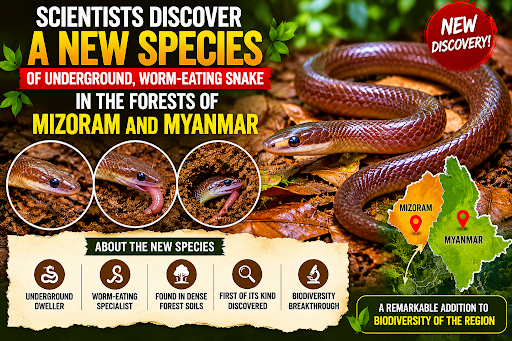
A new species of underground, worm-eating snake, Trachischium lalremsangai, has been discovered in Mizoram and Myanmar.
Scientists discover a new species of underground snake in the dense forests of Mizoram and Myanmar, they named the snake after Professor Hmar Tlawmte Lalremsanga, a herpetologist at Mizoram University.
The species belongs to the genus Trachischium, which scientists commonly refer to as slender snakes or worm-eating snakes.
It falls under the family Colubridae and subfamily Natricinae.
Species of this genus generally inhabit the mountain regions of northeast India, the Himalayas, Bangladesh, Bhutan, China, and Nepal.
Key Features
Climate & Eco-System
Flora & Plant Life
Fauna & Wildlife
Source: THEHINDU
|
PRACTICE QUESTION Q. Consider the following statements about the recently discovered Trachischium lalremsangai:
Which of the statements given above is/are correct? A) 1 only B) 2 only C) Both 1 and 2 D) Neither 1 nor 2 Answer: B Explanation: Statement 1 is incorrect: Trachischium lalremsangai is a harmless, non-venomous, burrowing snake (fossorial) rather than an arboreal, highly venomous species. It was recently discovered in Mizoram (Murlen National Park, near the Indo-Myanmar border), not the Western Ghats. Statement 2 is correct: The snake belongs to the genus Trachischium, which is a group of slender, "worm-eating" snakes (Natricinae family) known to inhabit Northeast India and the Himalayas. |
It is a newly discovered species of underground, slender, worm-eating snake belonging to the family Colubridae.
It was found during an expedition in Murlen National Park near the Mizoram-Myanmar border, with a second specimen identified from Chin State, Myanmar.
It is a non-venomous, fossorial (underground) snake that primarily survives by eating worms.





© 2026 iasgyan. All right reserved