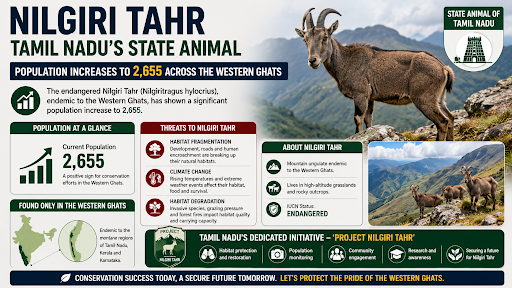
The endangered Nilgiri Tahr, Tamil Nadu's state animal, has seen a population increase to 2,655 across the Western Ghats. Despite this success, habitat fragmentation and climate change severely threaten these mountain ungulates, prompting Tamil Nadu's dedicated 'Project Nilgiri Tahr'
Why In News?
Recent synchronized surveys have recorded a rise in the endangered Nilgiri Tahr population across the Western Ghats, highlighting the early success of conservation efforts like 'Project Nilgiri Tahr'.
What is the Nilgiri Tahr?
The Nilgiri Tahr (Nilgiritragus hylocrius) is an endangered mountain ungulate endemic to southern India.
The species holds the title of the State Animal of Tamil Nadu.
Sangam literature refers to the animal as Varudai or Varaiaadu, translating to "cliff goat".
Physical characteristics feature a stocky build, short, coarse yellowish-brown fur, and a bristly mane.
Adult males undergo a color transformation to dark brown or black and develop a distinctive silvery-grey patch on their backs, earning them the name "saddlebacks".
Both males and females possess backward-curving horns, which uniquely develop growth rings that indicate the animal's exact age.
Full-genome sequencing reveals the species shares closer genetic ties to sheep (Ovis) than to standard goats.
Habitat
Geographic Distribution of Nilgiri Tahr
Key Findings of the 2026 Survey
The Tamil Nadu and Kerala Forest Departments executed a synchronized double-observer survey.
Surveyors recorded a population of 1,364 Nilgiri Tahrs in Tamil Nadu, marking a 4.68% increase from the 2025 count.
The combined population across Tamil Nadu and Kerala recorded at 2,655 individuals, representing the highest numbers in recent decades.
The Anamalai Hills dominate the distribution, holding 44.87% of Tamil Nadu's total population, followed by the Nilgiris landscape at 29.25%.
The demographic data indicates a healthy male-to-female ratio of 55:100 and a female-to-young ratio of 100:66.
Field staff deployed 'Varudai', an Android-based mobile application, to ensure real-time data collection, precise GPS coordinates, and standardized reporting.
Conservation Status
IUCN Red List: Classified globally as an Endangered species.
Wildlife Protection Act (1972): Accorded the highest protection under Schedule I.
Key Threats: The species faces extreme vulnerability to habitat fragmentation, encroachment by exotic invasive plants (like Eucalyptus, wattle, and Lantana), climate change, forest fires, and historical poaching.
Source: INDIANEXPRESS
|
PRACTICE QUESTION Q. Consider the following statements regarding the Nilgiri Tahr:
Which of the statements given above is/are correct? A) 1 and 2 only B) 2 and 3 only C) 1 and 3 only D) 1, 2, and 3 Answer: A Explanation: Statement 1 is correct. The Nilgiri Tahr (Nilgiritragus hylocrius) is the official state animal of Tamil Nadu. It is also the only mountain ungulate (hoofed mammal) found in southern India among the 12 species present across the country. Statement 2 is correct. This species is endemic to the southern part of the Western Ghats, specifically inhabiting the high-altitude montane shola-grassland ecosystems. Statement 3 is incorrect. The Nilgiri Tahr is listed as 'Endangered' (EN) on the IUCN Red List, not 'Critically Endangered'. It is protected under Schedule I of the Wildlife (Protection) Act, 1972. |
The Nilgiri Tahr is classified as endemic because it natively inhabits only the tropical montane grasslands and Shola forests located within a narrow 400-kilometre stretch of the Southern Western Ghats.
Launched by the Tamil Nadu government, Project Nilgiri Tahr is India’s first dedicated, long-term conservation initiative focused on restoring the fragmented habitats, monitoring populations, and exploring reintroduction strategies for this endangered state animal.
Kerala's Eravikulam National Park shelters the highest density and single largest surviving population of Nilgiri Tahrs in the wild.




© 2026 iasgyan. All right reserved