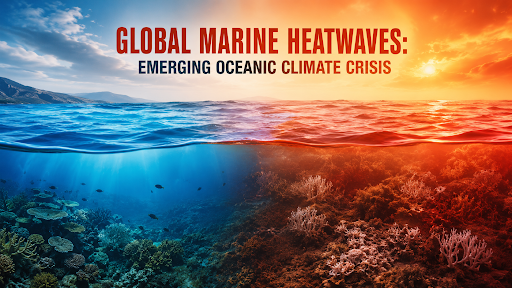
Marine heatwaves are prolonged periods of extreme ocean temperatures driven by anthropogenic global warming and phenomena like El Niño. They threaten marine biodiversity, supercharge tropical cyclones, disrupt global food security, and demand urgent climate adaptation and mitigation strategies.
Why In News?
According to the Copernicus Climate Change Service (C3S), Global sea surface temperatures reached a record 20.86ºC in June 2026, fueling marine heatwaves that now affect 82% of the world's oceans.
What are Global Marine Heatwaves?
Marine heatwaves (MHWs) represent prolonged periods of exceptionally high ocean temperatures persisting over specific regions for days, weeks, or months.
Oceans absorb over 90% of excess heat generated by global warming. Over the last decade, MHWs increased by 50% in frequency and occur at 10 times the intensity of pre-industrial levels. (Source: IUCN).
Scientists monitor these events to assess climate impacts, protect marine biodiversity via thermal thresholds, support fisheries management, and improve forecasting for coastal infrastructure
Why are Global Marine Heatwaves a Growing Concern?
Climate Regulation: Severe ocean stratification creates a density barrier that traps heat in the top 300 meters, preventing the exchange of deep cold water and disrupting global weather.
Biodiversity Loss: MHWs trigger habitat compression, behavioral shifts, and mass mortalities across marine taxa.
Food Security: Heat stress diminishes "blue food" systems, causing massive losses in aquaculture and threatening coastal livelihoods.
Extreme Weather: MHWs supercharge tropical cyclones, increasing maximum wind speeds by 20% and contributing to a 60% rise in billion-dollar disasters.
Economic Impact: Heat-intensified events, such as Hurricane Milton ($60 billion in damages), devastate coastal infrastructure.
Monsoon Disruption: In the Indian Ocean, basin-wide MHWs weaken monsoon winds, suppressing rainfall over central India while enhancing it in the south.
What are the Key Drivers of Marine Heatwaves?
Global Warming: Persistent greenhouse gas emissions raise the baseline temperature of the upper ocean.
El Niño Events: The transition into the El Niño phase acts as a massive atmospheric heat source, driving MHW development in the Pacific and Indian Oceans.
Circulation Changes: Reduced surface winds limit evaporative cooling, allowing solar radiation to overheat the surface.
Reduced Heat Exchange: Increased stratification blocks vertical mixing, preventing colder deep water from cooling the surface.
Natural Variability: Patterns like the Monsoon Intraseasonal Oscillation (MISO) interact with background warming to trigger MHW onset.
What are the Major Impacts of Marine Heatwaves?
Coral Bleaching: Thermal stress forces corals to expel symbiotic algae, triggering NOAA Bleaching Alert Levels 3-5.
Species Migration: Marine life migrates poleward or into deeper waters, disrupting food webs and facilitating invasive species.
Fisheries Decline: Sustained heat causes rapid die-offs of economically vital species like lobsters, crabs, and scallops.
Ecosystem Disruption: Extreme events cause regional mass extinction of foundational habitats like kelp forests and seagrass meadows.
Ocean Deoxygenation: Higher temperatures reduce oxygen solubility while increasing the metabolic rates of marine life, creating hypoxic zones.
What are the Major Challenges Associated with Marine Heatwaves?
Monitoring Gaps: Scarcity of high-resolution in-situ data forces reliance on satellite estimates that may miss deep-water or benthic heatwaves.
Non-linear Climate Jumps: The climate system exhibits unpredictable temperature spikes, signaling a loss in the ocean's historical buffering capacity.
Static Conservation: Existing Marine Protected Areas (MPAs) fail to accommodate species shifting habitats dynamically.
Scientific Uncertainty: Debates regarding measurement baselines (fixed vs moving climatologies) complicate political communication.
Forecasting Limits: Models struggle to predict the rapid intensification of cyclones passing over MHW patches.
What Institutional, Legal and Policy Frameworks Address Marine Heatwave Risks?
UNFCCC: The primary international treaty driving global negotiations to cut greenhouse gas emissions to mitigate the root cause of marine thermal extremes.
Paris Agreement: Binds nations to limit global warming to 1.5°C above pre-industrial levels, a threshold required to prevent the total functional extinction of coral reefs.
Sustainable Development Goal 14: Focuses on the conservation and sustainable use of the oceans, targeting the reduction of ocean acidification and marine pollution.
UN Decade of Ocean Science: A collaborative framework ensuring robust scientific research fully supports national efforts in sustainable ocean management through 2030.
Targeted Alert Systems: Global initiatives like NOAA Coral Reef Watch utilize advanced satellite products to provide near-real-time actionable intelligence, guiding emergency interventions such as coral relocation
What Measures Can Help Address Marine Heatwaves?
Reducing Greenhouse Gas Emissions: Reducing greenhouse gas emissions remains the only definitive method to halt rising baseline temperatures.
Expanding Marine Protected Areas: Designing adaptive protected areas helps safeguard climate refugia.
Strengthening Ocean Observation Networks: Deploying advanced machine learning models and comprehensive satellite arrays to forecast rapid cyclone intensification and MHW onset with higher accuracy.
Sustainable Fisheries: Implementing adaptive quota management allows populations to recover during active MHWs.
Active Emergency Interventions: Employing rapid response protocols—like shading vital nursery reefs or moving rare corals to land-based facilities during Alert Level 5 events.
Conclusion
Preventing marine ecosystem collapse requires the global community to integrate urgent, deep emission cuts with localized, science-based adaptive conservation.
Source: DOWNTOEARTH
|
PRACTICE QUESTION Q. "Marine heatwaves are emerging as a major manifestation of climate change with far-reaching ecological and economic consequences." Discuss. (250 Words, 15 Marks) |
A marine heatwave is an extended period of exceptionally high regional ocean temperatures that can last from days to years, impacting both surface and deep waters across all latitudes and ecosystems.
Anthropogenic global warming has relentlessly elevated the baseline temperature of the ocean. This excess heat ensures that natural climate variations routinely push temperatures past extreme thermal thresholds, leading to a 50% increase in MHW frequency over the past decade.
The oceans absorb approximately 90% of the trapped atmospheric heat generated by human-induced greenhouse gases. Extreme ocean stratification is trapping this immense heat specifically within the top 300 meters, preventing standard cooling dynamics.
MHWs induce physiological stress, habitat destruction, and mass mortality in commercially vital species (like crabs and scallops). They also disrupt complex marine food webs and force widespread species migration, triggering immense economic losses for coastal aquaculture and wild-catch fisheries.

© 2026 iasgyan. All right reserved