At the Bonn climate talks, India and the EU clashed over "climate tipping points." India cautioned against oversimplifying complex, uncertain science and undefined terminology, while the EU alleged misinformation. Understanding these non-linear climate thresholds is critical for UPSC aspirants.
Why In News?
During the Bonn climate talks, India urges the global community to exercise caution and demand greater clarity regarding the definition of "climate tipping points."
What are Climate Tipping Points?
It is a critical threshold where a segment of the earth’s climate system shifts into a new, often irreversible state.
Crossed thresholds trigger mechanisms that resist reversal on human timescales; for example, Arctic sea ice melt exposes dark ocean surfaces that absorb more heat, which further accelerates melting.
Tipping points do not follow the linear pace of greenhouse gas accumulation, as small temperature increases can trigger massive, self-amplifying feedback loops.
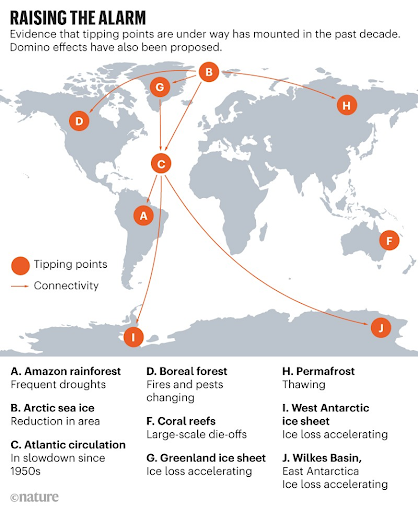
Identified risks include Amazon rainforest dieback, Atlantic Meridional Overturning Circulation (AMOC) collapse, coral reef mass-bleaching, monsoon shifts in India and West Africa, and Greenland ice sheet disintegration.
Reliable forecasting remains limited by climate system complexity and inherent data uncertainty, often restricting confirmation to post-facto historical analysis.
Major Climate Tipping Points
The major climate tipping points are broadly categorized into the Cryosphere (ice and snow), the Biosphere (ecosystems), and Ocean/Atmospheric Circulation.
The Cryosphere (Ice and Snow)
Greenland Ice Sheet: Rapid melting due to warming temperatures risks an irreversible collapse. A full melt would cause a global sea-level rise of over 7 meters, directly threatening coastal communities worldwide.
West Antarctic Ice Sheet: Scientists warn this ice sheet is highly vulnerable to destabilization. Collapse could take centuries, but it would lock in several meters of irreversible global sea-level rise
Permafrost Collapse: Vast areas of frozen soil in the Arctic are undergoing abrupt thawing. This releases massive quantities of trapped carbon dioxide and methane, creating a self-amplifying warming feedback loop.
Ocean and Atmospheric Circulation
AMOC (Atlantic Meridional Overturning Circulation): The AMOC is a vital ocean current system that distributes heat from the tropics to the North Atlantic. Freshwater influx from melting ice disrupts this system, which alters global weather patterns, weakened rainfall, and drastically lower temperatures in Northwest Europe.
The Biosphere (Ecosystems)
Amazon Rainforest Dieback: Deforestation combined with rising temperatures and prolonged droughts is pushing the Amazon toward a threshold where it could transition into a dry savanna. This would release billions of tons of stored carbon into the atmosphere.
Coral Reef Dieback: Warm-water coral reefs are highly sensitive to thermal stress. Scientists warn that even a 1.5°C increase above pre-industrial levels is pushing reefs past their thermal thresholds, leading to widespread bleaching and die-offs.
Scientific Uncertainties and Modeling Challenges
AMOC Uncertainty: Scientists struggle to predict exact collapse timelines; a Science Advances study suggests a 51% slowdown by 2100 under medium-emissions scenarios rather than an outright collapse.
Model-Dependent Findings: Projections often rank the credibility of competing models rather than forecasting a single outcome, as uncertainty remains embedded in the underlying data.
Amazon Complexity: Current projections often understate Amazon dieback risks by ignoring non-climate factors like cattle-ranching and deforestation, while also overlooking the social consequences for millions of tribal and urban residents.
Abruptness Disputes: Some researchers contest the "abrupt" nature of these events, noting that processes like ice sheet depletion can span thousands of years.
Source: THEHIND
|
PRACTICE QUESTION Q. Which of the following best describes 'non-linear climate responses' in the context of tipping points? A) Climate impacts increase at the exact same pace as greenhouse gas emissions. B) A small change in temperature triggers a large, self-amplifying feedback loop. C) The climate system perfectly reverses to its original state once carbon emissions drop to zero. D) Climate disruptions only occur in a linear progression across specific geographic zones. Answer: B Explanation: In the context of the climate system, a "tipping point" occurs when a critical threshold is crossed, causing the system to shift abruptly and often irreversibly into a new state. Unlike a linear response, where impacts scale proportionally with emissions, a non-linear response means that a relatively small push or temperature rise can trigger a massive, runaway, self-sustaining feedback loop (such as the collapse of an ice sheet or the dieback of the Amazon rainforest). |
Climate tipping points refer to critical thresholds beyond which small changes in the climate system trigger large, self-amplifying, and potentially irreversible environmental transformations.
They are crucial because crossing these thresholds carries risks vastly greater than routine climate disasters. However, they complicate negotiations due to scientific uncertainties and debates over how to allocate resources to prevent "abrupt" versus "slow" changes.
At the Bonn Climate Conference, India urged care and clarity in using the term, highlighting "definitional challenges." India cautioned against miscommunicating or oversimplifying the complex science, warning that unclear terminology hinders robust climate action.
Highly vulnerable ecosystems include the Amazon rainforest (risk of dieback into a savannah), Arctic sea ice, coral reefs (risk of mass bleaching), the Atlantic meridional overturning circulation (AMOC), and the Greenland and Antarctic ice sheets.



© 2026 iasgyan. All right reserved