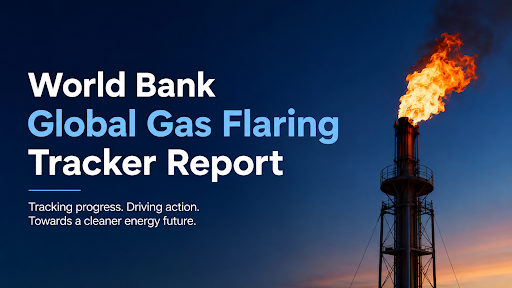
The 2026 World Bank Global Gas Flaring Tracker Report reveals a three-year surge in gas flaring, reaching 167 bcm in 2025 and wasting $54 billion. This highlights the urgent global need for infrastructure, stringent regulation, and immediate climate action.
Why In News?
The World Bank's 2026 Global Gas Flaring Tracker Report reveals a surge in global gas flaring to 167 billion cubic metres (bcm) in 2025, representing the highest level since 2019.
What is Gas Flaring?
Gas flaring is the controlled burning of natural gas that emerges during crude oil extraction when operators lack sufficient infrastructure to capture, process, or transport the gas.
Objectives of Flaring
Key Findings of the 2026 Global Gas Flaring Tracker Report
Three-Year Consecutive Rise: Global gas flaring rises to 167 bcm in 2025 (a 6% increase from 2024), marking the highest recorded level in six years and outpacing the 3.3% growth in global oil production.
Concentration of Emissions: Nine countries account for 83% of global flaring while producing only 46% of the world's oil.
Massive Economic Losses: The global oil and gas industry wastes gas worth nearly $54 billion in 2025 alone.
Why is Reducing Gas Flaring Important?
Climate Change Mitigation: Halting flaring removes industrial greenhouse gases, directly supporting Paris Agreement targets by avoiding 429 million tonnes of carbon dioxide equivalent (CO2e) emissions generated in 2025.
Methane Emission Reduction: Inefficient flares release 50 million tonnes of CO2e in the form of unburned methane, which traps over 80 times more heat than carbon dioxide over a 20-year period.
Energy Security Enhancement: The 167 bcm flared globally exceeds the 112 bcm of liquefied natural gas (LNG) that transited the Persian Gulf in 2025. Capturing this gas replaces expensive imports, such as in Iraq, which flared 24 bcm while importing high-cost gas.
Resource Conservation: The flared volume matches the entire annual gas consumption of the African continent, preventing the irrevocable loss of finite fossil fuels.
Sustainable Development Goals (SDGs): Reducing flaring supports SDG 7 (Affordable and Clean Energy) and SDG 13 (Climate Action). The wasted gas can generate 4 billion kilowatt-hours of electricity, bridging the energy deficit for 655 million people globally.
Environmental and Economic Impacts of Gas Flaring
Greenhouse Gas Emissions: Flaring releases short-lived climate pollutants like black carbon and methane, accelerating global warming and creating localized urban heat islands.
Air Pollution and Health Risks: Toxic byproducts like sulfur dioxide, carbon monoxide, benzene, and polycyclic aromatic hydrocarbons contaminate local air.
Loss of Electricity Generation: Flaring squanders potential baseload power. In Sub-Saharan Africa, widespread power outages are associated directly with a 13.5% reduction in employment, which captured flare gas can resolve.
Reduced Economic Efficiency: Eliminating global routine flaring requires an upfront capital investment of $70–100 billion, which represents less than twice the $54 billion annual value of the wasted gas.
Adverse Effects on Local Communities: Flaring triggers acid rain that corrodes infrastructure, leaches soil nutrients, and collapses aquatic ecosystems. The Izombe flaring site in the Niger Delta documented a 100% loss in crop yield within 200 meters of the station due to thermal pollution and toxic fallout.
Global Initiatives to Reduce Gas Flaring
Zero Routine Flaring by 2030 Initiative: Launched in 2015 by the World Bank and the United Nations, this initiative secures commitments from governments and oil companies to phase out routine gas flaring by 2030.
Global Flaring and Methane Reduction Partnership (GFMR): The World Bank's GFMR provides catalytic grant funding, policy advisory, and technical assistance to developing countries to deploy gas capture technologies.
Paris Climate Agreement Commitments: Nations embed flaring reduction targets into their Nationally Determined Contributions (NDCs).
Global Methane Pledge: This initiative targets a 30% reduction in global methane emissions by 2030, addressing unburned methane from inefficient flares.
Measures to Accelerate Global Flaring Reduction
Strengthening Regulatory Frameworks: Governments must enforce strict limits and severe financial penalties. The Government of India issued the Petroleum and Natural Gas Rules, 2025, capping gas flaring at 0.5% of a field's monthly production and enforcing fines up to ₹25 lakh for non-compliance.
Expanding Gas Capture Infrastructure: Public-private partnerships must build pipelines. The United States reduced flaring volumes by 7% in 2025 by commissioning the Matterhorn Express pipeline in the Permian Basin.
Increasing Investments in Clean Energy Technologies: Operators must invest in gas-to-power projects, reinjection wells for enhanced oil recovery, and modular small-scale Liquefied Petroleum Gas (LPG) units.
Enhancing International Cooperation: Global stakeholders must standardize emissions data. The integration of advanced Visible Infrared Imaging Radiometer Suite (VIIRS) satellite data by the Colorado School of Mines and the World Bank ensures accurate tracking of operator compliance.
Integrating Methane Reduction into Energy Policies: Governments must treat associated gas as a critical transition fuel, integrating its capture into national decarbonisation and energy security master plans.
Conclusion
Eradicating global gas flaring demands infrastructural investments, regulatory enforcement, and political will to transform $54 billion of wasted emissions into a catalyst for energy security and sustainable development.
Source: DOWNTOEARTH
|
PRACTICE QUESTION Q. Consider the following statements regarding the "Zero Routine Flaring by 2030" (ZRF) initiative: 1. It was launched jointly by the World Bank and the United Nations in 2015. 2. Under the initiative, all endorsing countries successfully reduced their gas flaring volumes to zero in 2025. 3. Nine countries currently account for more than 80% of global gas flaring volumes. Which of the statements given above is/are correct? A) 1 and 2 only B) 2 and 3 only C) 1 and 3 only D) 1, 2, and 3 Answer: C Explanation: Statement 1 is correct. The "Zero Routine Flaring by 2030" (ZRF) initiative was launched in 2015 by the United Nations Secretary-General and the World Bank President. Statement 2 is incorrect. The initiative commits endorsing countries to end routine flaring no later than 2030, not 2025. Global gas flaring did not reach zero in 2025; instead, flaring volumes increased in 2024 and 2025, reaching their highest levels since 2007. Statement 3 is correct. According to the 2026 Global Gas Flaring Tracker Report (covering 2025 data), the top nine flaring countries (Russia, Iran, Iraq, the United States, Venezuela, Algeria, Libya, Mexico, and Nigeria) accounted for 83% (which is more than 80%) of global gas flaring volumes. Previous reports from 2024 estimated this share at approximately 75–76%, but the most recent data confirms it has surpassed 80%. |


© 2026 iasgyan. All right reserved