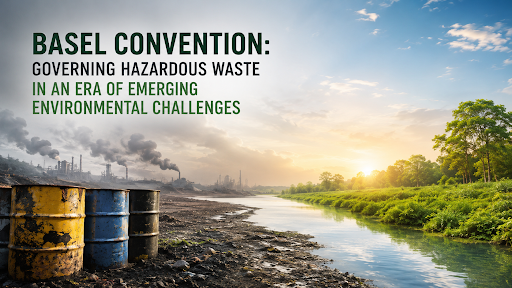
The Basel Convention regulates the transboundary movement and environmentally sound management of hazardous wastes. Evolving frameworks like the 2025 e-waste amendments, the 2025-2031 strategic framework, and plastic waste protocols tackle emerging challenges such as waste colonialism, plastic pollution, and illegal dumping.
Why In News?
The Open-ended Working Group (OEWG-15) meeting advances Basel Convention guidelines on e-waste, textiles, and hazardous substances, but faces division over expanding its scope to plastic and ship recycling.
What is the Basel Convention?
It is a legally binding international treaty regulating the transboundary movement, disposal, and environmentally sound management of hazardous and other wastes.
Origin: Adopted in 1989, and effective since 1992, the treaty emerged following global outrage over toxic waste dumping in developing nations.
Membership: The treaty unites 191 member parties, though the United States remains a notable non-signatory.
Objectives
Minimize Generation: Demands that states reduce hazardous waste at the source based on social and economic feasibility.
Regulate Trade: Restricts transboundary movement to cases where the exporting state lacks technical disposal capacity.
Ensure environmentally sound waste management (ESM): Guarantees that waste disposal protects human health and the environment.
Prevent Illegal Dumping: Defines deliberate dumping as "illegal traffic" and mandates domestic criminalization.
Regional Cooperation: Supports technology transfer via Basel Convention Regional and Coordinating Centres (BCRCs).
Why is the Basel Convention Important for Global Environmental Governance?
Prevents Waste Colonialism: Combats the structural phenomenon where industrialized nations offshore environmental costs to the Global South.
Protects Human Health: Restricts toxic elements like Polyvinyl chloride (PVC) and Polystyrene (PS) to prevent exposure to carcinogens and hormone-disrupting chemicals.
Promotes Sustainable Management: Obligates parties to verify operational capacity and environmental compliance certifications before approving imports.
Synergistic Governance: Functions alongside the Rotterdam and Stockholm Conventions to manage the full lifecycle of chemicals.
Empowers Enforcement: Grants customs departments the legal authority to inspect, detain, and repatriate illegal waste shipments.
What are the Key Features of the Basel Convention?
Prior Informed Consent (PIC): Requires exporting states to obtain explicit written consent from importing and transit countries before shipments proceed.
Classification Annexes: Uses Annex VIII for hazardous wastes (e.g., lead-acid batteries) and Annex IX for non-hazardous wastes (e.g., clean plastic B3011).
ESM Principle: Mandates the use of approved recovery operations (Annex IV) and prohibits rudimentary open-burning or crude landfilling.
Basel Ban Amendment: Prohibits all exports of hazardous waste from Annex VII nations (OECD, EU, Liechtenstein) to non-Annex VII developing countries.
Customs Integration: Aligns the Harmonized Commodity Description and Coding System (HS Codes) with Basel categories to flag controlled wastes at borders.
What Emerging Waste Challenges are Being Addressed Under the Convention?
Electronic Waste: Implements strict PIC procedures for all e-waste to eliminate "repairable goods" trafficking.
Textile Waste: Targets the influx of contaminated, unwearable synthetic clothing by proposing its inclusion in Annex II.
Hazardous Industrial Waste: Extends scrutiny to PFAS (Per- and Polyfluoroalkyl Substances) and Medium-chain chlorinated paraffins (MCCPs).
Plastic Waste: Enforces the 2019 Plastic Waste Amendments, categorizing mixed plastics under Annex II (Y48).
Vehicles and Batteries: Drafts technical guidelines for the chemical risks posed by lithium-ion batteries and waste pneumatic tires.
What are the Major Challenges Associated with the Basel Convention?
Illegal Trade: Criminal syndicates exploit fraudulent documentation and routing hubs, with e-waste trafficking valued at up to USD 19 billion annually. (Source: UNEP)
Weak Enforcement: Developing nations often lack the financial manpower and inter-agency coordination to audit shipping containers.
Volume Surge: Global e-waste reached 62 billion kg in 2022, with formal recycling rates stagnant at 22.3%. (Source: Global E-waste Monitor)
Geopolitical Fractures: Petroleum-producing nations argue that Basel mandates conflict with WTO rules and the UN Global Plastics Treaty.
Downcycling: Mechanical recycling in developing nations often results in toxic microplastic sludge and residual hazardous waste.
What Institutional, Legal and Policy Frameworks Complement the Basel Convention?
Stockholm Convention: Eliminates Persistent Organic Pollutants (POPs); COP-12 (2025) added Chlorpyrifos and LC-PFCAs (a forever chemical) to its list.
Rotterdam Convention: Manages the trade of hazardous commercial chemicals via a parallel PIC mechanism.
India’s Domestic Rules: Localizes commitments through the Hazardous Wastes (Management and Handling) Rules, 2016, and robust Extended Producer Responsibility (EPR) frameworks for plastics.
Hong Kong Convention: Addresses hazardous waste on maritime vessels, integrated into Indian law via the Recycling of Ships Act, 2019.
What Measures Can Strengthen Global Waste Governance?
Digital Monitoring: Adopts mandatory GPS container tracking and unified electronic movement documents.
Circular Economy: Mandates eco-design and phases out "toxic two" polymers like PVC and Polystyrene.
Technology Transfer: Mobilizes financial resources from developed nations to build sound management infrastructure in developing states.
Unified Enforcement: Synchronizes the Basel, Rotterdam, Stockholm (BRS) Conventions with the upcoming Global Plastics Treaty for full lifecycle traceability.
Total Phase-out: Expands the Basel Ban Amendment to include all plastic and e-waste exports to non-OECD countries.
Conclusion
The Basel Convention serves as the primary defense against toxic waste colonialism. However, effectively managing modern threats like e-waste and microplastics necessitates a shift from trade regulation toward strict upstream production limits and comprehensive circular economic systems.
Source: DOWNTOEARTH
|
PRACTICE QUESTION Q. Consider the following statements regarding international environmental conventions: 1. The Rotterdam Convention utilizes the Prior Informed Consent (PIC) mechanism to govern transboundary movement of hazardous waste. 2. The Stockholm Convention regulates the international trade of specific commercial chemicals and pesticides. 3. The Basel Ban Amendment prohibits the export of hazardous wastes from OECD countries to non-OECD developing countries. Which of the statements given above is/are correct? A) 1 and 2 only B) 3 only C) 2 and 3 only D) 1, 2, and 3 Answer: B Explanation: Statement 1 is incorrect: The Rotterdam Convention utilizes the Prior Informed Consent (PIC) mechanism. However, it governs the transboundary movement and international trade of specific hazardous commercial chemicals and pesticides, not hazardous waste. Statement 2 is incorrect: The Stockholm Convention aims to eliminate or restrict the production, use, and release of Persistent Organic Pollutants (POPs)—not commercial chemicals in general. The international trade of specific commercial chemicals and pesticides is primarily managed by the Rotterdam Convention. Statement 3 is correct: The Basel Ban Amendment (an amendment to the Basel Convention) strictly prohibits the export of hazardous wastes from OECD and European Union countries to non-OECD developing countries. |
The Basel Convention is a global multilateral treaty established in 1989 (enforced in 1992) designed to strictly regulate the transboundary movement, trade, and environmentally sound disposal of hazardous and other specific wastes, preventing the exploitation of developing nations.
PIC is the fundamental regulatory procedure of the Basel and Rotterdam Conventions requiring that an exporting country formally notify and receive explicit written permission from the importing country's competent authorities before a hazardous waste or chemical shipment can commence.
As of January 1, 2025, the Convention strictly mandates that all forms of electronic waste—even those previously classified as non-hazardous (Y49)—must undergo the rigorous Prior Informed Consent procedure, ensuring that e-waste shipments are not illegally disguised as "repairable" goods to bypass customs.
Plastic waste is highly contentious because the massive volume generated globally overwhelms downstream recycling capacities. While the 2019 Basel amendments brought contaminated plastics under the PIC procedure, heavy plastic-producing nations argue against stricter waste trade limits, citing economic necessity and overlaps with the ongoing UN Global Plastics Treaty negotiations.


© 2026 iasgyan. All right reserved