The Gaganyaan mission establishes India's human spaceflight capability by sending astronauts to Low Earth Orbit. Validated through rigorous tests like SOLVE, it enhances national prestige, drives technological innovation, and lays the foundation for the upcoming Bharatiya Antariksh Station.
Why In News?
ISRO successfully conducted the first ground static test of the Sub-Orbital Launch Vehicle for Experiments (SOLVE) solid motor, validating crucial safety parameters.
What is the Gaganyaan Mission?
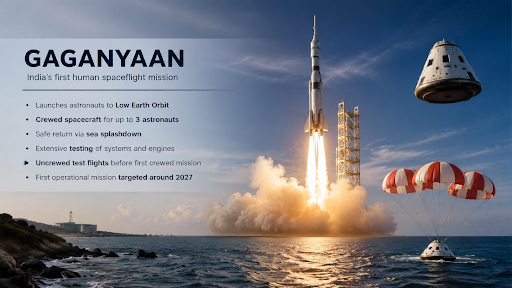
Gaganyaan is India's first human spaceflight mission, deploying a crew of three Gaganyatris into a 400 km Low Earth Orbit (LEO) for a three-day mission and returning them safely via a sea splashdown.
Objectives
What is SOLVE?
Sub-Orbital Launch Vehicle for Experiments (SOLVE)
SOLVE acts as a compact, solid-motor test platform specifically engineered to execute Integrated Parachute Tests for the Gaganyaan programme.
ISRO modifies the solid stage from the Polar Satellite Launch Vehicle (PSLV) strap-on motor, incorporating a slow burn-rate propellant and a straight nozzle with secondary injection thrust vector control.
Role in Crew Safety Validation
Crew Module Recovery Systems: The vehicle carries the Crew Module to an altitude of 10 to 17 km to simulate atmospheric re-entry.
Parachute Deployment Mechanisms: The platform initiates the deployment of a 10-parachute sequence, verifying the deceleration system's structural stability before splashdown.
Deceleration Technologies: The tests validate the transition from free-fall velocities to safe landing speeds under various extreme mission conditions.
Human-Rated Mission Safety Systems: The vehicle provides immense operational flexibility, ensuring that safety systems endure worst-case scenarios without risking the actual heavy-lift rocket.
What are the Key Components of the Gaganyaan Mission?
Crew Module: The Crew Module operates as a fully autonomous, 5.3-tonne habitat featuring an Earth-like pressurized environment, human-centric interfaces, and an apex cover housing redundant parachute systems.
Service Module: The Service Module weighs 2.9 tonnes and houses the Service Module Propulsion System (SMPS), equipped with liquid apogee motors and reaction control thrusters to perform orbit circularization and attitude control.
Human-Rated Launch Vehicle: The HLVM3 (Human-Rated LVM3) features a three-stage propulsion core (solid, liquid, cryogenic) modified with advanced safety parameters, capping acceleration at 4 Gs to guarantee astronaut comfort.
Crew Escape System: The Crew Escape System (CES) integrates five quick-acting solid motors designed to instantly propel the Crew Module away from the launch vehicle during pad or mid-flight emergencies.
Source: THEHINDU
|
PRACTICE QUESTION Q. Consider the following statements regarding the Sub-Orbital Launch Vehicle for Experiments (SOLVE): 1. It is designed to carry the Gaganyaan Crew Module to an altitude of 10 to 17 km to test the 10-parachute deceleration system. 2. Its solid stage is derived from the Geosynchronous Satellite Launch Vehicle (GSLV) liquid propulsion stage. Which of the statements given above is/are correct? (a) 1 only (b) 2 only (c) Both 1 and 2 (d) Neither 1 nor 2 Answer: a Explanation: Statement 1 is correct: The Sub-Orbital Launch Vehicle for Experiments (SOLVE) is designed by ISRO as a dedicated test platform for the Gaganyaan mission. Its primary purpose is to lift the Gaganyaan Crew Module to an altitude between 10 to 17 km, where it will separate to test the recovery and deceleration system involving a carefully choreographed sequence of 10 parachutes before a safe splashdown. Statement 2 is incorrect: The solid propulsion stage of the SOLVE vehicle is not derived from the GSLV liquid propulsion stage. Instead, it is modified and derived from the Polar Satellite Launch Vehicle (PSLV) solid strap-on booster motor. The modifications include the formulation of a slow-burning solid propellant, a straight nozzle configuration, and a secondary injection thrust vector control system. |



© 2026 iasgyan. All right reserved