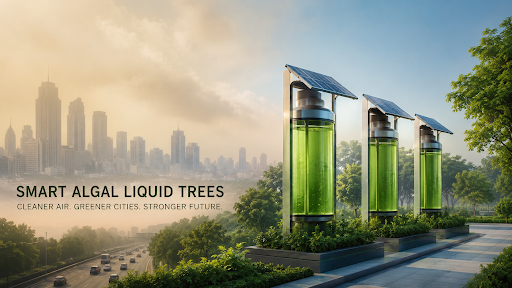
Smart Algal Liquid Trees (SALT) are mobile, microalgae-based photobioreactors designed to absorb carbon dioxide and release oxygen in space-constrained cities. Developed by CSIR-CIMFR, they offer a highly efficient, space-saving technological solution to urban air pollution, complementing traditional green infrastructure.
Why In News?
The Council of Scientific and Industrial Research-Central Institute of Mining and Fuel Research (CSIR-CIMFR) deployed India’s first mobile Smart Algal Liquid Tree (SALT) in Dhanbad and Singrauli.
What is a Smart Algal Liquid Tree (SALT)?
SALT functions as a compact, self-contained mobile photobioreactor that utilizes microalgae suspended in water to sequester carbon dioxide and release pure oxygen.
Working Principle: The system mirrors natural photosynthesis by using a pressure pump to pull polluted ambient air into a transparent water tank containing microalgae, such as Chlorella vulgaris, which produces oxygen and biomass.
How Does SALT Technology Work?
Photosynthetic Efficiency: Microalgae capture sunlight via integrated solar panels, demonstrating 10 to 50 times greater photosynthetic efficiency than conventional terrestrial trees.
Carbon Sequestration: A single 600-liter unit achieves the carbon fixation equivalent of two 10-year-old mature trees or 200 square meters of lawn, absorbing up to 1.5 tons of CO2 annually.
Air Quality Improvement: Pilot installations demonstrate a 15-20% reduction in particulate matter and a 90% CO2 reduction in the immediate microenvironment.
Smart Monitoring: The device integrates IoT smart sensors to track air quality, CO2 concentration, temperature, and humidity in real-time, supported by solar-powered LED lighting for 24/7 operation.
Why Consider SALT for Urban Areas?
Limited Green Space: Concretized Indian cities lack the open land and pristine soil required for traditional afforestation.
Rapid Urbanization: Population growth triggers the Urban Heat Island (UHI) effect, leaving cities vulnerable to toxic vehicular and industrial emissions.
Climate Mitigation: Cities account for 75% of global CO2 emissions, with many Indian cities reporting pollution levels 10 times higher than World Health Organization (WHO) safety guidelines.
Infrastructure Integration: Planners install SALT units at bus terminals, metro stations, and traffic intersections, where they function dually as street furniture, including benches and charging points
|
Supporting Sustainable Urban Development Smart City Alignment: Liquid trees align with the Smart Cities Mission by combining renewable energy with IoT environmental monitoring. Circular Economy: Technicians convert harvested biomass into third-generation biofuels and fertilizers. Wastewater Treatment: The system extracts excess phosphorus and nitrogen from water, acting as a natural bio-filter. Climate Resilience: The enclosed system operates independently of rainfall and soil quality, providing localized cooling to mitigate the UHI effect. |
Potential Advantages of SALT Technology
Resilience: Microalgae maintain carbon absorption even when pollution thresholds stunt conventional trees.
Optimized Design: An optimized wavy-bottom photobioreactor captures 24% more CO2 than standard cylindrical designs.
Space Efficiency: A cluster of 10-15 units occupies less than 20 square meters, making it ideal for heavily paved zones.
Educational Value: Schools and universities utilize these units as live tools to teach biotechnology and sustainability.
Limitations of SALT Technology
Ecological Constraints: SALT acts as a technological fix and cannot support biodiversity, soil conservation, or natural habitats like real trees.
Financial Costs: A single unit costs approximately INR 40,000, with annual maintenance requiring 10-15% of the initial investment for nutrient replacement and sensor inspection.
Operational Requirements: The system requires continuous energy for pumps and aeration, and active cooling mechanisms to prevent microalgae mortality in temperatures exceeding 35°C.
Management Challenges: Operators must manage biomass removal to prevent clogging and ensure precise nutrient dosing to avoid water contamination.
Way Forward
Pilot Projects: The government must establish experimental clusters in high-AQI cities like Delhi, Mumbai, and Pune to measure real-world efficacy.
Policy Integration: Municipal corporations should incorporate bioreactors into official urban greening master plans under the National Clean Air Programme (NCAP).
Research Focus: Scientists must develop climate-resilient microalgal strains capable of surviving extreme Indian summer heat.
Public-Private Partnerships: The government should incentivize private startups to scale manufacturing and utilize Corporate Social Responsibility (CSR) funds for deployment.
Holistic Approach: Urban planners must mandate natural afforestation alongside technological fixes to ensure comprehensive ecological restoration.
Conclusion
Smart Algal Liquid Trees (SALT) offer a revolutionary, space-saving technological bridge to mitigate severe urban air pollution, provided they complement rather than replace holistic ecological restoration and traditional afforestation.
Source: BUSINESS-STANDARD
|
PRACTICE QUESTION Q. "Technological innovations alone cannot solve urban environmental challenges, but they can complement nature-based solutions." Discuss . (250 Words, 15 Marks) |
SALT is a mobile, enclosed photobioreactor that uses microalgae suspended in water to absorb CO2 and release oxygen, mimicking the functions of a tree in space-constrained urban areas.
It pulls polluted air into the tank where microalgae use photosynthesis to sequester carbon dioxide, filter particulate matter, and release pure oxygen back into the environment.
While highly efficient at carbon capture, Liquid Trees cannot replace natural forests because they do not support biodiversity, prevent soil erosion, or provide natural habitats for wildlife.
SALT requires a fraction of the space, functions in highly polluted zones where plants struggle, requires no soil, operates 24/7 using solar power, and fixes carbon 10 to 50 times faster than terrestrial trees.

© 2026 iasgyan. All right reserved