The recent four-state agreement over the Narmada River resolves decades-old financial disputes regarding the Sardar Sarovar Project. This landmark pact strengthens cooperative federalism, advances sustainable water governance, and addresses long-standing rehabilitation challenges under the Narmada Water Disputes Tribunal framework.
Why In News?
The Union Government facilitated a one-time settlement agreement, among Madhya Pradesh, Gujarat, Rajasthan, and Maharashtra to resolve decades-old cost-sharing water sharing disputes of the Sardar Sarovar Project (SSP) on Narmada River.
About Narmada River
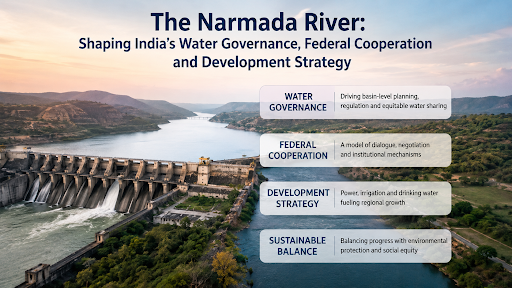
The Narmada River is India's longest west-flowing peninsular river.
Spanning 1,312 km, it originates at Amarkantak in Madhya Pradesh, flows through a tectonic rift valley between the Vindhya and Satpura ranges, and drains into the Arabian Sea via the Gulf of Khambhat.
Unique Flow Direction: Unlike most peninsular rivers that slope east toward the Bay of Bengal, the Narmada flows west because it occupies a graben (rift valley) created by faulting.
Estuary over Delta: Because it flows swiftly through a narrow trough, the Narmada forms an estuary rather than a delta before meeting the sea.
]Lifeline & Economy: The river's basin covers 98,796 sq km across Madhya Pradesh, Maharashtra, and Gujarat. It features major hydroelectric and irrigation projects, most notably the Sardar Sarovar Dam in Gujarat and the Indira Sagar Dam in Madhya Pradesh.
Natural Beauty: Along its course, it creates stunning geological formations, including the cascading Dhuandhar Falls near Jabalpur.
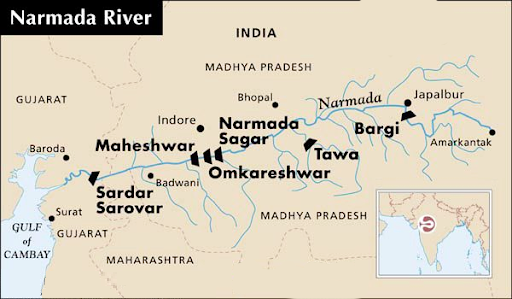
What is the Narmada Project and Why Has it Been Controversial?
Multi-State Development Programme: Following the Narmada Water Disputes Tribunal (NWDT) directives, the government approves the construction of 30 major, 135 medium, and 3,000 small dams, with the Sardar Sarovar Project (SSP) in Kevadia, Gujarat as the centerpiece.
Water Allocation Disputes: The NWDT Award (1979) allocates specific utilizable water limits at 75% dependability: Madhya Pradesh (18.25 MAF), Gujarat (9.00 MAF), Rajasthan (0.50 MAF), and Maharashtra (0.25 MAF), triggering frequent disputes over construction dues and water apportionment.
Massive Human Displacement: Raising the dam height to 58 meters submerges an additional 5,000 hectares of land in Madhya Pradesh, directly impacting 192 villages and displacing thousands of families.
Grassroots Resistance: The Narmada Bachao Andolan (NBA), led by activists Medha Patkar and Baba Amte, spearheads peaceful protests against the displacement of indigenous populations without adequate rehabilitation.
International Funding Withdrawal: The Morse Commission (1991) reports severe environmental and resettlement violations, forcing the World Bank to withdraw project funding in 1993.
Significance of the Recent Four-State Agreement
Resolving Historical Disputes: The pact successfully ends long-standing disputes originating from the 1979 NWDT Award, bridging trust deficits among the states.
Settling Financial Liabilities: Madhya Pradesh reduces its rehabilitation payout to Gujarat from a projected ₹1,500 crore to just ₹231.80 crore.
Reapportioning Expenditure Shares: Gujarat absorbs a larger financial responsibility, increasing its expenditure share from 50.57% to 75%.
Fostering Inter-State Cooperation: The agreement demonstrates states abandoning rigid political differences to negotiate mutually beneficial terms.
Strengthening Cooperative Federalism: The Union Government, through the Ministry of Home Affairs and Ministry of Jal Shakti, acts as a broker, prioritizing cooperative federalism over adversarial litigation.
Securing Water Management Certainty: Settling financial disputes allows state governments to focus on local rehabilitation and maximize water distribution infrastructure.
Source: NEWINDIANEXPRESS
|
PRACTICE QUESTION Q. Consider the following statements regarding the Inter-State River Water Disputes in India: 1. Under Article 262 of the Constitution, Parliament may by law provide for the adjudication of any dispute with respect to inter-state rivers and can bar the jurisdiction of the Supreme Court. 2. The Narmada Water Disputes Tribunal (NWDT) allocated river waters exclusively between Gujarat and Madhya Pradesh. 3. The Inter-State River Water Disputes Act was enacted in 1956. Which of the statements given above is/are correct? A) 1 only B) 1 and 3 only C) 2 and 3 only D) 1, 2, and 3 Answer: B Explanation: Statement 1 is correct: Under Article 262(1) of the Constitution of India, Parliament is empowered to enact laws to provide for the adjudication of disputes concerning inter-state rivers or river valleys. Article 262(2) explicitly allows Parliament to bar the jurisdiction of the Supreme Court or any other court regarding these specific disputes. Statement 2 is incorrect: The Narmada Water Disputes Tribunal (NWDT) allocated the river waters among four states, not just two. The beneficiary states are Madhya Pradesh, Gujarat, Maharashtra, and Rajasthan. Statement 3 is correct: In accordance with the powers granted by Article 262, the Parliament enacted the Inter-State River Water Disputes Act in 1956 to govern the resolution of water conflicts through specialized tribunals. |


© 2026 iasgyan. All right reserved