Marine Cloud Brightening (MCB) involves spraying sea salt into marine clouds to increase reflectivity and cool targeted ocean regions. Recent models suggest MCB could suppress devastating Super El Niños, though it carries massive risks of rainfall disruption and moral hazard.

Why In News?
Recent studies published in Science Advances and Earth's Future suggest that deploying Marine Cloud Brightening (MCB) in the eastern Pacific could disrupt ocean-wind feedback loops, suppress Super El Niño events, and mitigate extreme global heat.
What is Marine Cloud Brightening (MCB)?
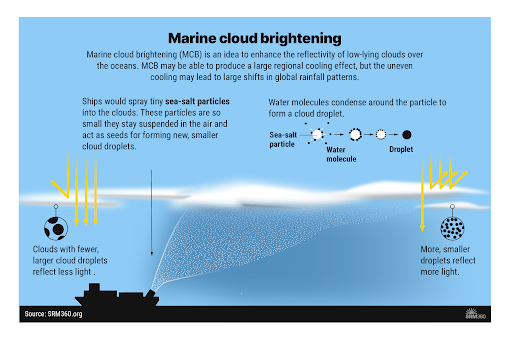
MCB is a proposed Solar Radiation Management (SRM) technology designed to reflect a small fraction of sunlight back into space to cool the planet.
It involves injecting microscopic aerosol particles into low-lying marine stratocumulus clouds to enhance their albedo (reflectivity).
How Does It Work?
Why is Marine Cloud Brightening Being Considered?
Rising Risk of Super El Niño: The National Oceanic and Atmospheric Administration (NOAA) confirms a rising probability of Super El Niños, where equatorial Pacific sea surface temperatures rise 2.0°C or more above the historical average.
Economic Losses: The 1997–1998 El Niño caused $5.7 trillion in global income losses. Without adaptation, extreme heat could cost the global economy over $2 trillion annually by 2030.
Human Health: Extreme heat is currently the deadliest climate hazard, responsible for 545,000 deaths annually, according to The Lancet.
Need for Supplementary Tools: The IPCC notes that greenhouse gas emissions already guarantee irreversible changes, making supplementary interventions critical.
Adaptation Limitations: Current methods, such as the Reef Restoration and Adaptation Program (RRAP), are inadequate to stop mass coral bleaching, necessitating new interventions like MCB.
How Could MCB Influence El Niño?
Ocean Cooling: Targeting the subtropical eastern Pacific increases local cloud albedo, cooling the ocean surface and triggering a loss of moist static energy.
Dampening Warming: Initiating MCB during the early growth phase of an El Niño limits the energy that fuels the event.
Trade Wind Restoration: Targeted cooling promotes atmospheric subsidence and intensifies trade winds across the tropical Pacific.
Bjerknes Feedback Disruption: MCB disrupts the positive feedback loop between surface winds and ocean temperatures, reducing the overall amplitude of El Niño by approximately 61%.
Global Temperature Moderation: Suppressing El Niño locally prevents the massive release of oceanic heat into the atmosphere, moderating worldwide temperature spikes.
Potential Benefits of Marine Cloud Brightening
Heatwave Mitigation: Reflecting solar radiation decreases regional temperatures, lowering the intensity and duration of heatwaves.
Drought Prevention: Damping El Niño prevents shifts in global circulation patterns that cause severe droughts in the western Pacific.
Food and Water Security: Early implementation of MCB safeguards global agricultural yields and freshwater supplies by reducing extreme wetting and warming impacts.
Economic Protection: Deploying MCB to prevent coral bleaching on the Great Barrier Reef is projected to yield $4.5 billion in benefits.
Time-Buying: MCB serves as a stop-gap measure to protect vulnerable ecosystems while the world transitions to a net-zero economy.
What are the Major Concerns Associated with Marine Cloud Brightening?
Termination Shock: If MCB is suddenly stopped, the masked warming triggers rapid and catastrophic global temperature spikes.
Rainfall Alteration: Models warn that MCB could reduce global mean precipitation, potentially causing ecological disasters like rainfall reduction over the Amazon basin.
Unintended Regional Shifts: Suppressing El Niño may force an earlier onset of La Niña, shifting extreme weather risks to different geographic regions.
Governance and Ethics: Indigenous groups, such as the Saami Council, oppose field tests, arguing that manipulating the atmosphere violates sacred relationships with nature.
Geopolitical Disputes: Unilateral deployment could induce drought or flooding in other nations, creating risks of weaponization and conflict.
Moral Hazard: Critics argue MCB creates a false sense of security, reducing the incentive to urgently cut greenhouse gas emissions.
What are the Implications for India?
Monsoon Dynamics: Artificial atmospheric manipulation could unpredictably alter precipitation patterns, presenting risks to India's hydrological cycle.
Agricultural Security: Unintended droughts triggered by geoengineering teleconnections threaten India’s rain-fed agriculture.
Disaster Risk: India ranks highly on the Climate Risk Index; while preventing Super El Niños could reduce heatwaves, the lack of complete modeling makes MCB a high-stakes gamble.
Governance Advocacy: India must advocate against unilateral deployment and demand robust, multilateral oversight under global treaties.
Research Bolstering: India must strengthen domestic research on aerosol-cloud interactions through frameworks like the National Air Quality Resource Framework of India.
Source: DOWNTOEARTH
|
PRACTICE QUESTION Q. "Geoengineering technologies are discussed as tools to address climate risks, but they also raise ethical, environmental and governance concerns." Examin. (250 Words, 15 Marks) |


© 2026 iasgyan. All right reserved