The Himalayan Yak serves as a vital lifeline for high-altitude pastoralists. Facing severe population declines due to climate-induced heat stress and shrinking pastures, institutions deploy advanced technologies like IoT smart collars and artificial insemination to ensure their ecological and economic survival.
Why In News?
Scientists from the ICAR-National Research Centre on Yak (NRC-Y) and Assam Don Bosco University deploy IoT-based smart collars to monitor Himalayan yak health and stress.
What is the Himalayan Yak?
The Domestic Yak (Bos grunniens), or the "Ship of the Himalayas," represents a long-haired, robust bovine species evolved for sub-zero alpine survival.
Conservation Status: The IUCN Red List classifies the species as Vulnerable (VU).
Population and Distribution: India maintains a population of 58,000 yaks (as per the 20th Livestock Census), inhabiting Ladakh, Jammu and Kashmir, Arunachal Pradesh, Sikkim, Himachal Pradesh, West Bengal, and Uttarakhand.
Habitat Requirements: Yaks thrive in temperatures as low as –40°C but possess a narrow thermoneutral range of 5-13°C, suffering severe heat stress above 15°C.
Importance of the Himalayan Yak
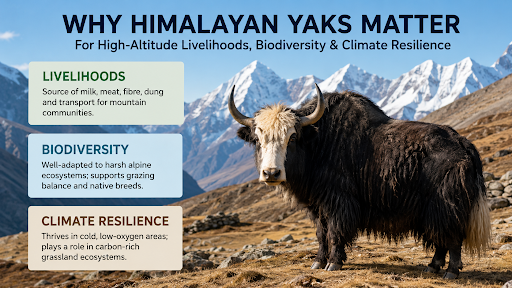
Livelihood Support: Yaks serve as the primary economic lifeline for nomadic pastoralists like the Changpas of Ladakh, enabling survival through seasonal transhumance.
Economic Contribution: Yak milk provides up to 60% of household earnings, while meat and khuloo (yak wool) form the foundation of the local economy.
Logistical Utility: Their physical strength and sturdy hooves allow them to transport essential supplies across treacherous, icy Himalayan terrain.
Cultural Preservation: Yak rearing sustains indigenous traditions, including the construction of rebos (traditional tents) woven from yak wool.
Ecosystem Sustainability: Yaks maintain alpine pasture health through grazing and ensure food security for remote populations during harsh winters.
Unique Biological Adaptations
Thermal Insulation: A dual-layer coat featuring thick guard hairs and dense underwool, combined with natural oils, provides weatherproofing against snow and rain.
High-Altitude Physiology: An enlarged chest cavity houses a larger heart and lungs, while specialized haemoglobin and large red blood cells facilitate efficient oxygen uptake in thin air.
Metabolic Efficiency: A slow metabolism allows yaks to survive on sparse, frost-covered vegetation during winter months.
Drivers of Population Decline
Climate Change: The 20th Livestock Census records a 24.67% population decline. Rising temperatures—specifically a 1°C increase in Leh over 35 years—induce heat stress in animals with a low temperature-humidity index of 52.
Resource Scarcity: Unpredictable rainfall and reduced snowfall degrade alpine pastures, limiting available grazing land.
Socio-Economic Shifts: Younger generations abandon traditional herding for wage labor, while low economic returns disincentivize the practice.
Disease Risks: Increased contact with domestic cattle and shifting climate zones expose yaks to new vector-borne diseases.
Source: THEHINDU
|
PRACTICE QUESTION Q. Consider the following statements regarding the Himalayan Yak (Bos grunniens): 1. The total yak population in India has seen a steep increase according to the 20th Livestock Census. 2. They possess a narrow thermoneutral range of 5-13°C, making them highly susceptible to heat stress. 3. The IUCN Red List categorises the Himalayan Yak as Vulnerable (VU). Which of the statements given above is/are correct? A) 1 and 2 only B) 2 and 3 only C) 1 and 3 only D) 1, 2 and 3 Answer: B Explanation: Statement 1 is Incorrect: The total yak population in India has declined significantly, not increased. The 20th Livestock Census (2019) recorded a population of roughly 58,000, representing a decrease of approximately 24.9% (or 25%) compared to the 2012 census figure of about 77,000. Statement 2 is Correct: Yaks are adapted to extreme cold and have a very low and narrow thermoneutral zone (TNZ) ranging from 5°C to 13°C. They are highly susceptible to heat stress when ambient temperatures exceed 13°C, as their physiological mechanisms are geared toward heat conservation rather than dissipation. Statement 3 is Correct: The IUCN Red List classifies the Wild Yak (Bos mutus, often taxonomically treated as the wild counterpart of Bos grunniens) as Vulnerable (VU). While the domestic yak (Bos grunniens) is not separately evaluated for conservation status in the same way, the statement refers to the species' threatened status in the wild, which is Vulnerable. |
The Himalayan Yak (Bos grunniens) is a highly resilient, long-haired bovine species uniquely adapted to high-altitude sub-zero environments, known as the 'Ship of the Himalayas' for its crucial role in transport and pastoral livelihoods.
Yaks are predominantly found in the Union Territories of Ladakh and Jammu & Kashmir, and the states of Arunachal Pradesh, Sikkim, Himachal Pradesh, West Bengal, and Uttarakhand.
Yak populations are declining sharply due to climate change-induced heat stress, shrinking alpine pastures from erratic weather, outmigration of youth, low economic returns, and increasing disease risks.
Climate change brings unpredictable rainfall and warmer winters, reducing grass availability. Because yaks have a narrow thermoneutral range (5-13°C), higher temperatures cause severe heat stress, lowering their milk and wool productivity while increasing susceptibility to new vector-borne diseases.




© 2026 iasgyan. All right reserved