India’s Extended Producer Responsibility framework enforces waste management for plastics, e-waste, and batteries. The Central Pollution Control Board launched a unified portal for compliance and certificate trading to enhance traceability, formalize recycling, and promote a robust circular economy in India.
Why In News?
The Union Ministry of Environment, Forest and Climate Change (MoEFCC) launched a common Extended Producer Responsibility (EPR) portal to streamline the recycling ecosystem.
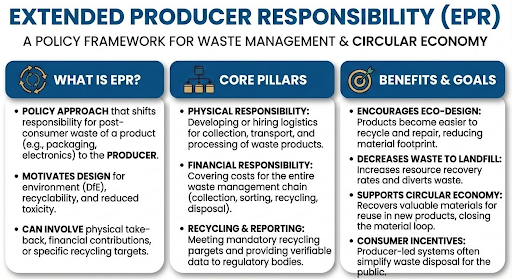
What is Extended Producer Responsibility (EPR)?
Under the EPR framework, Producers, Importers, and Brand Owners (PIBOs) are given the responsibility to ensure the environmentally sound management of the waste generated by their products at the end of their life cycle.
It mandates the entities to process their waste through recycling, re-use, or end-of-life disposal rather than allowing it to cause environmental damage.
How is EPR implemented in India?
In India, EPR is implemented through regulations notified by the Ministry of Environment, Forest and Climate Change (MoEFCC) and administered by the Central Pollution Control Board (CPCB).
The framework currently spans multiple waste streams including plastics, e-waste, batteries, end-of-life vehicles (ELV), tyres, used oil, and non-ferrous metals.
Producers are assigned specific EPR targets based on the quantity of products they introduce to the market.
Recently launched Common EPR Single Sign-On (SSO) Portal, a unified digital platform allows companies to register once and access all specific waste management modules through a single login.
What are the benefits of EPR?
Promotes Circular Economy: EPR shifts India from linear consumption to a circular model by enhancing resource efficiency and recycled material demand.
Resource Recovery: Mandates recovery of critical battery minerals (lithium, cobalt), cutting import reliance and boosting economic growth.
Digital Efficiency: The new Common EPR Portal streamlines compliance, reduces errors, and ensures transparent tracking of environmental liabilities.
Monetized Recycling: Enables a market where recyclers trade EPR certificates with producers, giving recycling a direct financial value.
Pollution Control: Enforces scientific processing targets to prevent hazardous e-waste, plastics, and batteries from damaging ecosystems.
What are the major challenges in EPR implementation?
Informal Sector Exclusion: India’s waste collection heavily involves the informal sector, yet the EPR framework lacks formal recognition for it, causing systemic inefficiency.
Limited Formal Recovery: A vast gap exists between waste generation and processing; in FY24, only 10% of India’s 6.2 million tonnes of e-waste was formally recycled, losing over ₹21,000 crore. (Source: NITI Aayog)
Incentive Mismatch: The framework prioritizes high-value metals like gold, leaving low-value materials like lithium ferro phosphate economically unviable for recyclers without tiered EPR pricing.
Governance Gaps: Execution is hindered by frequent administrative shifts, inconsistent regulations, and poor inter-ministerial coordination.
Verification Deficits: Lack of chemical disclosures and GST integration with EPR portals creates traceability gaps, making it hard to verify actual material recovery.
What should be the way forward for India?
Centralise Governance: Industry bodies like the Material Recycling Association of India (MRAI) recommend a national framework or specialized desks to streamline coordination and policy continuity.
Formalise the Informal Sector: Policies must integrate informal waste collectors into the official system to safeguard existing supply chains.
GST-Linked Verification: Integrating EPR portals with GST systems to enhance financial tracking, minimize claim discrepancies, and support authorized recyclers.
Broadened Scope and Tiered Pricing: EPR should cover more critical minerals and use differentiated pricing to ensure the economic feasibility of recovering low-value waste.
Tailor Material-Specific Frameworks: Policymakers should avoid generic approaches; high-value sectors like non-ferrous metals need specialized regulations to protect existing efficient markets.
Build Ground-Level Capacity and Feedback Loops: Sustaining the circular economy requires ongoing industry engagement, improved local regulatory capacity, and active feedback to align policy with execution.
Conclusion
India's unified EPR portal strengthens digital compliance for a circular economy, however, success depends on closing structural gaps, formalizing the informal sector, and enforcing regulations effectively.
Source: DOWNTOEARTH
|
PRACTICE QUESTION Q. Critically analyze the significance of the Extended Producer Responsibility (EPR) framework in India's transition towards a circular economy. 150 words |
The Common EPR Portal is a centralized digital platform developed by the Central Pollution Control Board (CPCB) that allows Producers, Importers, and Brand Owners (PIBOs) to register once and manage their environmental compliance across multiple waste streams via a single login.
Recyclers generate EPR certificates based on the volume of waste they scientifically process. Producers must purchase these certificates through the Electronic Trading Platform (EPR-ETP) to meet their mandated recycling targets and offset their environmental liabilities.
Key challenges include the exclusion of the informal sector (which handles most waste collection), lack of economic incentives for low-value waste, fragmented inter-ministerial governance, and weak traceability due to the absence of GST-integrated verification.


© 2026 iasgyan. All right reserved