Scientists from the Zoological Survey of India recently discovered a new leopard gecko species, Eublepharis jhuma, in Bihar’s Kaimur Wildlife Sanctuary. Protected under Schedule I of the Wildlife Protection Act, this finding highlights India's rich, yet threatened, herpetofaunal biodiversity.
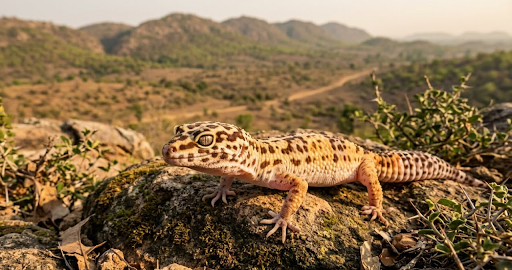
Scientists have discovered a new, highly trafficked leopard gecko species, Eublepharis jhuma, in the Kaimur hills of Bihar.
Discovery
Researchers from the Zoological Survey of India (ZSI) and the Wildlife Institute of India discover a new gecko species in the Kaimur hills of Bihar.
Scientists name the species Eublepharis jhuma, popularly calling it the Jhuma leopard gecko due to its leopard-like spots.
The team names the gecko after ZSI Director Dhriti Banerjee (nicknamed Jhuma) to recognize her contributions to India's animal diversity and conservation.
This finding records the first documented occurrence of the Eublepharis genus in Bihar.
India now have seven recognized species in this genus, making it the country with the largest species diversity for Eublepharis globally.
Physical Characteristics
The gecko features a 14cm-long body paired with a tail of equal length.
Dark brown spots resembling a leopard, along with several pale-yellow and brown spotted bands running across its body.
Large, flat, bumpy scales on its back with unusually wide gaps, which distinguishes it from its closest known relative, Eublepharis satpuraensis.
Utilizes a higher number of tiny, textured ridges (lamellae) under its fourth toe to achieve a better grip on surfaces.
Genetic sequencing shows the species is 6.9 to 7.8% distinct from its sister species, indicating it separated from its closest relatives millions of years ago.
Habitat and Ecology
The species is endemic to the Kaimur plateau and parts of the Chota Nagpur Plateau.
The gecko inhabits tropical dry deciduous forest ecosystems.
Scientists locate the species in the Kaiser range and areas like Parari, which agricultural fields isolate from the main Kaimur Wildlife Sanctuary.
Conservation Status and Threats
The government classifies all leopard geckos in India under Schedule I of the Wildlife Protection Act, 1972 (Amendment Act of 2022), providing it top-priority protection and strictly prohibiting hunting, captivity, and trade.
The IUCN Red List status is currently Not Assessed (NE) because this species is newly discovered.
The species faces severe environmental threats, including habitat loss, forest fires, pollution, persecution, and roadkill.
Source: RESEARCHMATTERS
|
PRACTICE QUESTION Q. Consider the following statements about the recently discovered Eublepharis jhuma:
Which of the statements given above is/are correct? A) 1 and 2 only B) 2 and 3 only C) 1 and 3 only D) 1, 2, and 3 Answer: A Explanation: Statement 1 is CORRECT: Scientists from the Zoological Survey of India (ZSI) discovered Eublepharis jhuma (Jhuma's leopard gecko), a new species of leopard gecko endemic to the rocky hills on the outskirts of the Kaimur Wildlife Sanctuary in Bihar. Statement 2 is CORRECT: In India, all species of leopard geckos are protected under Schedule I of the Wildlife Protection Act, 1972. This grants them top-priority protection, making their hunting, captivity, and trade completely illegal. Statement 3 is INCORRECT: While Eublepharis jhuma (and leopard geckos broadly) are highly trafficked globally and domestically—driven primarily by the growing craze for exotic pets in European countries and India. The reptiles targeted for medicinal remedies (such as 'tokay gecko' and 'gecko gallbladders') are different and serve distinct traditional medicine uses. |
Eublepharis jhuma is a newly discovered species of leopard gecko found in the Kaimur Wildlife Sanctuary of Bihar by scientists from the Zoological Survey of India (ZSI).
All leopard gecko species in India are protected under Schedule I of the Wildlife Protection (Amendment) Act, 2022, which prohibits their hunting, trade, and captivity.
The Tokay Gecko is heavily smuggled because it is highly sought after in Traditional Chinese Medicine (TCM) to treat ailments like cancer, asthma, and diabetes, despite no scientific proof supporting these claims.





© 2026 iasgyan. All right reserved