The 'Khet Bachao Abhiyan', running from June 1-30, 2026, tackles India's fertiliser import dependence and soil degradation. By promoting balanced nutrient management, climate-resilient practices, and decentralised Panchayat-level participation, it aims to ensure long-term agricultural sustainability and food security
Why In News?
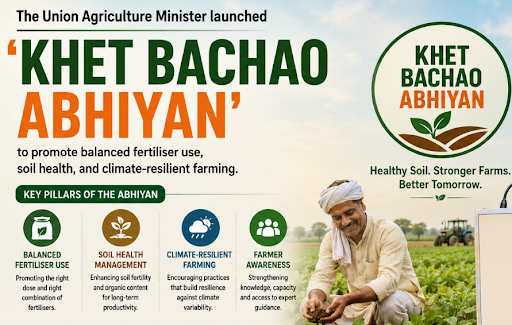
The Union Agriculture Minister launched the 'Khet Bachao Abhiyan' to promote balanced fertiliser use, soil health, and climate-resilient farming.
What Is Khet Bachao Abhiyan?
The Khet Bachao Abhiyan (KBA) is a nationwide campaign launched from the Raisen district of Madhya Pradesh, to promote sustainable agriculture and soil conservation across India.
Lead Agency: The campaign operates under the leadership of the Union Agriculture Minister and involves a multi-stakeholder network including Krishi Vigyan Kendras (KVKs), the Indian Council of Agricultural Research (ICAR), agricultural universities, and state agriculture departments.
Core Strategy: It emphasizes a transition from chemical-heavy farming to natural farming, green manuring, and balanced fertilizer use.
Operational Scope: The campaign focuses on widespread awareness of Soil Health Cards, climate-resilient agriculture, and the adoption of alternative crops in water-stressed regions.
Regulatory Focus: It identifies and targets the proliferation of counterfeit seeds, fertilizers, and pesticides that undermine farm productivity.
Why Khet Bachao Abhiyan Launched?
The campaign addresses a structural crisis in the Indian farm sector characterized by ecological degradation and economic vulnerability.
Combating the "Fertilizer Trap": Excessive chemical use has created a cycle where declining soil fertility forces farmers to apply more fertilizers to maintain yields, leading to diminishing marginal returns and organic matter depletion.
Protecting Long-term Food Security: With India’s population projected to reach 1.5 billion by 2030, the campaign seeks to protect the soil's productive capacity to meet an estimated food grain demand of 402–437 million tonnes by 2047.
Mitigating Environmental Pollution: Excessive nitrogen use causes ammonia emissions (air pollution), water eutrophication (water pollution), and increased greenhouse gas emissions.
Climate Change Adaptation: Agriculture faces threats from rising temperatures and erratic monsoons. The KBA promotes climate-resilient crop varieties to stabilize yields.
What Challenges Could Affect the Campaign's Success?
Fossil Fuel Dependence: Indian agriculture is "fossilized." Tractor numbers surged from 5,000 in 1946 to over 12 million in 2026, while draught animal power collapsed to just 2.3%. This makes farming vulnerable to global energy shocks.
Monoculture and MSP Bias: Although MSP exists for over 20 crops, procurement remains concentrated in rice and wheat. This incentivizes fertilizer-intensive monocropping, which depletes groundwater and soil nutrients.
The "Rice-Wheat System" Bane: Assured procurement for paddy has led to severe groundwater decline in states like Punjab, where water is over-extracted by 14 billion cubic meters annually.
Weak Pulse Procurement: Pulse cultivation—essential for natural nitrogen fixation—declined by nearly 10% between 2021 and 2025 because procurement infrastructure for pulses remains structurally weak compared to cereals.
Input Quality Risks: The prevalence of counterfeit agricultural inputs (seeds and chemicals) continues to deceive farmers and damage soil health.
How Can India Scale Up Land Conservation Efforts?
Integrated Nutrient Management (INM): Combine organic manure, biofertilizers, and crop residues with minimal chemical top-ups to restore soil organic carbon.
Pulse Diversification: Incentivize pulse-cereal rotations. Pulses require 90% less nitrogen fertilizer and naturally enrich the soil through Biological Nitrogen Fixation.
Digital Agriculture Mission: Deploy AgriStack and Digital Public Infrastructure (DPI) to provide farmers with real-time soil profile maps (1:10,000 scale) and weather-based advisories.
Policy Convergence: Implement the Prime Minister Dhan-Dhaanya Krishi Yojana (PMDDKY) to converge 36 existing schemes (like PM-KUSUM and Soil Health Cards) into a unified framework for 100 low-productivity districts.
Technological Innovation: Promote Cyborg Botany (using plants as biosensors) and Herbicide-Resistant Mustard Hybrids to manage "hidden threats" like the parasitic weed Orobanche.
4R Nutrient Stewardship: Enforce the use of the Right Source, Right Dose, Right Time, and Right Place for nutrient application to maximize Nutrient Use Efficiency (NUE).
Key Government Schemes for Land Conservation
PM-PRANAM: Provides incentives to states that successfully reduce chemical fertilizer consumption.
Soil Health Card Scheme: Enables scientific fertilizer application based on crop-specific nutrient requirements.
National Mission on Natural Farming (NMNF): A centrally sponsored scheme with an outlay of ₹2,481 crore aiming to reach one crore farmers.
Digital Agriculture Mission: A ₹2,817 crore initiative to create a digital ecosystem for precision farming.
Agriculture Infrastructure Fund (AIF): Provides medium-to-long-term debt financing for post-harvest management and community farming assets.
Conclusion
India must shift from a yield-only focus to an "Evergreen Revolution" that prioritizes soil health, nutrient-use efficiency, and crop diversification to balance food security with ecological sustainability.
Source: PIB
|
PRACTICE QUESTION Q. With reference to the 'Khet Bachao Abhiyan', consider the following statements:
Which of the statements given above is/are correct? (a) 1 only (b) 2 only (c) Both 1 and 2 (d) Neither 1 nor 2 Answer: (c) Explanation: Statement 1 is correct: The campaign's primary objective is to curb the excessive, imbalanced use of chemical fertilizers (like urea) and promote scientific, soil test-based nutrient management to improve long-term soil health. Statement 2 is correct: Krishi Vigyan Kendras (KVKs), operating as the frontline extension institutions at the district level, have been designated as the key coordinators for all participating institutions (such as ICAR institutes and state agriculture departments) in this campaign. |
It is a month-long national campaign (June 1-30, 2026) launched by the Ministry of Agriculture to promote balanced and judicious use of fertilisers, natural farming, and soil health.
The campaign is functioning on a bottom-up model where Krishi Vigyan Kendras (KVKs) act as key coordinators, partnering with the Indian Council of Agricultural Research (ICAR), Panchayats, and state governments.
INM is a holistic approach that combines chemical fertilisers, organic manures, bio-fertilisers (like Rhizobium), and crop residues based on soil tests. It aims to optimise nutrient efficiency and minimise environmental damage.



© 2026 iasgyan. All right reserved