Cyborg Botany integrates electronic sensors and nanomaterials into living plants, transforming them into "bio-hybrids." This allows flora to act as proactive environmental monitors, detecting pollutants or drought, thereby merging nature with technology to advance precision agriculture and climate resilience.
Why In News?
Researchers are developing cyborg botany to connect biological indicators with digital information, enabling vegetation to provide real-time updates on their physiological condition.
What is Cyborg Botany?
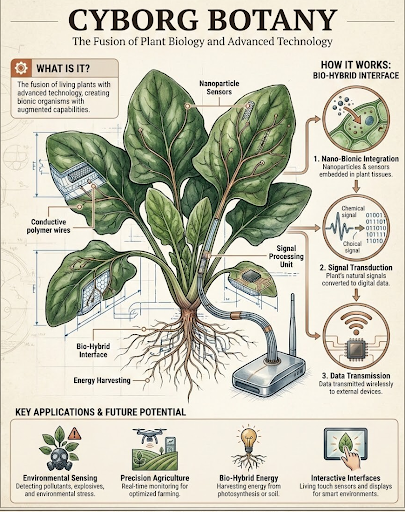
Cyborg Botany integrates living plants with electronic components (like sensors and wires) to create "bio-hybrid" systems. It turns plants into living sensors or displays that can communicate with digital devices.
How does Cyborg Botany work?
The technology works by bridging the plant's natural bio-electrochemical signals with artificial circuits.
Growing "Living Wires" (The Circuit)
Sensing & Communication (The Input)
Actuation (The Output)
Nano-Bionics (The Sensor)
What are the major applications of Cyborg Botany?
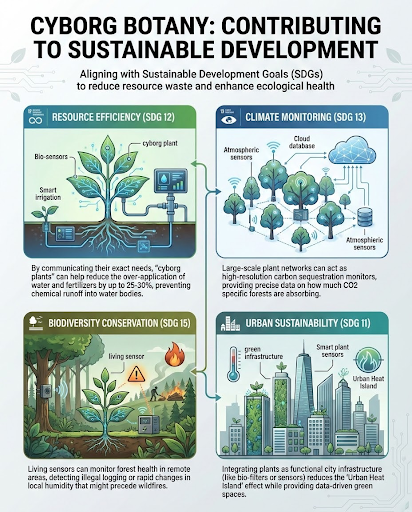
Environmental Monitoring: Plants act as sensor networks detecting soil moisture, pH, or heavy metals to provide digital data.
Precision Farming: Vascular sensors detect pests or diseases early, enabling proactive crop treatment.
Living Lights: Nanoparticles can turn trees into bio-luminescent streetlights, reducing electrical reliance.
Mobile Flora: Initiatives like Elowan allow plants to move toward resources by triggering robotic bases.
Defense & Safety: Nano-bionic plants serve as alarms by detecting explosive chemical vapors in groundwater.
What are the concerns about Cyborg Botany?
Ecological Disruptions: Non-biodegradable components might harm soil and food chains upon plant decomposition.
Ethical "Plant Rights": Vascular manipulation for data collection risks over-instrumentalizing living organisms.
Electronic Waste: Embedded circuits in forests could create "bio-e-waste" that is difficult to recover.
Technological Reliance: High costs may cause a "digital divide" and erode traditional agricultural knowledge.
Security Risks: Vulnerability to hacking could lead to data manipulation or food security disruptions.
What should be the way forward?
Bio-compatible Material Development: Research should focus on biodegradable conductive polymers that soil microbes can safely decompose.
Regulatory Frameworks: Clear government guidelines are necessary to regulate bio-hybrid tech with the same rigor applied to Genetically Modified Organisms (GMOs).
Integrated Monitoring: Cyborg systems should provide multi-layered environmental protection by augmenting satellite and drone data.
Focus on Public Good: Early use should prioritize disaster warnings and tracking urban groundwater contamination.
Conclusion
Cyborg Botany transforms plants into proactive bio-digital entities, offering revolutionary solutions for precision agriculture and climate resilience; however, India must adopt a precautionary regulatory framework to balance technological utility with ecological integrity for its 2047 sustainability vision.
Source: THEHINDU
|
PRACTICE QUESTION Q. With reference to 'Cyborg Botany', consider the following statements:
Which of the statements given above are correct? A) 1 and 2 only B) 2 and 3 only C) 1 and 3 only D) 1, 2, and 3 Answer: D Experiment: Statement 1 is correct: Cyborg botany is described as a hybrid system that integrates living plants with electronic components (synthetic materials) to create cybernetic organisms, aiming to bridge biological signals and electronic data. Statement 2 is correct: Researchers (notably at Linköping University) developed an 'Electronic Rose' (e-Rose) by filling the vascular system (xylem) with conductive polymers (such as PEDOT) to form functioning "wires" within the plant. Statement 3 is correct: The technology aims to utilize plants for real-time monitoring of their environment and health, allowing them to act as self-powering sensors (or bio-hybrid generators). |
Cyborg Botany, or Plant Nanobionics, is a field that physically integrates living plants with electronic components and nanomaterials, turning them into bio-hybrid sensors, living circuit boards, or power sources without altering their DNA.
Unlike GMOs, which alter a plant's foundational DNA, Cyborg Botany leverages a plant's existing biological framework (like its vascular system) and enhances it by infusing synthetic materials like carbon nanotubes and conductive polymers.
The b-IoT is an environmentally friendly alternative to traditional IoT. It uses networked "cyborg plants" acting as native biosensors in forests or agricultural fields to monitor ecosystems without generating toxic electronic waste (e-waste).




© 2026 iasgyan. All right reserved