Canine Distemper Virus (CDV) is a highly contagious, fatal RNA virus threatening India's endangered tigers and lions. Transmitted primarily by feral dogs, prevention requires establishing immunization buffers of 70-80% to create herd immunity around tiger reserves.
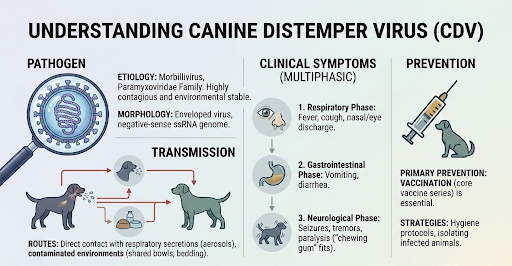
A recent Canine Distemper Virus (CDV) outbreak resulted in the death of a tigress and her four cubs in Kanha Tiger Reserve (Madhya Pradesh).
Pathogen Details
Virus Type: CDV is a highly contagious, single-stranded RNA virus.
Family: It belongs to the Paramyxoviridae family and is closely related to the viruses that cause measles in humans and rinderpest in animals.
Nature of Virus: The virus is relatively fragile outside a host.
Affected Species
Vulnerable Animals: It affects a wide variety of domestic and wild carnivores, including domestic dogs, foxes, wolves, pandas, ferrets, raccoons, and large cats like tigers, lions, and leopards. It also affects marine mammals like seals.
Human Threat: CDV does not affect humans.
Transmission & Vectors
Primary Vector: Domestic and feral dogs act as the primary reservoir and most common source of infection for wildlife.
Mode of Transmission: The virus spreads through aerosol droplets (coughing, sneezing).
Key Symptoms
Treatment & Immunity
No Cure: Currently no specific antiviral treatment or cure for CDV.
Immunity: Infected animals that survive the virus develop a life-long immunity.
Source: TIMESOFINDIA
|
PRACTICE QUESTION Q. Consider the following statements regarding the Canine Distemper Virus (CDV):
Which of the statements given above is/are correct? A) 1 and 2 only B) 2 and 3 only C) 1 and 3 only D) 1, 2, and 3 Answer: C Explanation: Statement 1 is correct: Canine Distemper Virus (CDV) is a single-stranded RNA virus and a member of the Paramyxoviridae family (specifically the genus Morbillivirus). It is closely related to the measles virus in humans. Statement 2 is incorrect: While CDV is highly contagious among animals, it cannot be transmitted to humans. There is no evidence that the virus causes disease in people, though humans can accidentally carry the virus on their clothes or hands and pass it to other susceptible animals. Statement 3 is correct: Feral and domestic dogs are the primary reservoirs. Because these dogs often interact with wildlife or live near protected areas, they frequently transmit the virus to wild carnivores (like tigers, lions, and pandas), where it can be fatal and threaten endangered populations. |
Canine Distemper is a highly contagious, potentially fatal viral disease caused by a single-stranded RNA virus of the Paramyxoviridae family. It is a multi-systemic disease that attacks the respiratory, gastrointestinal, and central nervous systems of various mammals.
The Canine Distemper Virus does not affect humans.
Domestic and feral dogs act as the primary reservoir for CDV, leading to a "spillover" infection into wildlife populations, especially at the forest-village interface. The virus spreads primarily through aerosol droplets, direct contact with infected bodily fluids, or by consuming contaminated carcasses.




© 2026 iasgyan. All right reserved