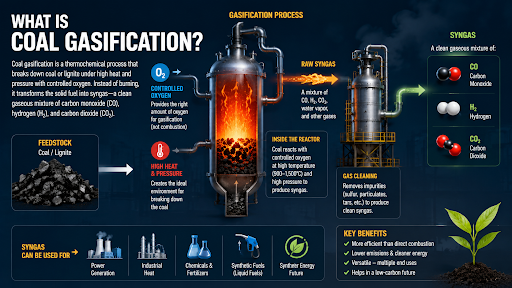
The ₹37,500 crore Coal Gasification scheme accelerates India’s National Coal Gasification Mission to convert domestic coal into valuable syngas. By integrating CCUS technologies, this strategy secures energy autonomy, slashes chemical import bills, and advances Atmanirbhar Bharat.
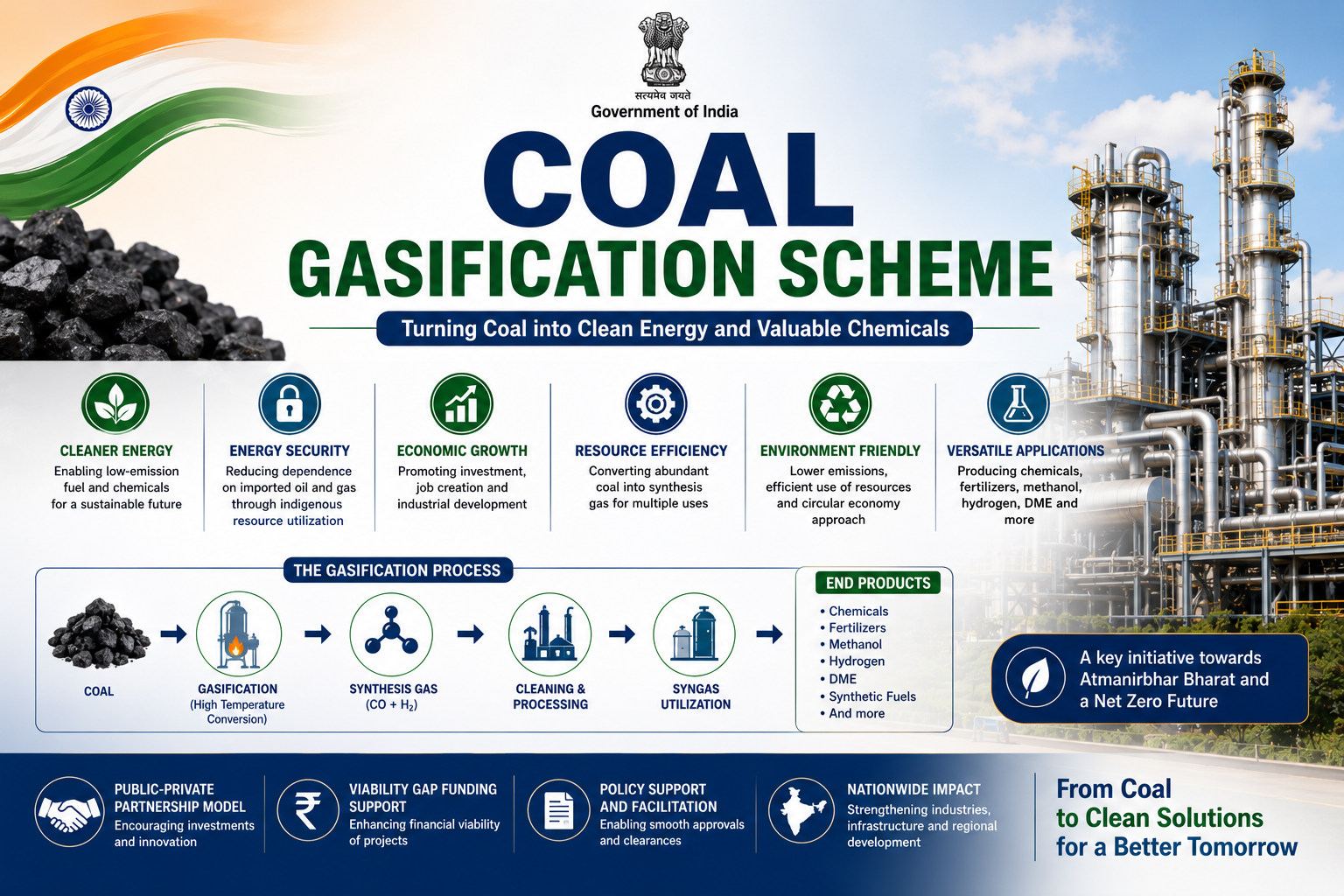
The Union Cabinet approved a ₹37,500 crore financial package to promote coal gasification as a sustainable alternative mining method in India.
Coal Gasification is a thermochemical process that converts solid coal into Synthesis Gas (Syngas), which contains a mixture of carbon monoxide, hydrogen, carbon dioxide, and methane.
The process uses steam, oxygen, or carbon dioxide as reforming agents to react with the carbon source at high temperatures, producing syngas without directly burning the coal.
This Syngas serves as a versatile feedstock that industries further process to produce synthetic natural gas (SNG), fertilizers, and downstream chemicals.
The Union Cabinet approves a ₹37,500 crore scheme to promote Surface Coal/Lignite Gasification Projects across the country. (Source: PIB)
The scheme support the national target to gasify 100 Million Tonnes (MT) of coal by 2030.
It builds upon an earlier ₹8,500 crore financial incentive scheme introduced in 2024 to support Public Sector Undertakings (PSUs), private sector projects, and demonstration-scale plants.
Reduce Import Dependence
Substitutes the import of high-value chemicals and fuels. India currently imports more than 50% of its LNG, 80–90% of its methanol, 100% of its ammonia, and 20% of its urea. (Source: PIB)
Directly slashes India's import bill for substitutable products, which stood at ₹2.77 lakh crore in FY2025. (Source: PIB)
Improve Strategic Autonomy
Leverages India's abundant domestic fossil fuel reserves, which include 401 billion tonnes of coal and 47 billion tonnes of lignite. (Source: PIB)
Support the Atmanirbhar Bharat and Make in India objectives by establishing an indigenous energy pathway.
Support Industrial Growth
Mobilizes capital investments ranging from ₹2.5 to 3.0 lakh crore into economy. (Source: PIB)
Generates 50,000 direct and indirect jobs across 25 upcoming projects located primarily in coal-bearing regions. (Source: PIB)
Yields ₹6,300 crore annually in government revenue from the targeted 75 MT gasification. (Source: PIB)
Enhance Domestic Chemical Production
Provides a domestic foundation to synthesize downstream value-added chemicals such as ammonium nitrate, methanol, dimethyl ether (DME), and green urea.
Strengthen Supply Chains
Insulates the Indian economy from sudden global price volatility and supply-chain disruptions (eg COVID-19).
Mitigates vulnerabilities that the ongoing geopolitical situation in West Asia exposes regarding global fuel and chemical supply networks.
High-Ash Indian Coal Issues
Indian coal possesses high ash content (>40%), which differs from global coal (containing <25% ash); this affects the suitability and efficiency of imported technologies.
Technology Dependence
India currently lacks mature indigenous technologies and local supply chains, making the country reliant on foreign EPC contractors and imported processes designed for low-ash coal.
Financial Viability
Coal gasification plants require high capital intensity and upfront investments.
Environmental Concerns
Thermochemical process emits carbon dioxide (CO2), contradicting the climate commitments if industries fail to reduce these emissions.
Carbon Management Challenges
Integration of Carbon Capture, Utilization, and Storage (CCUS) adds cost penalties and operational complexities, further compounded by the lack of mapped geological storage data for deep saline aquifers and basaltic traps.
Indigenous technology development
Incentivize indigenous technologies, such as the pressurized fluidized bed gasification (PFBG) technology, modified to handle India's high-ash coal.
Carbon capture integration
Industries must integrate CCUS facilities to capture emissions at the source and convert them into value-added commodities like "blue hydrogen" and "green urea”.
Strengthen R&D
Support a comprehensive R&D ecosystem through bodies like the National Centre of Excellence in Carbon Capture and Utilization to innovate novel CO2 conversion methods.
Environmental safeguards
Implement stringent Monitoring, Verification, and Accounting (MVA) frameworks to manage geological risks and prevent sub-surface CO2 leakages.
Public-private partnerships
Leverage public-private partnerships to mobilize private capital, share technological intellectual property, and de-risk the massive investments required for scalable deployment.
Alignment with net-zero goals
Overall strategy must align with India’s goal to reach net-zero by 2070, ensuring coal utilisation bridges the energy transition.
Coal gasification reflects India's attempt to balance energy security, industrial growth, and import reduction, but long-term success will depend on technological viability.
Source: THE HINDU
|
PRACTICE QUESTION Q. With reference to Syngas and Carbon Capture, Utilization, and Storage (CCUS) in India, consider the following statements:
Which of the statements given above is/are correct? (a) 1 and 2 only (b) 2 and 3 only (c) 1 and 3 only (d) 1, 2, and 3 Answer: (d) Explanation: Statement 1 is correct: Downstream industries utilize syngas (a mixture of carbon monoxide and hydrogen) as a fundamental feedstock to manufacture various products. Specifically, syngas is processed to produce methanol, ammonia (which is then used to make urea and other fertilizers), and other chemicals like dimethyl ether (DME). Statement 2 is correct: Hydrogen produced through coal gasification is termed "Grey Hydrogen" due to its high carbon footprint. However, when this process is integrated with Carbon Capture, Utilization, and Storage (CCUS) technologies to capture the resulting CO₂ emissions, the product is classified as low-emission Blue Hydrogen. Statement 3 is correct: India is heavily dependent on imports for its methanol needs. Recent data indicates that India imports over 90% to 95% of its domestic methanol requirement, primarily from countries like Iran and Saudi Arabia. This high import dependency exposes the economy to supply chain vulnerabilities. |
It is a ₹37,500 crore initiative designed to promote clean coal technologies. It aims to gasify approximately 75 million tonnes of coal by incentivizing both public and private sectors to convert coal into synthetic gas (syngas) to manufacture essential chemicals and fertilizers.
Coal gasification is a thermochemical process that transforms solid coal into syngas under controlled oxygen conditions, without directly burning the fuel.
Blue Hydrogen refers to hydrogen derived from fossil fuels (like syngas) where operators capture and permanently store the carbon emissions using CCUS infrastructure.




© 2026 iasgyan. All right reserved