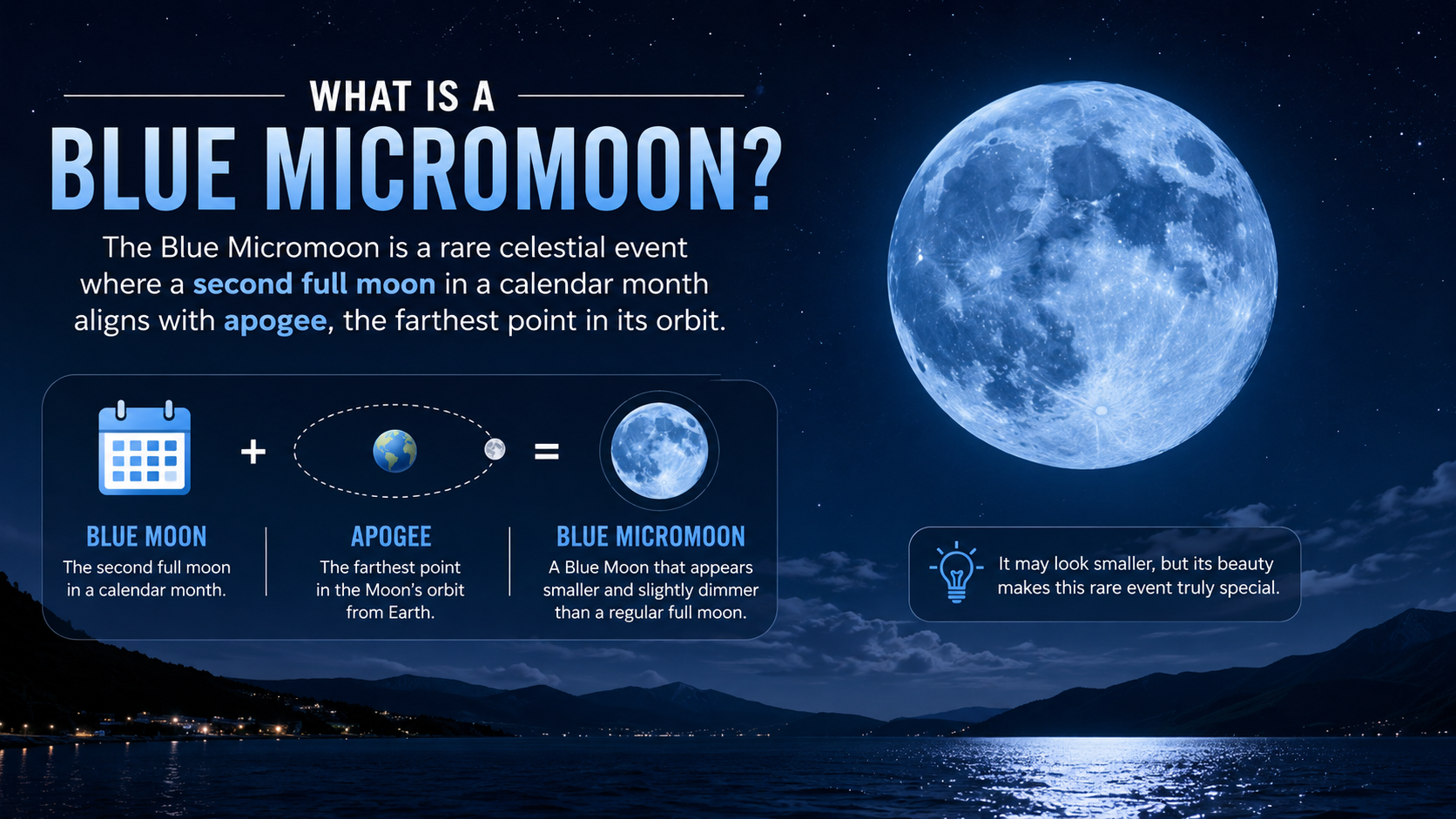
The Blue Micromoon is a rare celestial event where a second full moon in a calendar month aligns with apogee, the farthest point in its orbit. It appears smaller and dimmer, with the next occurrence not expected until 2053.
An rare astronomical event known as a "Blue Micromoon" was visible on May 31, 2026, a phenomenon that will not repeat until 2053.
What Is a Blue Micromoon?
A Blue Micromoon represents the simultaneous occurrence of two distinct lunar phenomena: a Blue Moon and a Micromoon.
The Blue Moon marks the second full moon within a single calendar month.
The Micromoon marks a full moon that exactly coincides with apogee, which is the farthest point in the moon's orbit around Earth.
 How Blue Micromoon Occur?
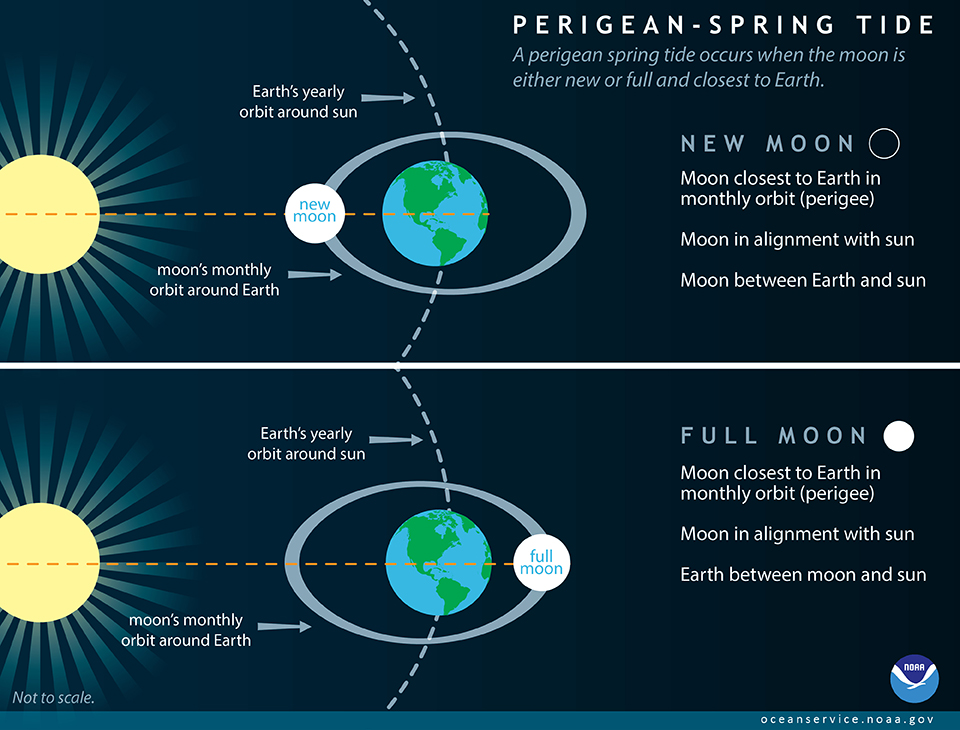
Orbital Mechanics: The moon orbits Earth in an elliptical (elongated) path over a 27.3-day cycle. When the fully illuminated phase aligns within a short time window of reaching apogee (approximately 403,945 km away), the Micromoon forms.
Calendar Alignment: A standard lunar cycle from new moon to new moon takes 29.5 days. Because a standard calendar month lasts 30 or 31 days, a full moon occurring on the 1st or 2nd allows a second full moon (the Blue Moon) to squeeze into the 30th or 31st of the same month.
Key Features of a Blue Micromoon
The extreme distance at apogee causes the moon to reflect less concentrated light back to Earth, making it the dimmest full moon of the calendar year.
Despite the "Blue" designation, the moon retains its standard pearly-gray hue and does not change color, unless rare atmospheric dust scatters red wavelengths.
The absolute angular size of the disk noticeably compresses, making the moon appear about 7% smaller than an average full moon.
Why Blue Micromoon Considered Rare?
The event requires the rare, simultaneous alignment of a calendar anomaly (two full moons in one month) and peak orbital distance (apogee).
While standard blue moons occur consistently every 2 to 3 years, the dual alignment of a Blue Micromoon remains highly unusual; the next such alignment happens in the year 2053.
How Does a Blue Micromoon Differ from a Supermoon?
|
Feature |
Blue Micromoon |
Supermoon (Macro Moon) |
|
Orbital Position |
Occurs strictly at or near Apogee (farthest point from Earth). |
Occurs at or near Perigee (closest point to Earth). |
|
Visual Size |
Appears roughly 14% smaller than a Supermoon. |
Appears roughly 14% larger than a Micromoon. |
|
Luminosity |
Appears roughly 30% dimmer than a Supermoon. |
Appears roughly 29% brighter than a Micromoon. |
|
Calendar Anomaly |
Contains the Blue Moon anomaly (two full moons in a month). |
Follows standard lunar naming conventions; no calendar anomaly required. |
|
Rarity |
Highly unusual dual event; next occurrence in 2053. |
Occurs multiple times a year (e.g., three supermoons happen in 2026). |
Source: INDIANEXPRESS
|
PRACTICE QUESTION Q. With reference to the "Blue Micromoon" phenomenon, consider the following statements:
Which of the statements given above is/are correct? A) 1 only B) 1 and 2 only C) 2 and 3 only D) 1, 2, and 3 Answer: A Explanation: Statement 1 is correct: A calendrical/monthly Blue Moon is defined in modern astronomy as the occurrence of a second full moon within a single calendar month. Because a standard lunar cycle takes 29.5 days to complete, an "extra" full moon occasionally squeezes into a single month roughly once every 2.5 to 3 years. Statement 2 is incorrect: A Micromoon occurs when a full moon coincides with apogee, which is the farthest point from Earth in its elliptical orbit. It is a Supermoon that occurs when the moon is at perigee (the closest point to Earth). Statement 3 is incorrect: The moon does not naturally change color or turn blue during a Blue Moon event; the name is purely a scheduling designation. While the moon can physically look blue under exceptionally rare atmospheric circumstances (such as smoke or ash from massive volcanic eruptions), this is an accidental, non-cyclical event and is not caused by the Blue Moon phenomenon itself. |
A Blue Micromoon is a rare celestial event involving two simultaneous phenomena: a Blue Moon (the second full moon in a single calendar month) and a Micromoon (a full moon that coincides with apogee, the farthest point in its orbit).
No, a Blue Moon retains its standard pearly-gray hue. The term refers to a calendar anomaly. The moon only appears blue during rare atmospheric events, such as when specific volcanic ash or smoke particles scatter red light.
The moon revolves around Earth in an elliptical orbit. A Micromoon forms when the fully illuminated phase occurs near "apogee," which is the point farthest from Earth (approx. 405,500 km away).






© 2026 iasgyan. All right reserved