India launches its first indigenous hydrogen-powered train on the Jind-Sonipat route, advancing the National Green Hydrogen Mission. Generating onboard electricity via fuel cells emitting only water vapour, this 10-coach train accelerates Indian Railways' transition towards net-zero carbon emissions.
Why In News?
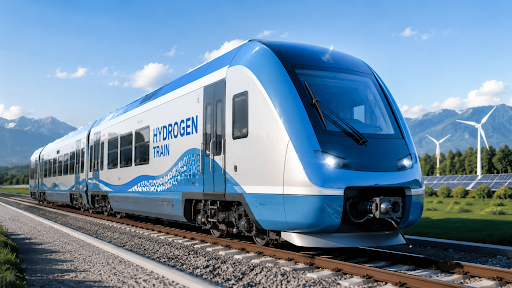
The Prime Minister flagged off India's first indigenous hydrogen-powered train from Jind, Haryana.
About India's First Hydrogen-Powered Train
The train, Namo Green Rail, operates as a zero-emission Hydrogen-Electric Multiple Unit (HEMU).
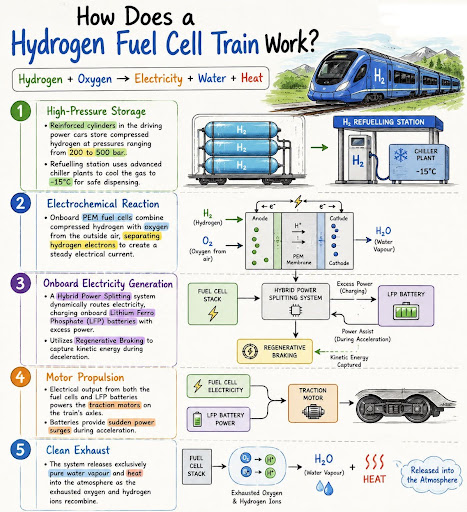
The system uses an advanced Proton Exchange Membrane Fuel Cell (PEMFC) and Lithium Ferro Phosphate (LFP) battery propulsion architecture to generate its own electricity onboard.
Operational Route: The train covers an 89-km corridor on the Jind-Sonipat section of the Northern Railway in Haryana.
Why is Hydrogen Rail Technology Important?
Net-Zero Emission Goals: Hydrogen is a critical pillar for the decarbonisation of Railways, advancing the national goal to achieve net-zero carbon emissions by 2070 and eliminating tailpipe carbon emissions.
Fossil Fuel Reduction: Hydrogen possesses higher energy density of 120 MJ/Kg compared to diesel's 43 MJ/Kg, which curtails reliance on imported diesel and mitigates foreign exchange burdens.
Green Hydrogen Ecosystem: The project establishes India's largest railway hydrogen storage and refuelling facility at Jind, holding 3,000 kg of hydrogen, to create a complete ecosystem encompassing production, compression, storage, and dispensing.
Clean Mobility: The technology empowers trains to generate electricity onboard, eliminating the need for expensive continuous overhead electrification infrastructure and protecting fragile ecosystems on heritage routes and hill railways.
Energy Security: Domestic production of green hydrogen via electrolysis using renewable energy bolsters India's energy independence and reduces vulnerability to global fossil fuel supply chain disruptions.
Key Features of India's Hydrogen Train
Fuel Cell Propulsion: The train set integrates two Hydrogen Driving Power Cars (DPCs), generating a total traction capacity of 2,400 kW (3,200 hp) using PEM fuel cells that react hydrogen with ambient oxygen.
Zero Emissions: The electrochemical reaction produces only water vapour and heat as direct by-products, completely eliminating combustion, smoke, and particulate pollution.
Indigenous Development: The Integral Coach Factory (ICF) in Chennai developed and built the trainset prototypes under the Atmanirbhar Bharat vision, partnering with Medha Servo Drives for systems integration.
Advanced Safety Systems: The train integrates multiple safety layers, including continuous hydrogen leak detectors, flame detectors, an automatic shut-off mechanism, and specialized roof ventilation to safely dissipate leaked gas.
Physical Configuration: Unlike global prototypes with 2 to 4 coaches, this Indian HEMU boasts a 10-coach configuration with a maximum operational speed of 75 kmph and a design speed of 110 kmph.
Passenger Capacity: The 10-car format accommodates approximately 2,600 passengers per trip, establishing the system as one of the most powerful and scalable high-capacity passenger operations globally.
Benefits of Hydrogen Train
Greenhouse Gas Reduction: Hydrogen trains reduce the carbon footprint of the transport sector by completely omitting CO2 emissions during transit.
Air Quality Improvement: Transition eliminates harmful particulate matter (PM) and nitrogen oxides (NOx) historically emitted by traditional diesel DEMU rakes.
Enhanced Public Transit: The trains offer quieter operations and require less mechanical maintenance, improving the overall quality of green mass transit corridors.
Economic Savings: Generating fuel internally via local green energy infrastructures mitigates massive import bills associated with petroleum.
Industrial Stimulation: The massive 3,000 kg refuelling demand acts as an anchor load to stimulate the domestic Green Hydrogen production ecosystem.
Global Technological Leadership: India joins an elite group of nations—including Germany, Japan, China, and the US—commercially pioneering high-capacity hydrogen rail technologies.
What are the Major Concerns Associated with Hydrogen Trains?
High Capital Expenditure: Complex engineering and imported specialized fuel cells (such as those from Ballard Power Systems) result in a steep ₹136-crore investment for the initial pilot project.
Storage and Transportation Hazards: Handling highly flammable gas requires ultra-high-pressure containment up to 500 bar and rigid adherence to global ISO 19880 standards.
Infrastructure Bottlenecks: India currently features only a single dedicated large-scale hydrogen railway refuelling facility in Jind, which limits nationwide expansion.
Production Cost Viability: The ecological benefit depends on producing Green Hydrogen via electrolysis using renewable energy, which remains expensive compared to fossil fuels.
Rigid Safety Protocols: Operating combustible hydrogen requires multi-layered oversight, including TÜV SÜD third-party safety assessments and specialized training for loco-pilots.
Measures to Accelerate Hydrogen Mobility
Scaling Green Hydrogen Production: Scales up domestic electrolysis capacity powered exclusively by renewable grids to ensure a cost-effective, truly green fuel supply.
Expanding Refuelling Infrastructure: Rapid replication of the Jind refuelling facility model, complete with advanced chiller plants and high-pressure compression systems, across major railway nodes accelerates network expansion.
Promoting Indigenous Technologies: Empowering institutions like the Research, Design & Standards Organisation (RDSO) and local engineering firms to manufacture domestic PEM fuel cells bypasses expensive imports.
Encouraging Public-Private Partnerships: Inviting private sector investment into the supply chain—from hydrogen generation to fuel cell fabrication—diffuses capital risks and accelerates technology deployment.
Multi-Modal Integration: Leveraging established railway hydrogen hubs to supply surrounding heavy-duty road transport and maritime sectors optimizes the green hydrogen ecosystem through economies of scale.
Conclusion
The deployment of India's first indigenous 10-coach hydrogen train signifies a watershed moment in decarbonising public transit, forging a robust, self-reliant pathway to achieve the nation's ambitious Net Zero 2070 targets.
Source: INDIANEXPRESS
|
PRACTICE QUESTION Q. "Hydrogen-powered transportation can play a crucial role in India's transition towards a low-carbon economy." Discuss. 150 words |



© 2026 iasgyan. All right reserved