ISRO validates the CE20 cryogenic engine through rigorous sea-level and boot-strap mode tests. This indigenous marvel delivers a massive 22-tonne thrust, driving India's heavy-lift capabilities. It guarantees multi-orbit flexibility and secures vital human-rating certification for the upcoming Gaganyaan spaceflight mission.
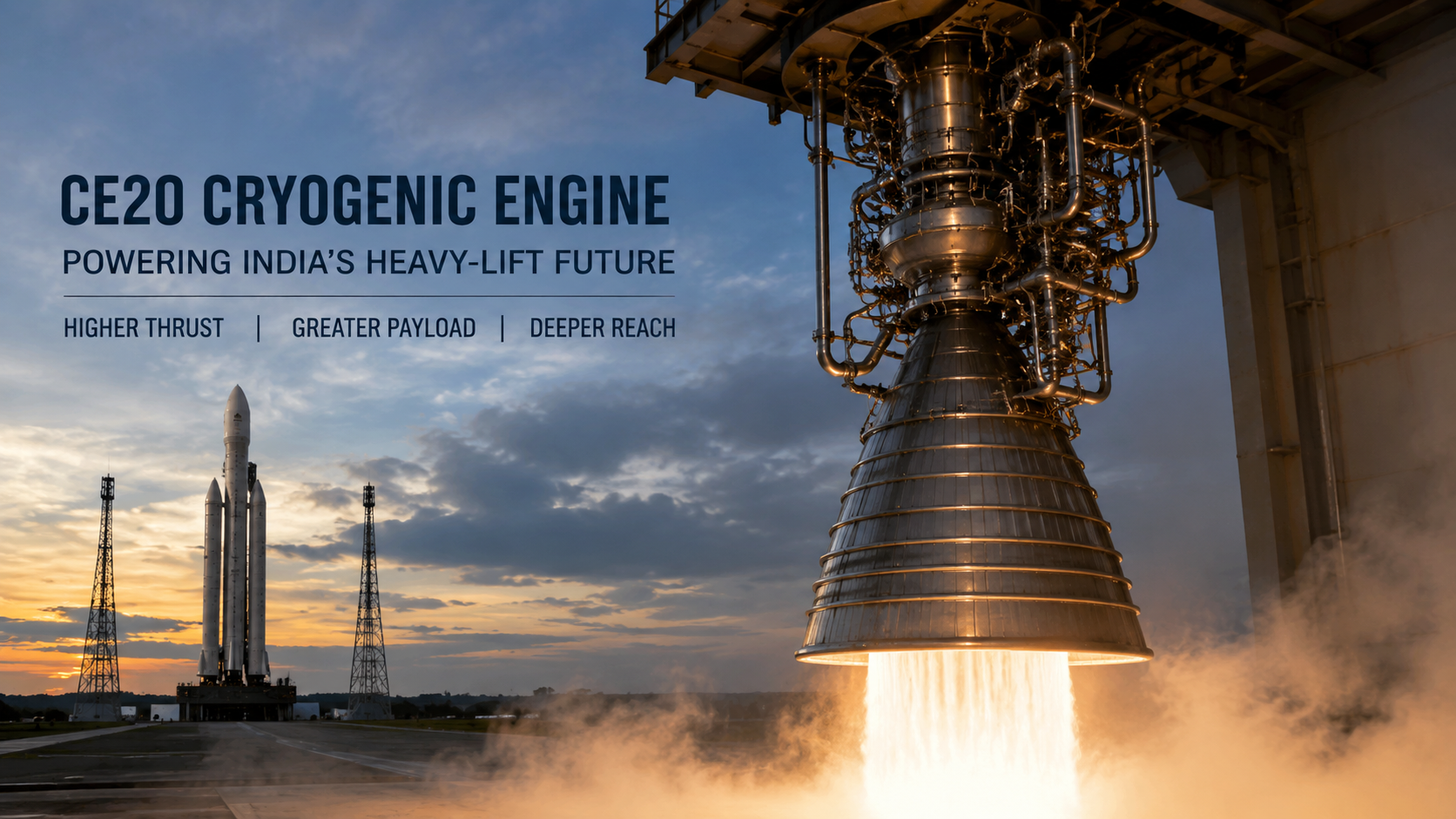
ISRO successfully executed the flight acceptance hot test of the CE20 cryogenic engine for the LVM3-M7 mission using an innovative Nozzle Protection System (NPS).
The CE20 is India’s first cryogenic rocket engine to feature a gas-generator cycle.
The Liquid Propulsion Systems Centre (LPSC) designs this engine specifically to power the upper stage of the heavy-lift LVM3 rocket.
It ranks among the most powerful upper-stage cryogenic engines currently in global operational service.
The engine utilizes Liquid Hydrogen (LH2) as fuel and Liquid Oxygen (LOX) as the oxidizer, maintaining a precise mixture ratio of 5.05.
Core Concept: A cryogenic engine functions as the final stage of space launch vehicles, utilizing cryogenics—the science of managing temperatures below -150°C.
Energy Density: Cryogenic fuels generate significantly higher thrust than traditional solid or earth-storable liquid engines, facilitating the transport of heavier payloads.
Fuel Efficiency: The engine achieves a high specific impulse of 442 seconds (4.33 km/s) in a vacuum, maximizing payload delivery efficiency.
Indigenous Manufacturing: Hindustan Aeronautics Limited (HAL) produces the engine at its Integrated Cryogenic Engine Manufacturing Facility (ICEMF) in Bengaluru.
Launch Vehicle Integration: The engine drives the C25 and the newly uprated C32 cryogenic stages of the LVM3 launch vehicle.
Uprated Thrust: While the nominal thrust ranges from 19 to 20 tonnes, the engine successfully scales to 22 tonnes, allowing the LVM3 to carry an additional 450 kg of payload into Geostationary Transfer Orbit (GTO).
Boot-strap Mode Start: Enables steady operation without external start-up gas bottles, reducing vehicle weight and enabling multiple in-flight restarts.
Proven Reliability: The engine maintains a flawless performance record across eight consecutive LVM3 missions, including Chandrayaan-2, Chandrayaan-3, and various commercial payloads.
Human-Rating Certification: ISRO subjected the engine to 39 hot-firing tests for a cumulative 8,810 seconds, surpassing the 6,350-second requirement for human-rated safety.
Strategic Autonomy: India secures independent access to space for heavy satellites, eliminating reliance on foreign launch providers.
Heavy-Lift Capability: The 22-tonne thrust upgrade allows ISRO to place next-generation communication satellites directly into higher orbits.
Gaganyaan Mission: The human-rated CE20 provides the reliability necessary to place a crew of three Gagannauts into a 400 km Low Earth Orbit (LEO).
Commercial Competitiveness: The engine establishes ISRO and NewSpace India Limited (NSIL) as dominant players in the global heavy-lift commercial launch market, evidenced by successful constellations like OneWeb.
Source: ISRO
|
PRACTICE QUESTION Q. Consider the following statements regarding the CE20 Cryogenic Engine: 1. It is the first Indian cryogenic engine to feature a gas-generator cycle. 2. It uses liquid nitrogen and liquid oxygen as its primary propellants. 3. It has successfully received human-rating certification for the Gaganyaan mission. Which of the statements given above is/are correct? A) 1 and 2 only B) 2 and 3 only C) 1 and 3 only D) 1, 2, and 3 Answer: C Explanation: Statement 1 is correct: The CE20 is the first indigenous Indian cryogenic engine to function on a gas-generator cycle. This design choice distinguishes it from India's earlier cryogenic engine, the CE-7.5, which operates on a staged combustion cycle. Statement 2 is incorrect: The CE20 engine uses Liquid Oxygen (LOX) and Liquid Hydrogen (LH2) as its propellants. Liquid nitrogen is not used as a primary propellant. Statement 3 is correct: ISRO has successfully completed the human-rating certification of the CE20 engine for the Gaganyaan mission. This involved rigorous ground qualification tests, including life demonstration and endurance tests, to ensure safety for human spaceflight. |
The engine uses Liquid Hydrogen (LH2) as fuel and Liquid Oxygen (LOX) as the oxidizer.
The CE20 powers the upper stage of the LVM3 launch vehicle. It underwent stringent human-rating certification (over 8,810 seconds of testing) to ensure the flawless reliability required to safely carry astronauts into space.
While it operates at a nominal thrust of 19 to 20 tonnes, ISRO recently tested and qualified the engine to safely operate at an uprated 22-tonne thrust level.
The engine is manufactured by Hindustan Aeronautics Limited (HAL) at its Integrated Cryogenic Engine Manufacturing Facility (ICEMF) in Bengaluru.





© 2026 iasgyan. All right reserved