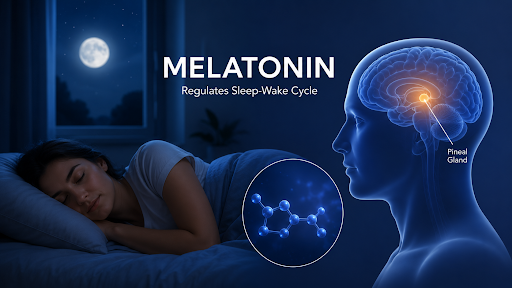
Melatonin is a hormone produced by the pineal gland that regulates the body's sleep-wake cycle. Secretion rises in the evening as darkness falls to induce sleepiness. Over-the-counter supplements are commonly used to treat insomnia, jet lag, and circadian rhythm disorders
Why In News?
The University of Sydney reveals that melatonin reduces chronic musculoskeletal pain, offering a safe, low-cost alternative to highly addictive opioid painkillers.
What is Melatonin?
Melatonin (N-acetyl-5-methoxytryptamine) is an endogenous indoleamine hormone naturally secreted by the pineal gland in the brain during periods of darkness.
Primary Functions
Why is Melatonin Important in Human Health?
Biological Clock Regulation: The hormone coordinates chronobiology by transmitting signals from the retina through the suprachiasmatic nucleus, adapting human physiology to light-dark environmental cycles.
Sleep Quality Improvement: It aligns sleep architecture, serving as a primary therapy for chronobiological disorders like insomnia and jet lag.
Immune Function Support: It acts as a potent immunomodulator that proactively suppresses pro-inflammatory cytokines like tumour necrosis factor-α (TNF-α), interleukin-1β, and interleukin-6, while upregulating the anti-inflammatory interleukin-10.
Antioxidant Protection: It functions as a superior free radical scavenger that directly neutralizes hydroxyl radicals and superoxide anions, limiting deep cellular damage from oxidative stress.
Pain Modulation: It dampens pain signals relayed through the central nervous system (brain and spinal cord), calms hyperexcitable nerves, and limits localized inflammation that aggravates joint damage.
What are the Key Findings of Recent Research?
Chronic Pain Relief: Patients record an average 9-point reduction on a 100-point pain scale.
Sleep Quality Rectification: Trials feature subjects with pre-existing sleep distress, confirming that melatonin rectifies sleep latency issues and pain scores.
Post-Surgical Limitations: Data confirms melatonin yields a negligible 2.5-point reduction for acute postoperative pain, making it medically insignificant for post-surgery recovery.
Clinical Trial Gap: Scientists report an absence of a clear dose-response relationship, validating that current findings require verification through expanded, multi-center randomised controlled trials.
Source: INDIANEXPRESS
|
PRACTICE QUESTION Q. Consider the following statements regarding Melatonin: 1. It is a peptide hormone synthesized primarily in the adrenal cortex. 2. The enzyme aralkylamine N-acetyltransferase (AANAT) facilitates its synthesis from serotonin. 3. According to the Food Safety and Standards Authority of India (FSSAI), dietary supplements containing melatonin can legally display explicit therapeutic claims for curing arthritis. Which of the statements given above is/are correct? A) 1 and 2 only B) 2 only C) 2 and 3 only D) 1, 2, and 3 Answer: B Explanation: Statement 1 is incorrect. Melatonin is not synthesized primarily in the adrenal cortex; it is synthesized and secreted by the pineal gland in the brain. Furthermore, it is chemically classified as an indoleamine (derived from the amino acid tryptophan), not a peptide hormone. The adrenal cortex produces corticosteroids like cortisol and aldosterone. Statement 2 is correct. The enzyme aralkylamine N-acetyltransferase (AANAT), also known as serotonin N-acetyltransferase, is the rate-limiting enzyme that facilitates the synthesis of melatonin from serotonin (specifically converting serotonin to N-acetylserotonin, which is then methylated to form melatonin). Statement 3 is incorrect. Under the Food Safety and Standards (Health Supplements, Nutraceuticals, Food for Special Dietary Use, Food for Special Medical Purpose, Functional Food and Novel Food) Regulations, products labeled as dietary supplements or nutraceuticals cannot make explicit therapeutic claims for treating or curing specific diseases like arthritis. |






© 2026 iasgyan. All right reserved