The draft CAFE-III norms aim to drastically reduce vehicular carbon emissions in India by enforcing stricter fleet-average fuel efficiency targets between 2027 and 2032. The framework offers regulatory super credits for zero-emission vehicles, ethanol, and biofuels to accelerate clean mobility

Why In News?
The Ministry of Power released the Draft Corporate Average Fuel Economy 2027 Norms (CAFE-III) for stakeholder consultation.
What is the Corporate Average Fuel Efficiency (CAFE) Framework?
The CAFE framework is government-mandated regulatory standards that limit the weighted average fuel consumption and Carbon Dioxide (CO2) emissions of an automobile manufacturer's entire fleet of M1 category passenger vehicles (vehicles with up to nine seats and weighing under 3,500 kg).
Objective: Force manufacturers to balance the sales of high-emission vehicles with low-emission ones, thereby reducing the nation's total carbon footprint and curbing high domestic fuel consumption.
Key Features of the Revised CAFE III Draft
Stricter Fuel Efficiency Targets: Proposes a progressive tightening of fleet-average targets, reducing the benchmark from 94.76 grams of CO2 per km (3.996 litres/100 km) in 2027-28 down to 78.90 grams of CO2 per km (3.327 litres/100 km) by 2031-32.
Carbon Neutrality Factor (CNF): Introduces a CNF for the first time, applying an 8% reduction in declared tailpipe emissions for current ethanol blending levels.
Biofuel and CBG Recognition: Acknowledges Compressed Bio-Gas (CBG) and biofuels, linking specific emission reduction benefits directly to actual market blending levels.
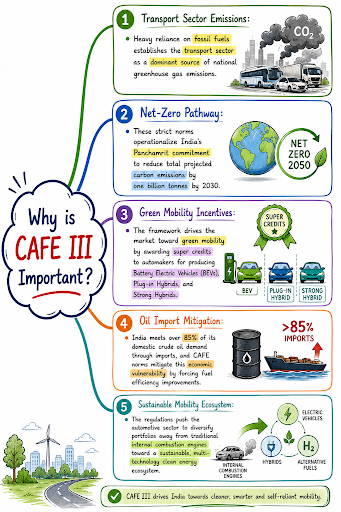
Lifecycle Emissions-Based Assessment: Moves beyond standard tailpipe tracking by awarding volume derogation factors (super credits) for clean technologies, assigning a multiplier of 3 to BEVs and 1.6 to strong hybrids.
Compliance Benefits: Manufacturers earn compliance benefits of up to 9 gCO2/km for deploying fuel-saving technologies like regenerative braking and efficient air conditioning.
Multi-Year Compliance Blocks: Regulators assess compliance over two distinct blocks—an initial three-year block followed by a subsequent two-year block—providing automakers flexibility to average out fleet emissions.
Credit-and-Debit Passbook System: Establishes a system where automakers purchase compliance credits directly from the BEE at an initial buyout price of ₹2,500 per credit under the Energy Conservation Act, subject to annual escalation.
Significance of Carbon Neutrality Factors (CNFs)
Lifecycle Emission Validation: CNFs officially validate that renewable fuels absorb carbon dioxide during biomass growth, which neutralizes a portion of tailpipe emissions across the vehicle's lifecycle.
Biofuel Vehicle Incentives: Automakers receive direct regulatory and financial incentives to rapidly manufacture and sell Flex-Fuel Vehicles (FFVs) and biofuel-compatible engines.
Ethanol Blending Alignment: The baseline 8% emission discount aligns with the government's push to roll out E20 (20% ethanol blended) fuel uniformly across the country.
Technology-Neutral Environment: CNFs guarantee a technology-neutral regulatory environment, ensuring the industry does not rely exclusively on BEVs, thereby reducing pressure on critical mineral supply chains.
Benefits of CAFE III
Reduced Carbon Emissions: The norms mandate a nearly 19% reduction in allowable CO2 limits compared to the outgoing CAFE-II phase, cutting the transport sector's carbon output.
Improved Fuel Efficiency: Continuous year-on-year tightening of the compliance constant forces manufacturers to deploy advanced, highly efficient engine technologies.
Lower Fossil Fuel Dependence: Enforcing strict fuel consumption limits and heavily incentivizing electric and hybrid fleets curbs reliance on conventional petrol and diesel.
Biofuel Ecosystem Growth: Integrating biofuels into national emission frameworks provides an economic boost to agrarian communities and scales up indigenous biomass supply chains.
Enhanced Energy Security: Diversifying automotive energy sources toward domestic electricity, ethanol, and biogas insulates the Indian economy from global geopolitical shocks and oil price volatility.
Climate Commitment Support: The framework creates a transparent, data-driven pathway for the transport sector to meet India's global Paris Agreement targets.
Source: INDIANEXPRESS
|
PRACTICE QUESTION Q. "India's transport decarbonisation strategy increasingly relies on a mix of electrification, biofuels and fuel-efficiency regulations." Discuss. 150 words |







© 2026 iasgyan. All right reserved