India introduces Flex Fuel Vehicles running on E20 to E100 ethanol blends to slash crude oil imports and boost local farmer incomes. Widespread adoption faces severe challenges regarding fuel pricing constraints, dispensing infrastructure bottlenecks, and water-intensive sugarcane crop dependencies.
Why In News?
India is launching its first mass-market flex-fuel vehicles (FFVs) running on pure ethanol (E100).
What Are Flex Fuel Vehicles (FFVs)?
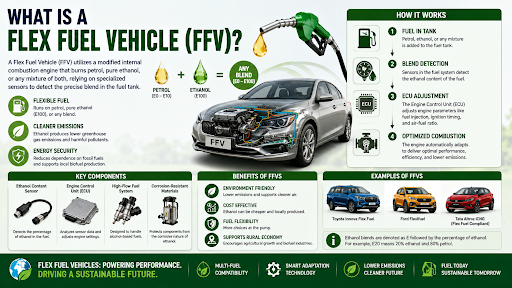
Flex Fuel Vehicles (FFVs) feature an internal combustion engine capable of operating on petrol, pure ethanol, or any blend of the two fuels.
These vehicles automatically detect the ethanol concentration in the fuel tank (ranging from E20 to E100) and adjust the engine parameters to ensure smooth functioning.
How Do Flex Fuel Engines Operate?
Continuous Monitoring: Specialized sensors continuously monitor the fuel mixture to determine the exact ethanol ratio.
Active Engine Adjustments: The Engine Control Unit (ECU) adjusts the fuel injection timing, air-fuel ratio, and ignition timing to guarantee optimal combustion.
Corrosion Resistance: Manufacturers use ethanol-resistant fuel tanks, upgraded fuel lines, and modified fuel injectors because ethanol possesses corrosive properties and absorbs moisture.
Cold Start Calibration: Engines incorporate specific hardware and calibration strategies to overcome ethanol's lower vaporization rate at low temperatures.
How Do FFVs Support India's Energy Security Goals?
Slash Crude Imports: India imports over 85% of its crude oil; replacing petrol with domestically produced biofuels directly reduces economic vulnerability to geopolitical shocks.
Conserve Foreign Exchange: The Ethanol Blended Petrol (EBP) program has already saved India ₹1.84 lakh crore in foreign exchange by substituting 302 lakh metric tonnes of crude oil.
Empower Rural Economies: The program provides immediate income support to sugarcane and maize farmers, transforming them from Annadatas (food providers) into Urjadatas (energy providers).
Drive Low-Carbon Mobility: FFVs avoid the upstream carbon emissions associated with electric vehicle battery supply chains and have already reduced CO₂ emissions by 909 lakh metric tonnes.
What Challenges Limit Large-Scale Adoption of FFVs?
Energy Density Deficit: Ethanol contains 30% to 35% less energy per litre than petrol. Vehicles running on E85 suffer a 20% to 30% reduction in fuel economy (kilometres per litre).
Unfavourable Consumer Economics: Brazilian consumers adopt ethanol only when it costs 70% or less than petrol.
Severe Infrastructure Bottlenecks: Widespread adoption faces a massive hurdle, as India currently operates only 50 to 100 dispensing outlets for flex fuels, largely restricted to the Delhi-NCR and Mumbai-Nagpur corridors.
Intensive Water Consumption: Producing one litre of sugarcane-based ethanol demands 2,800 to 3,600 litres of irrigation water, draining critical groundwater aquifers and straining state electricity subsidies.
What Should Be India's Way Forward?
Implement Transparent Fuel Pricing: The government must enforce a pricing framework that gives E20 and E85 deep, explicit discounts to keep the consumer's rupee-per-kilometre cost neutral.
Accelerate Dispensing Infrastructure: Oil Marketing Companies (OMCs) need to scale up operations rapidly to meet the government target of 5,000 ethanol outlets by 2027.
Optimize Engine Designs: Automakers must move beyond "petrol-primary" designs and build high-compression engines that exploit ethanol's superior Research Octane Number (108-110) to recover lost fuel efficiency.
Promote Sustainable Feedstocks: Policymakers must shift ethanol sourcing away from water-intensive sugarcane and rice towards alternative biomass and second-generation biofuels to protect India's hydrological security.
Conclusion
Flex Fuel Vehicles provide a pragmatic, scalable bridge toward India's energy self-reliance, provided the government aligns fuel pricing with mileage trade-offs and rapidly scales fuel dispensing infrastructure.
Source: PIB
|
PRACTICE QUESTION Q. Consider the following statements regarding Flex Fuel Vehicles (FFVs) and the Ethanol Blended Petrol (EBP) program in India:
Which of the statements given above is/are correct? (A) 1 only (B) 2 only (C) Both 1 and 2 (D) Neither 1 nor 2 Answer: A Explanation: Statement 1 is correct: Flex Fuel Vehicles (FFVs) are equipped with specialized sensors (like fuel composition sensors) and modified engine control modules. These systems actively detect the percentage of ethanol in the fuel and adjust fuel injection and ignition timing to ensure optimal combustion. Statement 2 is incorrect: Ethanol contains a lower energy density (calorific value) than petrol. Because it contains less energy per drop, vehicles running on high-ethanol blends like E85 actually experience a decrease in fuel economy (requiring more fuel to travel the same distance) compared to running on pure petrol. |
An FFV utilizes a modified internal combustion engine that burns petrol, pure ethanol, or any mixture of both, relying on specialized sensors to detect the precise blend in the fuel tank.
Ethanol holds 30% to 35% less energy density than petrol, which inevitably causes vehicles running on high blends like E85 to suffer a 20% to 30% reduction in fuel economy.
Cultivating sugarcane for ethanol consumes massive amounts of water; producing just one litre of fuel drains 2,800 to 3,600 litres of critical irrigation water, threatening India's hydrological security.




© 2026 iasgyan. All right reserved