The ₹37,500 crore Coal Gasification Scheme aims to process 100 MT of coal by 2030, converting domestic reserves into versatile syngas. This reduces India's heavy reliance on imported LNG and fertilizers, boosting energy security while driving sustainable industrial transformation.
Why In News?
The Union Cabinet approves a ₹37,500 crore scheme to incentivize surface coal and lignite gasification projects.
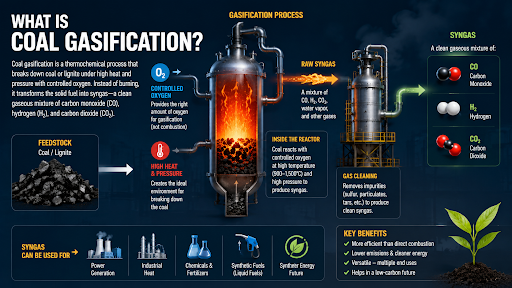
It is a thermo-chemical process that converts solid coal or lignite into synthesis gas (syngas), primarily containing carbon monoxide (CO) and hydrogen (H2).
The process operates under high temperatures (700–1,600°C) and elevated pressure using controlled amounts of oxygen and steam, offering a cleaner alternative to direct coal combustion.
India holds massive domestic reserves of approximately 401 billion tonnes of coal and 47 billion tonnes of lignite, with coal accounting for over 55% of the national energy mix.
India imported ₹2.77 lakh crore worth of substitutable products like LNG, methanol, and urea in FY2025, exposing the economy to geopolitical supply chain shocks.
Reduces Import Dependence: India currently imports over 50% of its LNG, 80-90% of its Methanol, and 100% of its Ammonia.
Energy Self-Reliance: Converting domestic coal into syngas insulates the economy from global price volatility and West Asian geopolitical disruptions, supporting the Atmanirbhar Bharat vision.
Industrial Feedstock: Syngas serves as a versatile building block for fertilizers, petrochemicals, and liquid fuels, facilitating the Methanol Economy and Direct Reduced Iron (DRI) production.
Manufacturing Ecosystem: The policy promotes indigenous, technology-agnostic processes to build a robust local engineering and manufacturing sector.
Socio-Economic Impact: Generates approximately 50,000 direct and indirect jobs across 25 proposed projects, with an investment mobilization of ₹2.5 to ₹3.0 lakh crore in states like Jharkhand and Odisha.
Financial Outlay: The government injects ₹37,500 crore to catalyze projects, targeting the gasification of 75 MT of coal.
Incentive Caps: The scheme limits financial incentives to ₹5,000 crore per commercial project and ₹12,000 crore per entity to prevent market monopolies.
Private and PSU Participation: It provides incentives reaching up to 20% of the cost of Plant and Machinery and guarantees a 30-year long-term coal linkage under the Non-Regulated Sector (NRS) auction framework.
Revenue Generation: The utilization of 75 MT of coal generates an estimated ₹6,300 crore in annual government revenue.
Technological Bidding: The framework rewards the adoption of indigenous technologies or the acquisition of international technology tailored for high-ash Indian coal.
Methanol Production: Syngas converts into methanol for use as a fuel additive and LPG substitute.
Fertilizer Manufacturing: The process produces Ammonia and Urea, reducing the ₹50,000 crore annual fertilizer import subsidy burden.
Synthetic Natural Gas (SNG): SNG serves as a direct substitute for expensive LNG imports.
Hydrogen Production: Gasification extracts industrial hydrogen, which, when paired with Carbon Capture and Storage (CCS), produces Blue Hydrogen.
Power Generation: Integrated Gasification Combined Cycle (IGCC) plants generate efficient baseload electricity with minimal particulate emissions.
Source: PIB
|
PRACTICE QUESTION Q. With reference to 'Syngas' produced from coal gasification, consider the following products: 1. Dimethyl Ether (DME) 2. Synthetic Natural Gas (SNG) 3. Ammonia Urea Which of the above can be manufactured using Syngas as a feedstock? A) 1 and 2 only B) 3 and 4 only C) 1, 2, and 4 only D) 1, 2, 3, and 4 Answer: D Explanation: Synthesis gas (syngas), produced primarily from coal gasification, is a versatile mixture of carbon monoxide (CO) and hydrogen. It serves as a vital industrial feedstock for manufacturing all of the following:
|
Coal gasification is a thermo-chemical process that subjects coal or lignite to high heat (700–1,600°C) and elevated pressure in the presence of oxygen and steam, converting the solid fuel into a versatile synthesis gas (syngas) composed primarily of carbon monoxide and hydrogen (Source: Legacy IAS).
Unlike coal combustion, which burns coal directly in the air to release heat and high levels of emissions, gasification controls the oxygen levels to prevent direct burning, instead chemically transforming the carbon into a cleaner gaseous feedstock (syngas) with significantly lower direct particulate and sulphur emissions.
India promotes coal gasification to leverage its massive 401 billion tonnes of coal reserves, drastically reducing its ₹2.77 lakh crore import bill for LNG, ammonia, methanol, and urea, thereby insulating the economy from geopolitical shocks and achieving energy self-reliance.
Syngas produced from coal gasification is a foundational chemical block used to manufacture Synthetic Natural Gas (SNG), fertilizers (Urea and Ammonia), chemicals (Methanol, Dimethyl Ether, Acetic Acid), Blue Hydrogen, and liquid fuels, as well as fueling Integrated Gasification Combined Cycle (IGCC) power plants.





© 2026 iasgyan. All right reserved