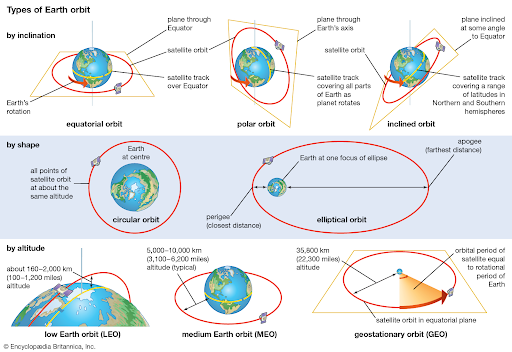
ISRO's Gaganyaan mission aims to send astronauts into a 400-km low Earth orbit. To guarantee their survival, ISRO is indigenously developing an advanced Environmental Control and Life Support System (ECLSS) to recreate Earth-like air, pressure, and temperature in microgravity.
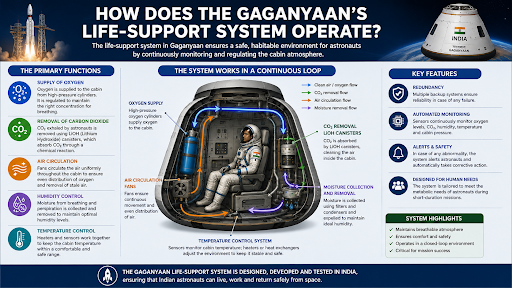
ISRO is advancing its Gaganyaan Mission by indigenously developing the Environmental Control and Life Support System (ECLSS) to sustain astronauts in a 400-km low Earth orbit.
The Gaganyaan mission is India’s maiden effort to send humans into space. It aims to demonstrate indigenous capability to undertake human spaceflight to Low Earth Orbit (LEO).
Indigenous Achievement: Unlike the first sounding rocket (1963) where components came from abroad, the current mission relies on domestic technology realized through ISRO's 50-year history.
Primary Goal: To launch a crew of 2 to 3 members into a circular orbit of approximately 400 km for a duration of 3 days, and bring them back safely to Earth.
Launch Vehicle Technology
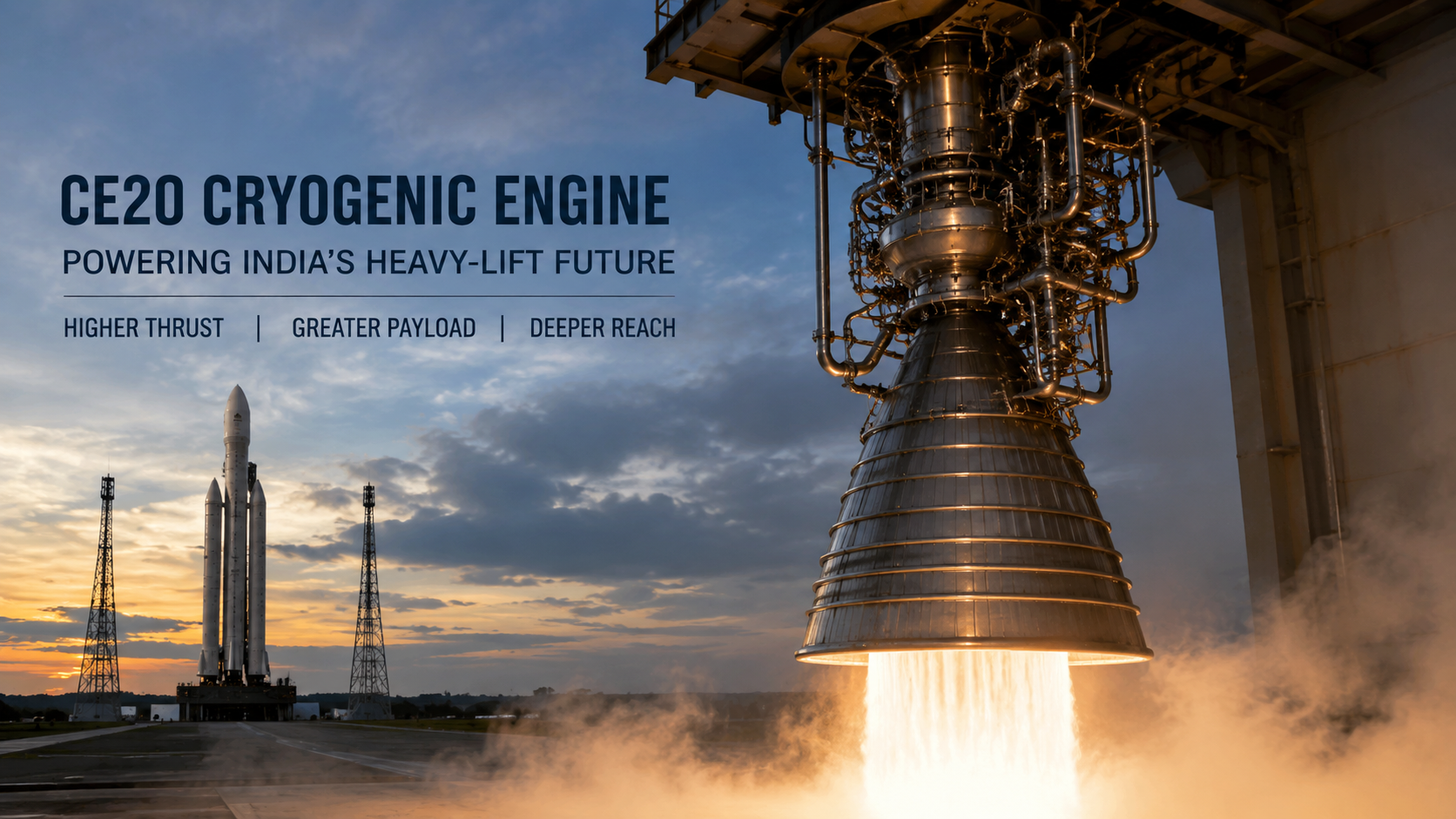
The mission utilizes the GSLV Mk III (also known as LVM3) as primary launch vehicle.
Developed by the Indian Space Research Organisation (ISRO), this system artificially replicates Earth's biosphere to sustain crew members in the harsh environment of a 400 km low Earth orbit.
Nature and Objectives of the ECLSS
Biosphere Replication: The system functions as a complex network of thermal, chemical, and mechanical engineering protocols designed to mimic Earth's sea-level conditions inside the spacecraft.
Open-loop Configuration: For short-term missions like Gaganyaan, the ECLSS operates in an open-loop setup.
Crew Safety: The system ensures the physiological safety, cognitive health, and general comfort of the astronauts while simultaneously protecting sensitive onboard electronics.
Microgravity Management: It continuously regulates cabin variables such as air composition, atmospheric pressure, and temperature within a microgravity vacuum.
Key Functional Components
The ECLSS utilizes several specialized subsystems to maintain a habitable environment:
|
Subsystem |
Primary Function |
|
Air Revitalization System (ARS) |
Supplies oxygen continuously from onboard tanks; uses lithium hydroxide canisters to remove carbon dioxide and activated charcoal filters to eliminate harmful gases and odors. |
|
Forced Atmospheric Circulation |
Employs internal cabin fans to maintain constant airflow, preventing the dangerous buildup of carbon dioxide or oxygen pockets around the crew. |
|
Pressure Control System |
Uses sensors and control valves to maintain Earth-like cabin pressure by balancing oxygen and nitrogen levels. |
|
Temperature & Humidity Regulation |
Controls the thermal environment and removes body heat and excess moisture to prevent equipment damage and microbial growth. |
|
Water & Waste Management |
Utilizes pressurized systems for drinking water and suction-based mechanisms to collect and chemically treat human waste in zero gravity. |
|
Spherical Fire Suppression |
Features specialized smoke detectors and water-mist extinguishers designed to control spherical fires and remove toxic smoke particles. |
Strategic Significance
Mission Criticality: The ECLSS stands as one of the most vital systems of the Gaganyaan mission, as it directly enables safe human survival in space.
Technological Prowess: The development of this system demonstrates ISRO's advanced capabilities in microgravity life-support engineering and thermal control.
Strategic Self-Reliance: By developing these advanced technologies indigenously, India strengthens its self-reliance (Atmanirbhar Bharat) in the domain of complex human spaceflight technologies.
Source: THEHINDU
|
PRACTICE QUESTION Q. Consider the following statements regarding the Environmental Control and Life Support System (ECLSS) of the Gaganyaan mission:
Which of the statements given above is/are correct? A) 1 only B) 2 only C) Both 1 and 2 D) Neither 1 nor 2 Answer: C Explanation: Statement 1 is correct: The Environmental Control and Life Support System (ECLSS) is a mission-critical, complex engineering network designed specifically to artificially replicate Earth's sea-level biosphere inside the spacecraft. It regulates oxygen supply, filters carbon dioxide, maintains optimal cabin pressure, controls temperature and humidity, and safely manages metabolic waste to sustain life in a microgravity environment. Statement 2 is correct: The primary objective of the Indian Space Research Organisation's (ISRO) Gaganyaan mission is to demonstrate indigenous human spaceflight capability by sending a crew into a 400-km low Earth orbit (LEO) and returning them safely back to Earth. |
The Gaganyaan Mission is an ISRO initiative that aims to send Indian astronauts into a 400-km low Earth orbit.
The ECLSS recreates Earth-like living conditions inside the spacecraft by regulating air, water, pressure, temperature, humidity, and managing waste in microgravity.
The Human Space Flight Centre (HSFC), established in 2019, is the lead centre responsible for the Gaganyaan mission, including life support systems and astronaut training.



© 2026 iasgyan. All right reserved