NASA officially retired the MAVEN mission following an unrecoverable communication failure. During its eleven years orbiting Mars, the spacecraft provided groundbreaking insights into atmospheric sputtering, solar wind interactions, and exactly how the Red Planet lost its early habitable climate forever.
Why In News?
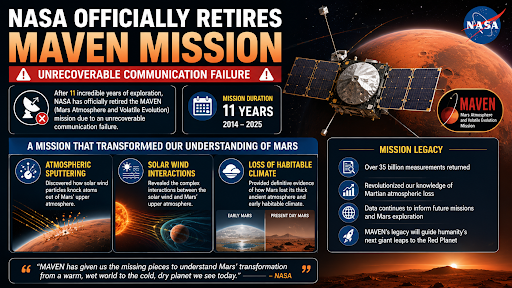
NASA has officially ended its Mars Atmosphere and Volatile Evolution (MAVEN) mission after 11 years in orbit following an unrecoverable loss of communications that began in late 2025.
What is the MAVEN Mission?
NASA launched the Mars Atmosphere and Volatile Evolution (MAVEN) spacecraft in November 2013.
The probe entered Mars' orbit in September 2014, operating as the first mission devoted solely to observing the Martian atmosphere and its evolution.
MAVEN actively functioned for over 11 years, far exceeding its primary one-year mission timeline.
The spacecraft simultaneously operated as a crucial data relay orbiter for NASA's Curiosity and Perseverance rovers.
Objectives of the MAVEN Mission
The mission investigates the Martian upper atmosphere, ionosphere, and dynamic interactions with the Sun.
Scientists use the orbiter to determine exactly how atmospheric gas loss to space permanently altered the Martian climate over geological time.
MAVEN tracks the specific mechanisms of how solar wind and space weather actively strip away the planet's atmospheric layers.
Why Did NASA Study Atmospheric Loss on Mars?
Atmospheric stripping transformed Mars from a warm, wet, potentially habitable environment into the cold, arid desert planet we observe today.
Tracking this loss resolves profound mysteries regarding the history of liquid water on the Red Planet.
The mission's dataset unlocks secrets of planetary habitability, helping scientists understand why Earth remained habitable throughout history while planets like Mars and Venus did not.
Major Scientific Discoveries of MAVEN
Solar Storm Erosion: MAVEN discovered that atmospheric erosion increases significantly during solar storms, as charged particles from the Sun violently strip away Martian gases.
Proton Auroras: The probe observed that incoming solar protons create a new kind of aurora that illuminates the entire Martian atmosphere, contrasting with Earth's localized polar auroras.
Atmospheric Sputtering: MAVEN became the first mission to measure atmospheric sputtering in real time by tracking noble argon gas.
Global Dust Storm Effects: The team confirmed that global dust storms (like the one observed in 2018) push water molecules to unusually high altitudes, triggering a sudden, extreme surge in water loss to space.
Metal Ion Layer: The orbiter recorded a permanent layer of metal ions in the Martian ionosphere generated by incoming interplanetary dust hitting the atmosphere.
Comet 3I/ATLAS Observation: MAVEN captured high-resolution ultraviolet images of escaping hydrogen from interstellar comet 3I/ATLAS to analyze its chemical composition.
Source: NASA
|
PRACTICE QUESTION Q. The scientific phenomenon of "atmospheric sputtering," measured for the first time by the MAVEN mission, refers to: A) The greenhouse effect triggered by global dust storms. B) The condensation of water vapor into underground Martian aquifers. C) A process where high-speed ions crash into the atmosphere, splashing gas molecules out into space. D) The absorption of solar radiation by atmospheric metal ions. Answer: C Explanation: Atmospheric sputtering is a form of space weathering where high-energy particles (typically ions accelerated by the solar wind) collide with atoms in a planet's upper atmosphere. These collisions transfer enough energy to the atmospheric gas molecules to "splash" them out, giving them sufficient velocity to escape into deep space. |
The MAVEN mission was a NASA robotic orbiter project dedicated to studying the composition, structure, and history of the Martian upper atmosphere and ionosphere.
The probe helped scientists by simultaneously measuring the Sun's energetic output and the immediate response of the Martian upper atmosphere to map planetary erosion.
NASA formally declared MAVEN dead on June 3, 2026, after the orbiter entered an unrecoverable, high-speed spin that drained its batteries following six months of radio silence.






© 2026 iasgyan. All right reserved