India's push for coal gasification aims to convert vast high-ash coal reserves into syngas, producing vital chemicals like methanol and urea to reduce import dependence. The ₹37,500-crore incentive scheme targets 100 million tonnes of gasification by 2030.
Why In News?
The Union Cabinet approved an incentive package to promote surface coal gasification to substitute imports..
What Is Coal Gasification?
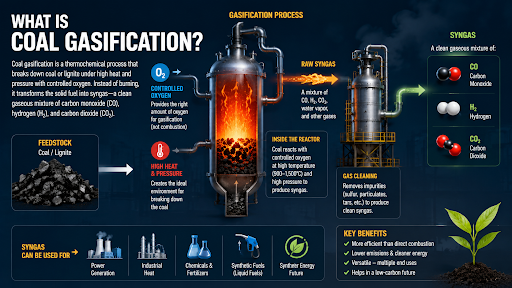
Coal gasification represents a thermo-chemical process that breaks down coal or lignite to produce synthetic gas, commonly known as syngas.
How Does Coal Gasification Differ from Conventional Coal Combustion?
|
Feature |
Coal Gasification |
Conventional Coal Combustion |
|
Core Reaction |
Uses partial oxidation and thermal cracking under strictly controlled oxygen levels. |
Burns solid coal directly using an abundant supply of oxygen. |
|
Primary Output |
Produces syngas (a mix of Carbon Monoxide, Hydrogen, and Carbon Dioxide). |
Generates heat, heavy smoke, traditional chimney stack soot, and ash. |
|
End Application |
Creates base inputs for downstream chemicals (urea, methanol, fertilizers, hydrogen) and clean energy. |
Provides thermal heat primarily for direct power and electricity generation. |
|
Environmental Impact |
Extracts minerals cleanly without melting them into slag; shows higher compatibility with carbon capture technologies. |
Discharges higher direct pollutants and requires extensive post-combustion scrubbing to mitigate heavy smoke. |
What Are the Key Benefits of Coal Gasification For India?
Enhances National Energy Security
Utilizing domestic reserves—comprising 401 billion tonnes of coal and 47 billion tonnes of lignite—to create a "strategic shield" against global fuel supply disruptions and price volatility.
Drives Import Substitution
The gasification process substitutes imports worth up to ₹3 lakh crore, conserving valuable foreign exchange. Currently, India imports 20% of its urea, 80–90% of its methanol, and almost all of its ammonia, which domestic gasification will replace.
Produces Versatile Downstream Chemicals
The process transforms raw coal into syngas (a mix of Carbon Monoxide and Hydrogen) to manufacture crucial industrial products, including urea, methanol, ammonia, synthetic natural gas (SNG), ether, dimethyl, and hydrogen.
Advances Cleaner Energy Goals
Gasification offers a cleaner alternative to direct coal burning by eliminating traditional chimney stack soot. It shows high compatibility with Carbon Capture, Utilisation and Storage (CCUS) technologies, which directly supports decarbonization efforts and the National Hydrogen Mission.
Monetizes Deep Coal Reserves
Underground coal gasification (UCG) converts deep, hard-to-mine coal resources directly into hydrogen, delivering significant cost advantages over surface gasification methods.
What Major Government Initiatives Promote Coal Gasification?
National Coal Gasification Mission: Sets an ambitious national target to gasify 100 million tonnes of coal by 2030 to reduce reliance on imported petrochemical feedstocks.
Financial Incentive Packages: The Union Cabinet approved ₹37,500-crore incentive package via the Scheme for Promotion of Surface Coal/Lignite Gasification Projects to boost commercial adoption.
Revenue Share Rebates for Miners: Grants a 50% rebate in revenue share during commercial coal block auctions, provided the operator utilizes at least 10% of the total coal production strictly for gasification purposes.
Technology Transfer Waivers: To accelerate the deployment of advanced gasifiers, the government establishes a framework that grants waivers from registration for Transfer of Technology (ToT) from land-border-sharing countries on a case-by-case basis.
What Challenges Limit Coal Gasification in India?
High Ash Content
Indian coal contains 25–45% ash, compared to the global average of less than 15%, which severely lowers system efficiency and escalates operating expenses.
Complex Mineral Chemistry
Domestic coal holds high concentrations of silica and alumina. These minerals react under intense heat, forming damaging slag deposits that destroy equipment and cause frequent plant shutdowns.
Severe Water Scarcity
Gasification process consumes massive water volumes, requiring 15–30 tonnes of water per tonne of olefin. This triggers severe sustainability conflicts in water-stressed, coal-rich states like Jharkhand and Chhattisgarh.
Massive Capital Expenditure (CAPEX)
Gasification infrastructure requires heavy upfront capital investments and endures long gestation periods. Capital costs alone drive nearly 30% of total syngas production costs, making financial viability a major hurdle.
High Carbon Emissions & Pollution
Without intervention, coal gasification emits significant CO2 greenhouse gases and harmful wastewater. It only becomes a "clean" technology if operators install expensive Carbon Capture, Utilisation, and Storage (CCUS) systems.
Variable Energy Output
The Gross Calorific Value (GCV) of Indian coal fluctuates, making it difficult for engineers to design gasifiers that operate with consistent energy yields.
Way Forward
Adopt Fluidized-Bed Gasification
Transition to Pressurized Fluidized-Bed Gasification (PFBG) systems. This indigenous technology successfully handles high ash content and fine coal particles without creating damaging slag.
Leverage Financial Incentives
Utilize the Union Cabinet's ₹37,500-crore incentive package. The government should also distribute targeted Viability Gap Funding (VGF) grants covering up to 70% of costs to de-risk commercial-scale plants.
Drive Atmanirbhar Bharat (Indigenization)
Empower local manufacturers like BHEL and Jindal Steel, alongside the MSME sector, to build indigenous gasifier components. Localizing supply chains slashes total project costs by 30–40%.
Mandate CCUS Integration
Integration of Carbon Capture, Utilisation, and Storage (CCUS) technologies in all new gasification plants to create a zero-emission pathway aligned with India's National Hydrogen Mission and net-zero 2070 goals.
Streamline Regulatory Clearances
Expedite regulatory approvals, specifically under the Indian Boiler Regulations (IBR), to accelerate project timelines.
Ensure Raw Material Security
Providing subsidized coal through auctions and establishing guaranteed off-take mechanisms for downstream products to secure private investments.
Conclusion
India strategically accelerates the National Coal Gasification Mission by utilizing a ₹37,500-crore incentive package and indigenous fluidized-bed technology to convert high-ash coal reserves into vital chemicals, driving massive import substitution and cementing national energy security by 2030
Source: THEHINDU
|
PRACTICE QUESTION Q. Consider the following statements regarding Coal Gasification:
Which of the statements given above is/are correct? A) 1 only B) 2 only C) Both 1 and 2 D) Neither 1 nor 2 Answer: B Explanation: Statement 1 is incorrect: Coal gasification involves the partial oxidation of coal in a controlled, limited-oxygen environment rather than direct combustion (which occurs in excess air). It reacts coal with oxygen and steam at high temperatures to produce synthetic gas (syngas) consisting primarily of carbon monoxide and hydrogen. Statement 2 is correct: Indian coal is unique because it contains an exceptionally high ash content (often exceeding 30-40%). Conventional entrained-flow gasifiers require high temperatures that can melt this ash into a damaging liquid slag. Therefore, Pressurized Fluidized-Bed Gasification (PFBG), which suspends coal particles on upward-blowing gas streams to gasify them without melting the ash, is technically much more suitable for Indian coal. |
Coal gasification is a thermochemical process that breaks down coal or lignite under high heat and pressure with controlled oxygen. Instead of burning, it transforms the solid fuel into syngas—a clean gaseous mixture of carbon monoxide (CO), hydrogen (H2), and carbon dioxide (CO2).
India possesses the world's fifth-largest coal reserves (approx. 401 billion tonnes), yet imports 80-90% of its methanol and almost all its ammonia. Gasification turns domestic coal into valuable chemicals and fuels, potentially substituting imports worth up to ₹3 lakh crore.
Indian coal is challenging because it has exceptionally high ash content (25-45%), complex mineral matter like silica and alumina, and variable gross calorific value. These impurities can damage equipment, form slag, and lower the plant's operational efficiency.





© 2026 iasgyan. All right reserved