Punjabi University and PGIMER developed an AI tool to diagnose rare Autoimmune Blistering Diseases (AIBDs). This deep learning innovation assists rural doctors, reduces misdiagnosis, and ensures early treatment for these life-threatening immune disorders, revolutionizing accessible healthcare and clinical dermatology.
Why In News?
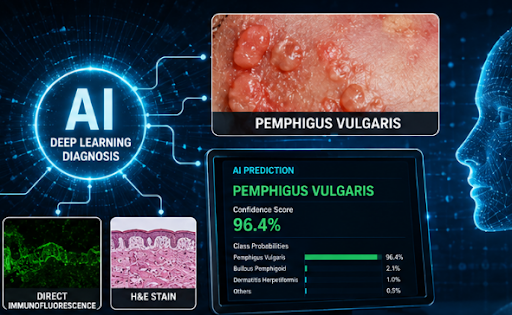
Researchers from Punjabi University and PGIMER Chandigarh developed an Artificial Intelligence tool that accurately diagnoses rare Autoimmune Blistering Diseases (AIBDs).
What are Autoimmune Blistering Diseases (AIBDs)?
Autoimmune Blistering Diseases (AIBDs) is a rare group of autoimmune disorders where the immune system mistakenly attacks structural proteins in the skin and mucous membranes.
Autoantibodies—primarily IgG and sometimes IgA—target desmosomal proteins or hemidesmosomal components, disrupting cell-to-cell adhesion.
This immunological assault triggers acantholysis (loss of keratinocyte cohesion) or subepidermal blistering, producing fluid-filled lesions.
Dermatologists classify AIBDs into intraepidermal (pemphigus group) and subepidermal (pemphigoid group) categories based on the level of blister formation.
These diseases carry significant morbidity; without treatment, widespread blistering leads to dehydration, sepsis, and death.
What are Rare Diseases?
Rare diseases affect a small percentage of the population; the World Health Organization (WHO) defines them as conditions with a prevalence of <1 per 2,000 people.
India adopts a broader threshold—diseases with prevalence <1 per 10,000 qualify as rare under the National Policy for Rare Diseases (NPRD) 2021.
80% of rare diseases stem from genetic mutations; single-gene disorders like cystic fibrosis, Huntington's disease, and Duchenne muscular dystrophy dominate.
Autoimmune blistering diseases, lysosomal storage disorders (e.g., Gaucher disease, Pompe disease), and primary immunodeficiencies constitute non-genetic or complex rare disease categories.
These diseases remain under-researched because pharmaceutical companies prioritize drugs for common conditions over small-market therapeutics.
Role of Artificial Intelligence in Healthcare
Image-Based Diagnosis: Convolutional Neural Networks (CNNs) analyze dermatoscopic and clinical images, differentiating pemphigus from pemphigoid with >90% accuracy.
Digital Pathology: AI algorithms quantify direct immunofluorescence patterns and immunoblotting results, reducing inter-observer variability in histopathological diagnosis.
Predictive Analytics: Machine learning models mine electronic health records, identifying patients at high risk of relapse before clinical recurrence.
Drug Discovery: AI screens molecular databases, accelerating the identification of novel biologics that target specific autoantibody epitopes.
Telemedicine Integration: AI-powered triage tools enable remote dermatology consultations, bridging the urban-rural specialist gap in countries like India.
Adverse Event Monitoring: Natural Language Processing (NLP) scans patient forums and clinical notes, detecting rare side effects of immunosuppressive therapy in real time.
Genomic Diagnostics: Deep learning models interpret whole-exome sequencing (WES) data, pinpointing pathogenic variants in rare genetic diseases within hours instead of weeks.
Outperforming Experts: An innovative AI tool built jointly by Punjabi University and PGIMER Chandigarh successfully outperforms trained dermatologists in classifying AIBD sub-types.
Artificial Intelligence directly transforms the management of rare diseases by empowering frontline workers with highly accurate, mobile diagnostic tools that prevent life-threatening diagnostic delays.
Source: TIMESOFINDIA
|
PRACTICE QUESTION Q. Consider the following statements regarding Autoimmune Blistering Diseases (AIBDs):
Which of the statements given above are correct? (a) 1 and 2 only (b) 2 and 3 only (c) 1 and 3 only (d) 1, 2, and 3 Answer: a Explanation: Statement 1 is correct: Autoimmune Blistering Diseases (AIBDs) are a group of disorders where the body's immune system erroneously attacks healthy structural proteins (like desmosomes and hemidesmosomes) essential for holding skin layers together. This causes the skin layers to separate and leads to blistering lesions. Statement 2 is correct: Dermatitis herpetiformis is an intensely itchy, blistering autoimmune disease that is widely recognized as the specific cutaneous manifestation of coeliac (celiac) disease. It occurs due to gluten sensitivity which triggers the immune system to form specific IgA antibodies. Statement 3 is incorrect: AIBDs are not easily diagnosed in rural India. The gold standards for diagnosis—such as direct and indirect immunofluorescence tests—require specialized perilesional biopsies, advanced equipment, and significant technical expertise. These immunological investigations are costly, time-consuming, and only available in specialized, urban tertiary care or research centers. |
An autoimmune blistering disease is a rare, potentially life-threatening disorder where the body's immune system mistakenly produces autoantibodies that attack structural proteins essential for holding the layers of skin and mucous membranes together.
Artificial intelligence helps diagnose rare conditions by analyzing complex photographic, histopathological, and immunofluorescence images to distinguish highly complex lesions from healthy tissues with extreme algorithmic precision.
The primary clinical features include painful or severely itchy, fluid-filled skin blisters, crusted erosions, and fragile sores that break open across the skin and mucosal linings of the mouth, eyes, or genitals.
These conditions are challenging to identify because their symptoms continuously fluctuate, mimic standard viral or allergic reactions, and present significant histopathological overlap with multiple other common medical disorders.



© 2026 iasgyan. All right reserved